
All Activity
- Past hour
-
Here are the key points from thia page: ⚖️ Core IssueA claim is circulating that only expensive Feng Shui cures sold by a particular “Grand Master” are authentic, embedded with mantras, and effective. Cheaper alternatives are dismissed as useless, but this is based on anecdotal stories rather than verifiable evidence. 🚩 Red Flags HighlightedThe consultant is also the seller of the products. Customers are told that only branded cures from one source work. The practice becomes product-driven rather than principle-driven. 📜 Traditional Feng Shui PrinciplesClassical Feng Shui is rooted in landforms, orientation, layout, and timing—not in branded objects. Historically, practitioners adjusted space and energy flow without selling commercial “cures.” 🔍 Logical ConcernsClaims of “mantras embedded in products” cannot be objectively verified. Reported effectiveness often relies on personal belief, expectation, or placebo effect. Extraordinary claims require strong evidence, which is lacking here. 🛑 Commercialization TrapMany modern Feng Shui masters operate as storefronts, pushing annual “cures” for all nine sectors of a home. This creates a cycle of fear-based upselling, where clients feel pressured to buy new items every year. The real motive appears to be profit rather than genuine guidance. ✅ Geomancy.net’s PositionAuthentic Feng Shui = knowledge, analysis, and adjustments to space/timing. Commercialized Feng Shui = selling expensive products under the guise of tradition. Genuine consultants should empower clients with advice, not trap them into endless purchases. Main takeaway: Be cautious of practitioners who insist that only their costly products are effective. True Feng Shui is about energy flow and spatial harmony, not mandatory shopping.
-
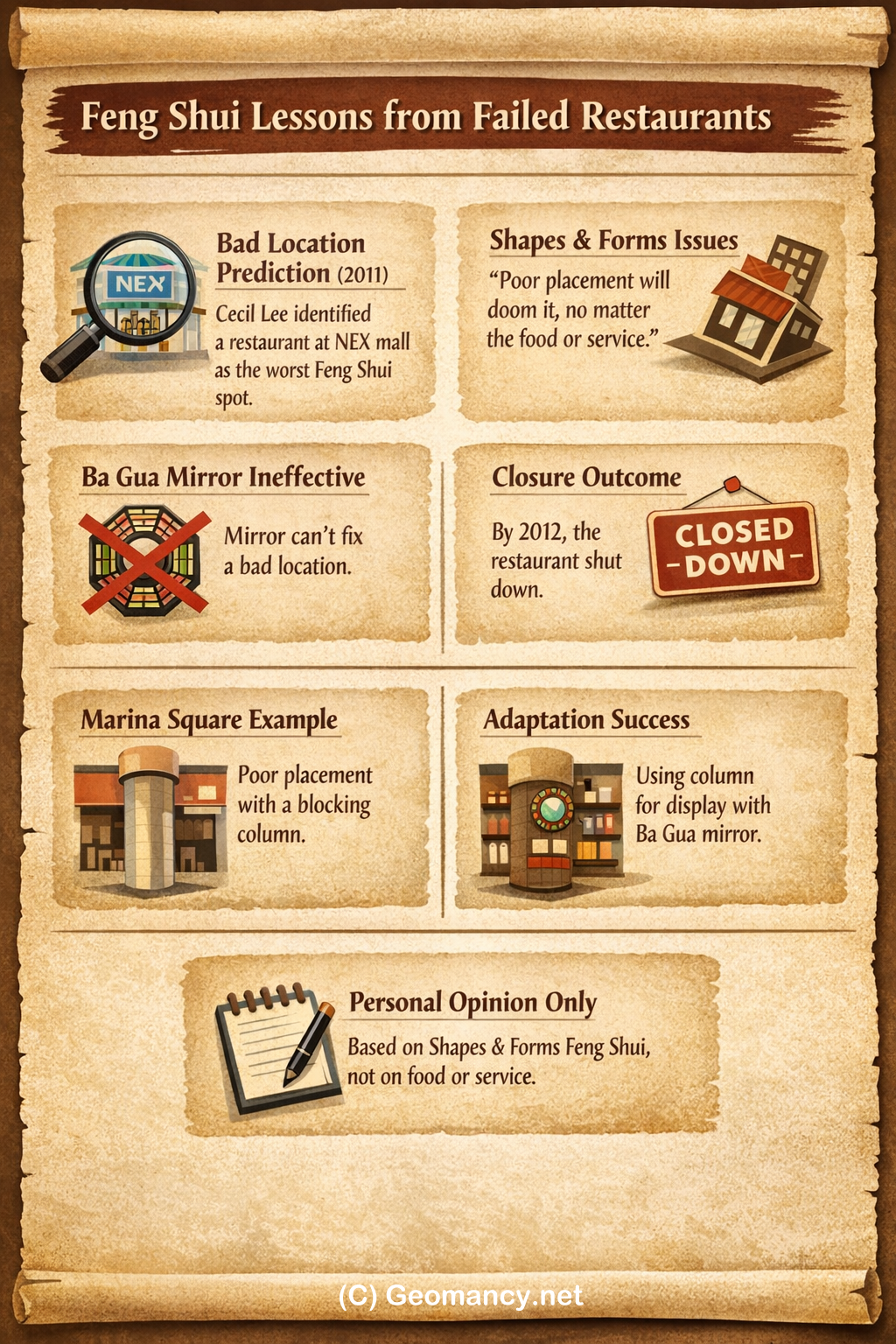
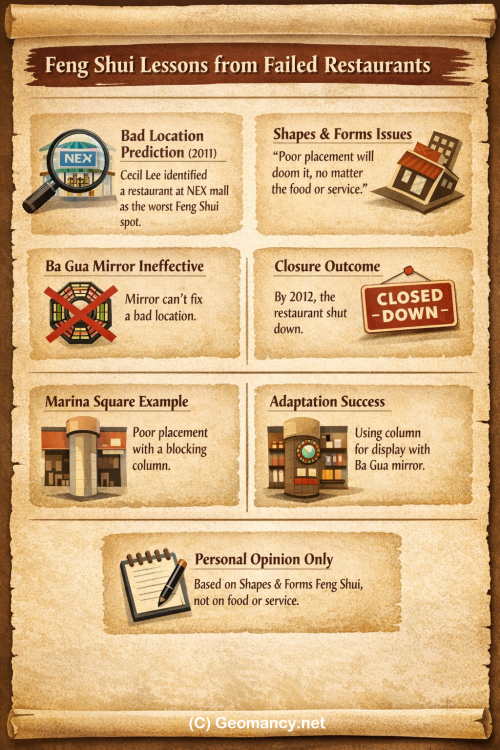
Here are the main points from this page: Initial Observation (2011): Cecil Lee assessed the NEX shopping mall’s layout and concluded that one particular restaurant had one of the worst Feng Shui locations in the mall. Reasoning: He believed the poor “Shapes and Forms” of the site—its physical positioning and structural features—would doom the restaurant regardless of its food or service quality. Ba Gua Mirror Ineffectiveness: He dismissed the idea that placing a Ba Gua mirror on the signage could remedy the situation, emphasizing that location alone would cause failure. Outcome: By June 2012, the restaurant had permanently closed, making it one of the first businesses to shut down in the busy NEX mall. Further Examples: In Marina Square, another restaurant from the same chain had a large support column blocking its frontage. Lee again predicted closure, citing poor Feng Shui placement. Adaptation Case (2012): Interestingly, one store managed to turn a similar column into a feature by using it to display merchandise and placing a Ba Gua mirror strategically. This creative adaptation improved its Feng Shui and attracted customers. Disclaimer: Lee repeatedly stressed that these were his personal opinions based on Shapes and Forms Feng Shui, not judgments on food quality or service. In essence, the page is a case study highlighting how poor physical placement and structural obstacles can undermine a restaurant’s success, while clever adaptation of Feng Shui principles can sometimes reverse the fortune.
-
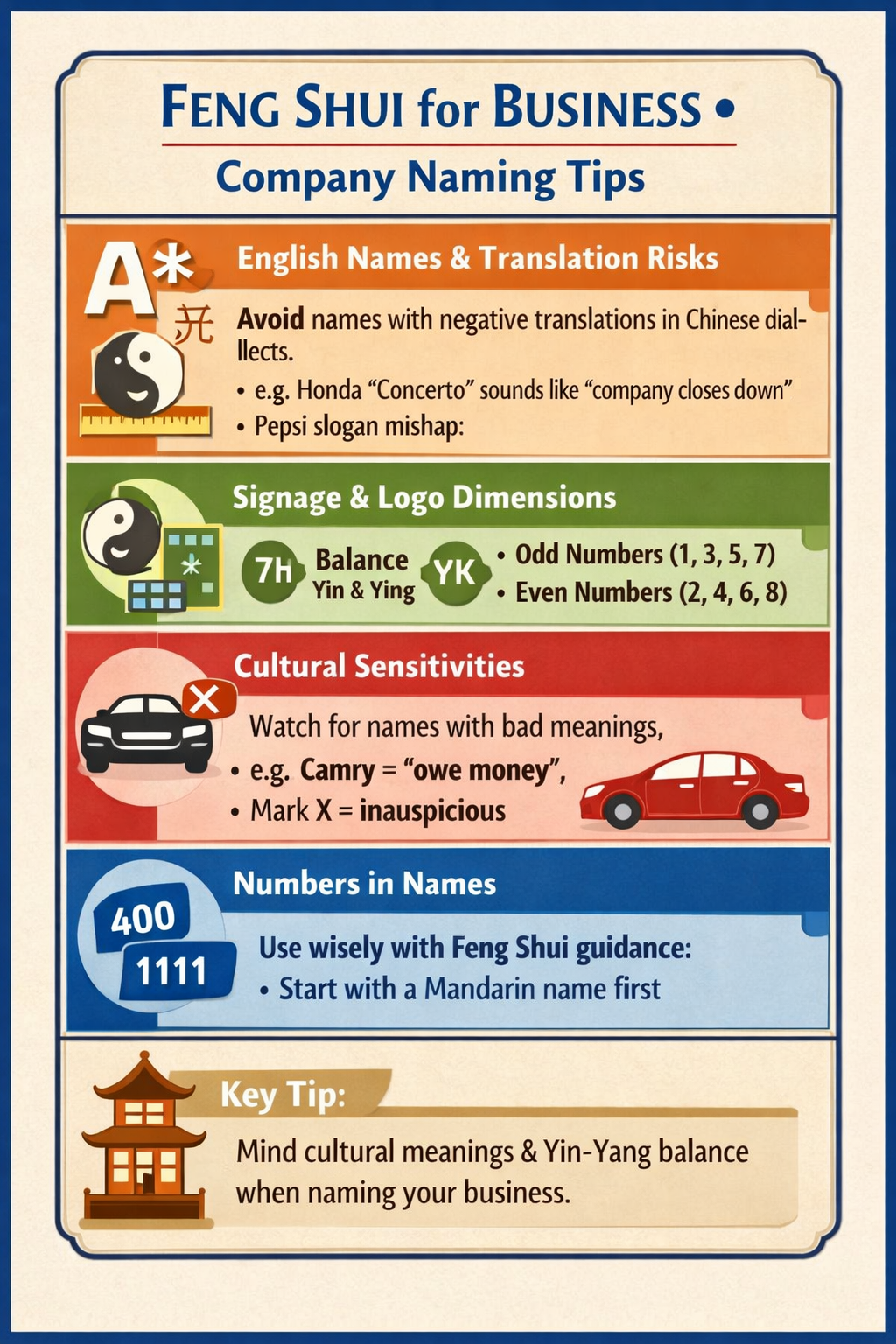
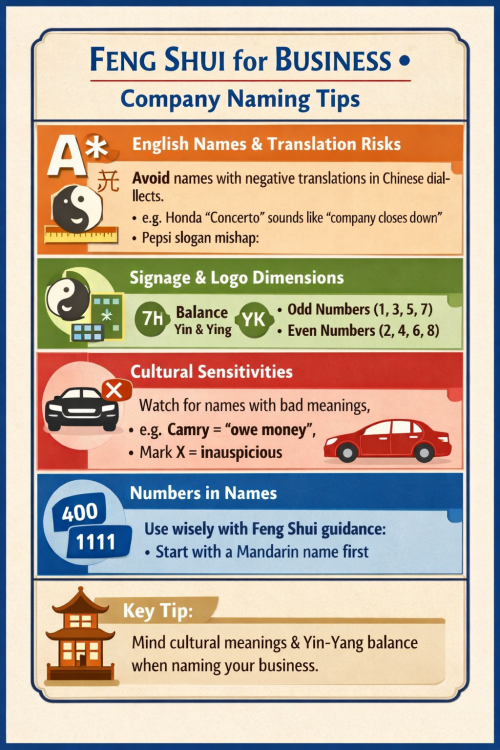
Here are the main points from this page on Feng Shui for Business – Company Name: English Names & Translation Risks Purely English names usually pose no Feng Shui issue unless they carry negative connotations when translated into Chinese dialects. Examples of poor translations: Pepsi’s slogan misinterpreted in Mandarin; Honda “Concerto” sounding like “company close down” in Hokkien; Nissan “Blue Bird” sounding crude in Hokkien. Signage & Logo Dimensions Company signage should balance Yin and Yang through dimensions. Yang = odd numbers (1, 3, 5, 7), Yin = even numbers (2, 4, 6, 8). Example: a logo panel sized 5 feet 8 inches by 2 feet 9 inches combines odd and even for balance. Suitability of Names Names like “Angelica Fabrics” are acceptable since they don’t carry negative meanings in major Chinese dialects or Mandarin. Cultural Sensitivities in Naming Car names illustrate pitfalls: Toyota “Camry” sounds like “owe money” in Hokkien, making it undesirable for some buyers. “Mark X” is avoided because “X” is considered inauspicious in Chinese culture. Numbers in Company Names Using numbers (e.g., “400 Events,” “7 Events,” “1111 Events”) can be considered, but Feng Shui guidance suggests starting with a Mandarin name and then converting to English, not the reverse. Numbers may be better applied to logo design rather than the company name itself. Key takeaway: When naming a business, Feng Shui emphasizes avoiding negative translations across dialects, balancing Yin and Yang in signage dimensions, and being mindful of cultural sensitivities tied to words, numbers, and symbols.
-
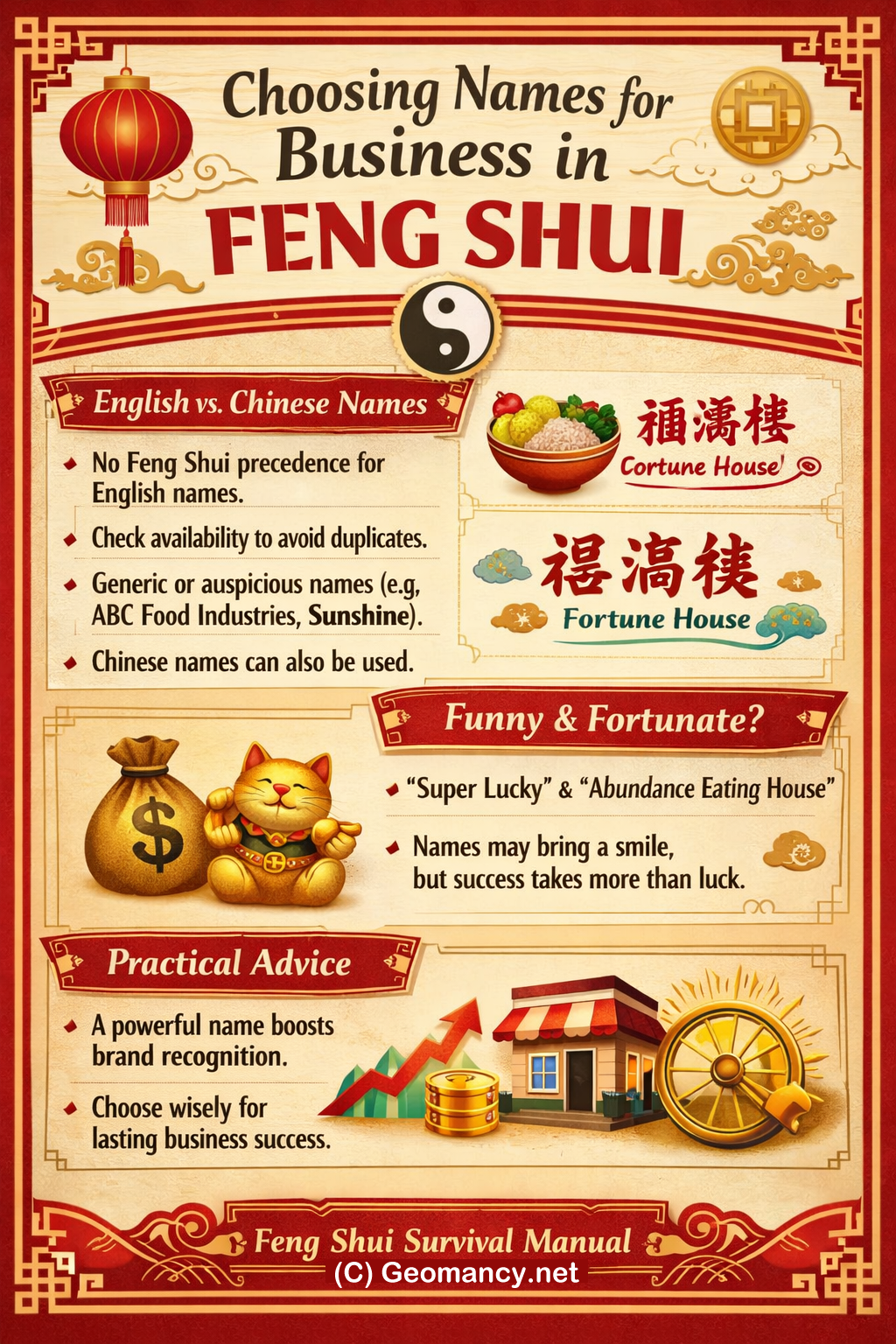
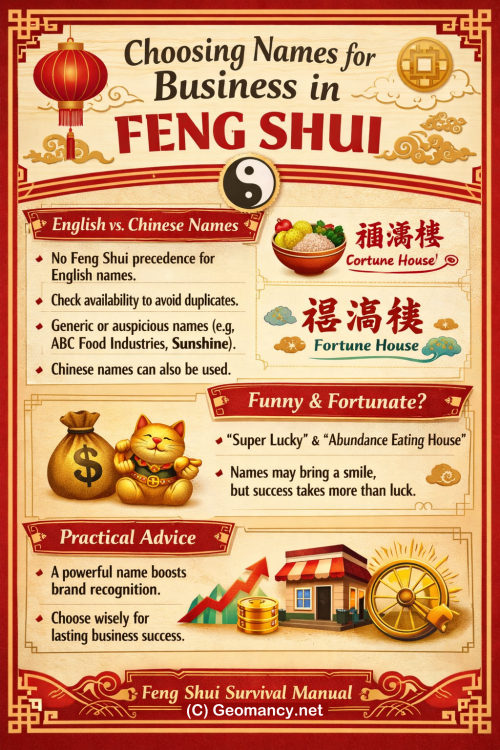
Here are the main points from this page on choosing names for business in Feng Shui: English vs. Chinese names: There is no Feng Shui precedence for English names. It’s important to check if the name is already taken by another company. Many businesses opt for generic names (e.g., ABC Food Industries) or auspicious ones (e.g., Sunshine). Choosing a Chinese name is still feasible, and businesses may also display it prominently on signage. Examples and commentary: Names like Super Lucky, Abundance Eating House, and Good Luck Chicken Rice were cited, sometimes humorously noting the irony of luck not extending to the actual business outcomes. The discussion highlights how names can project prosperity or fortune, but real-world success depends on more than just naming. Practical advice: A company’s name is a powerful tool for brand awareness. Whether it’s a first venture or a seasoned business, the right name can significantly influence recognition and success. In essence, the page blends Feng Shui considerations, cultural naming practices, and branding strategy, emphasizing that while auspicious names may help, careful thought and originality are equally important.
- Today
-
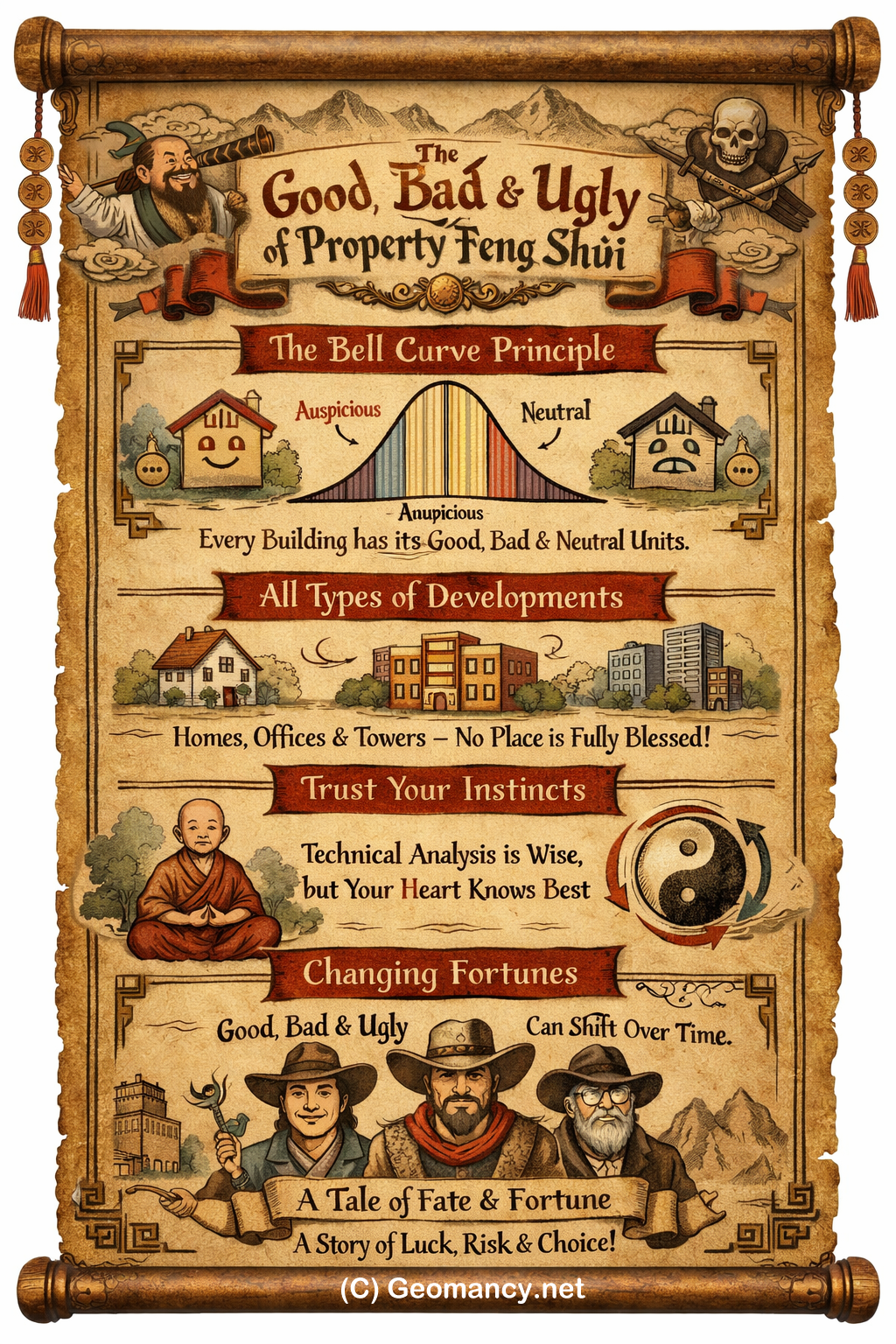
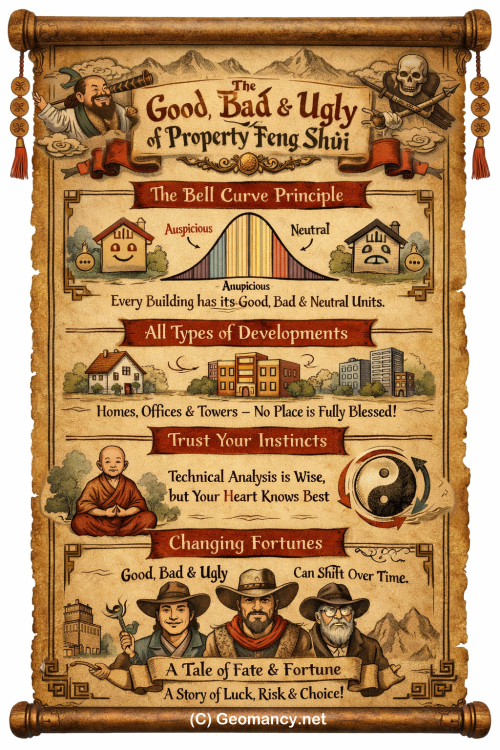
📈 Bell Curve Principle in Feng Shui: The idea is that every building naturally distributes its units along a bell curve — meaning some units will be highly auspicious, some neutral, and some less favorable. No building is entirely “good” or entirely “bad.” 🏢 Universal Application: This principle applies across all types of developments — whether residential, commercial, or mixed-use. It suggests that even prestigious buildings contain a mix of fortunes. 🌟 Instinct Matters: Beyond technical Feng Shui analysis, the page emphasizes trusting one’s own feelings when choosing a unit. Personal resonance with a space can be as important as its calculated auspiciousness. 🔄 Dynamic Perspective: The “good, bad, and ugly” mix isn’t static. Over time, changes in environment, renovations, or even personal circumstances can shift how a unit aligns with its occupants. 🎭 Satirical Resonance: The metaphor of “good, bad, and ugly” echoes broader cultural storytelling — it frames property selection not just as a technical exercise but as a narrative of fortune, risk, and human judgment.
-
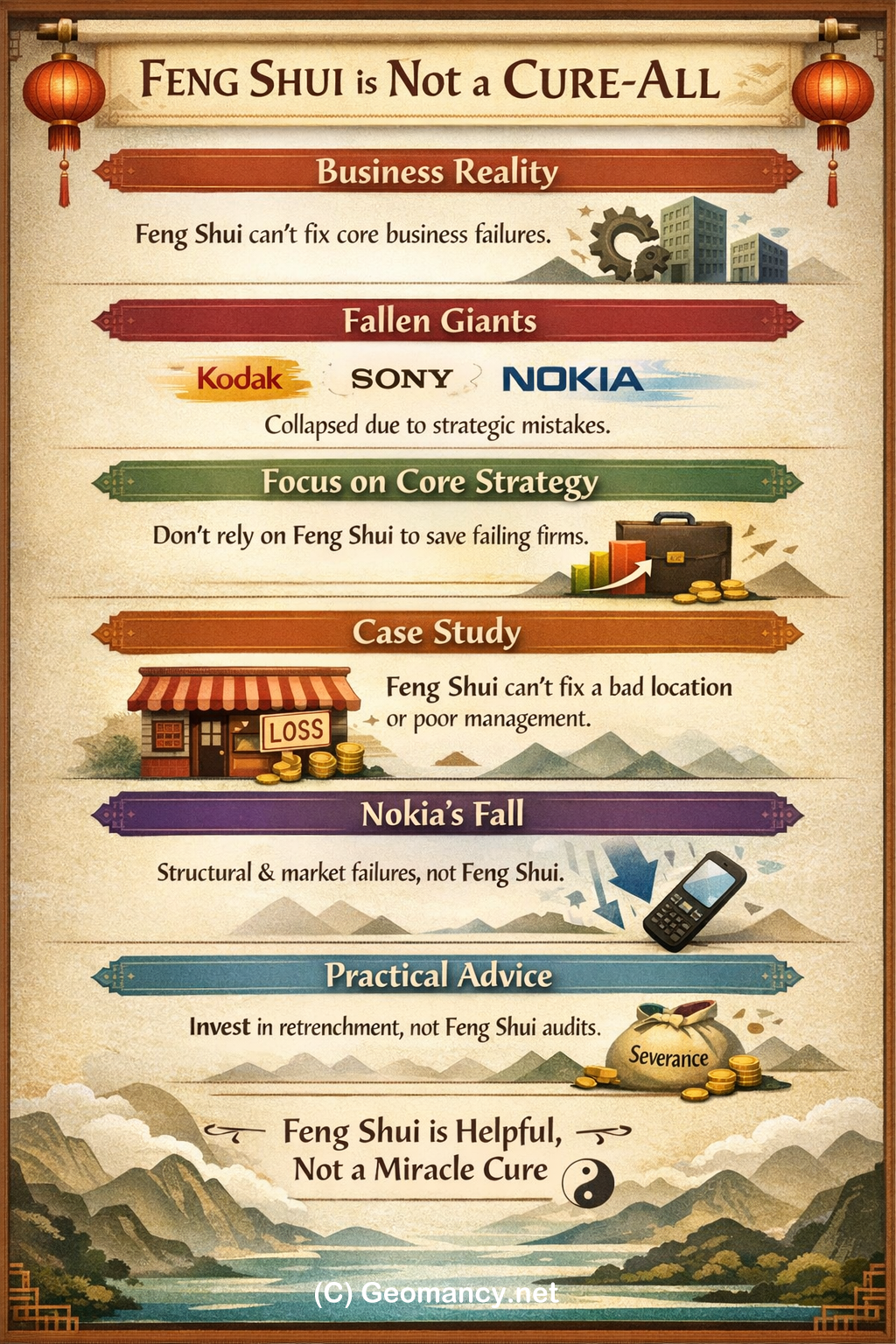
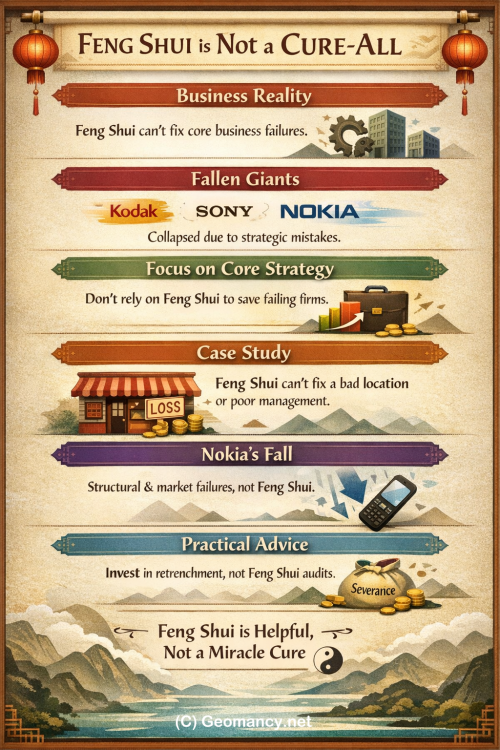
Here are the main points from this page: Key TakeawaysFeng Shui is not a universal cure-all: The central argument is that Feng Shui should not be seen as a solution to every business or corporate problem. Structural and strategic issues cannot be solved by Feng Shui alone. Examples of fallen giants: Companies like Kodak, Sony, and Nokia are cited as examples of once-dominant firms that collapsed due to core business failures, not because of Feng Shui neglect. Business focus over Feng Shui reliance: Large corporations are advised to concentrate on their core competencies rather than relying on Feng Shui audits as a way to rescue failing operations. Case study – failed restaurant: Feng Shui can help at the stage of choosing a location (e.g., avoiding poor “Shapes and Forms”), but it cannot compensate for deeper structural or market problems. A failed restaurant example illustrates heavy financial losses despite Feng Shui considerations. Nokia’s decline: The company’s collapse is attributed to structural and strategic missteps, showing that Feng Shui could not prevent retrenchments or industry shifts. Practical advice for businesses: Companies facing inevitable decline should spend resources on retrenchment benefits rather than Feng Shui audits, which cannot reverse fundamental business weaknesses. Balanced perspective: While Feng Shui can be useful in specific contexts (like site selection), it is not a panacea for systemic corporate issues. In essence, the page emphasizes realistic expectations: Feng Shui can provide guidance in certain areas, but it cannot replace sound business strategy or rescue failing giants.
-
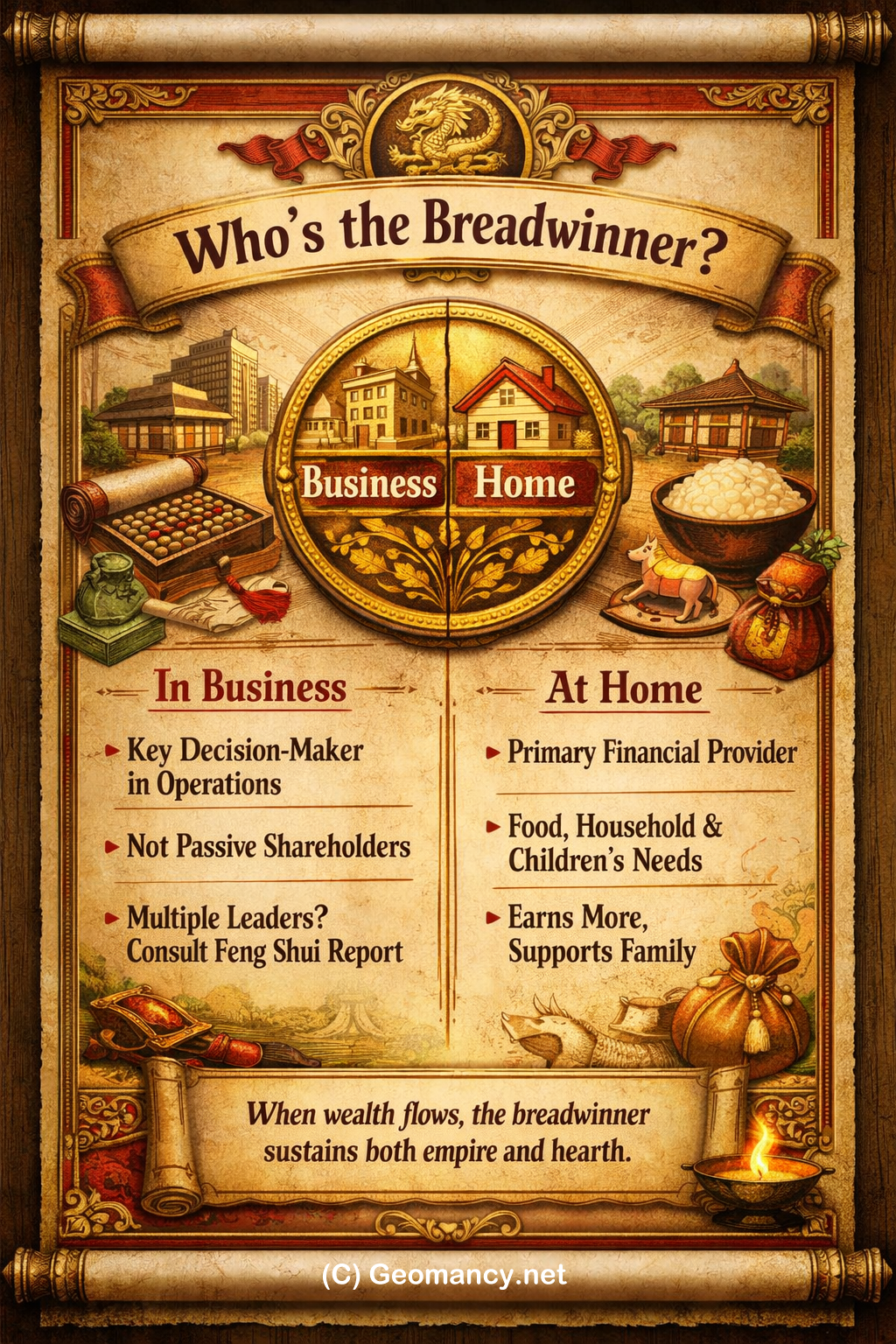
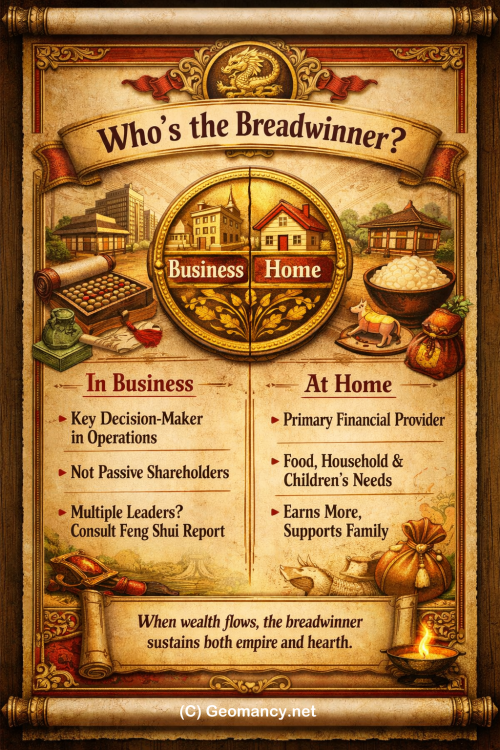
Here are the main points from this page: 🔑 Key TakeawaysBreadwinner in business context Refers to the most important person or key decision-maker actively involved in operations. Essential figure who ensures the business continues running. Passive shareholders who don’t participate in daily operations are not considered breadwinners. If multiple leaders exist, an additional Feng Shui Eight House Report can help, but focus should remain on the most crucial person. Breadwinner in home context Identified as the person who contributes the most financially to household expenses. Includes providing for food, household items, children’s needs, and allowances. The one who earns more and supports the family financially is considered the breadwinner. Geomancy.net can calculate even if both partners (husband and wife) earn the same amount. 📌 Overall MessageThe concept of “breadwinner” depends on context: At work → the active leader essential to the business. At home → the person who provides the larger share of financial support.
-
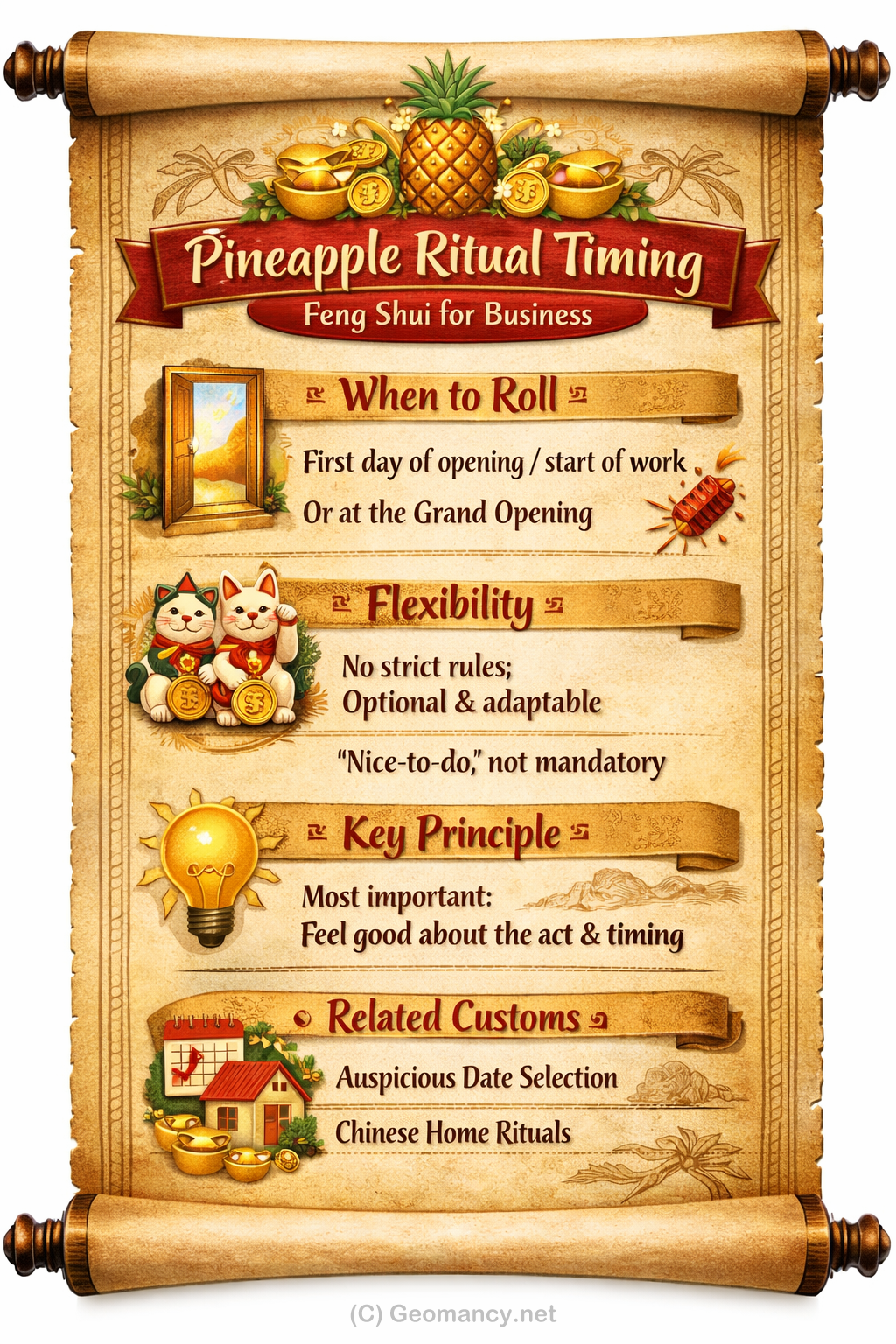
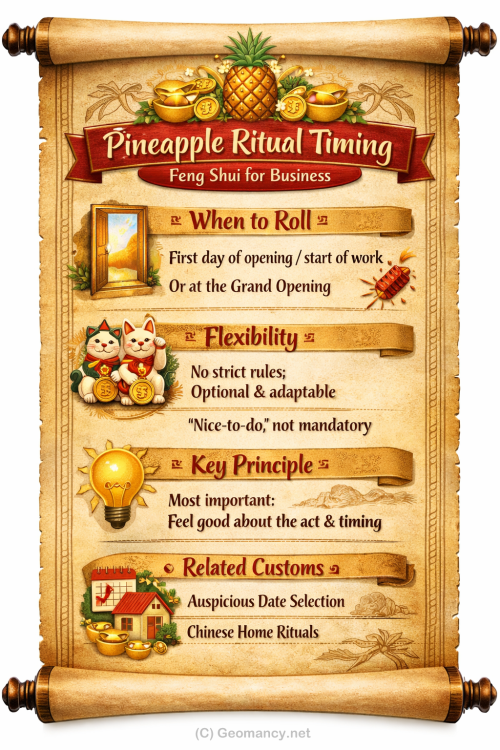
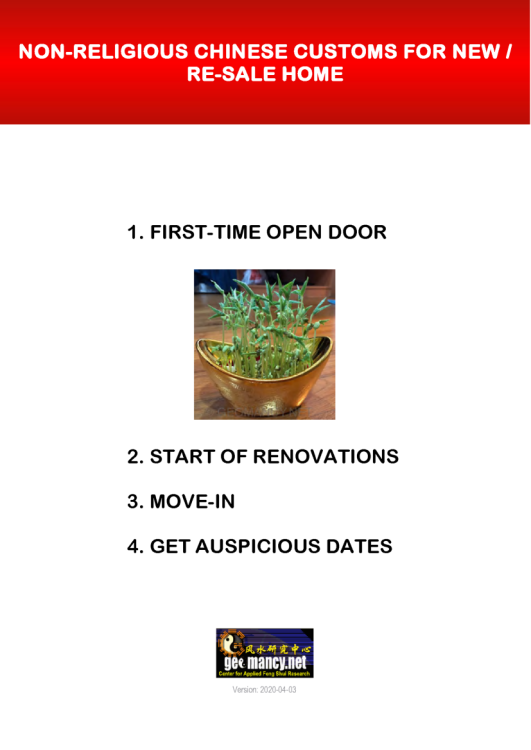
Here are the main points from this page: Pineapple ritual timing: It is generally recommended to perform the pineapple rolling ritual on the first day of opening or starting work. Flexibility: There is no strict rule; it can also be done at the grand opening if desired. Optional practice: The ritual is considered a “nice-to-do” rather than a mandatory step. Key principle: What matters most is that participants feel good about the timing and act. Additional resources: The site also references auspicious date selection services and related non-religious Chinese customs for new or resale homes.
-
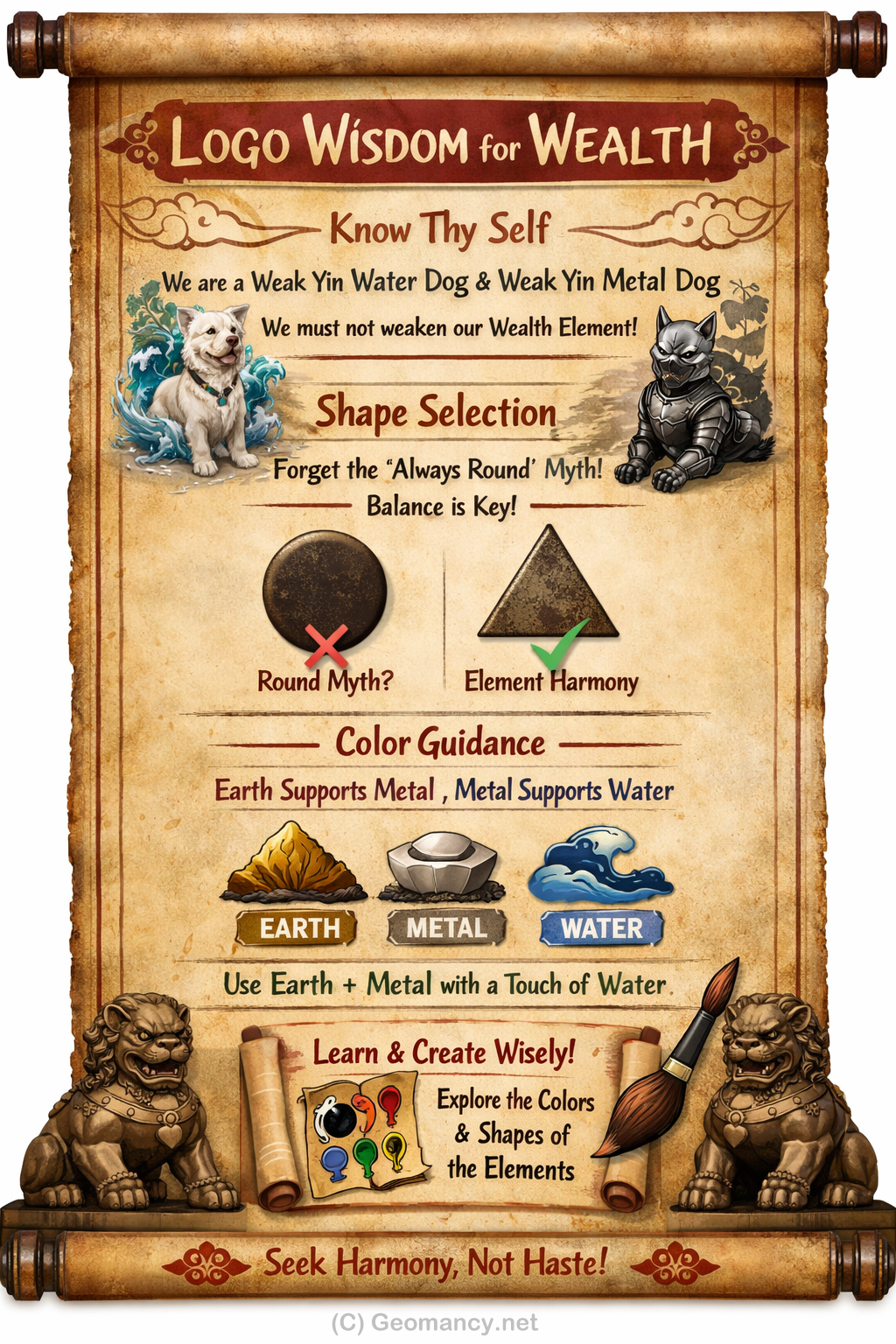
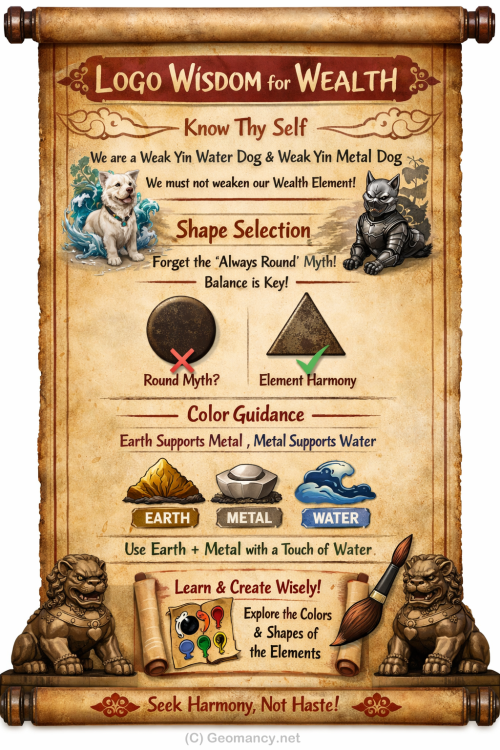
Here are the main points from this page: Business context: The discussion centers on choosing the right shape and color for a company logo in relation to Feng Shui principles. User background: The individuals involved are described as a weak yin Water Dog and a weak yin Metal Dog in the Chinese zodiac system. Both are advised not to weaken further, as this would reduce their ability to benefit from their Wealth Element. Shape of logo: There is a common belief that logos should be round (circle or oval), but the page clarifies that this is not strictly correct. Shape choice should be guided by elemental balance rather than a blanket rule. Color and element guidance: Earth supports Metal, and Metal supports Water. Therefore, the logo should incorporate Earth + Metal elements, and it can also include Water elements. Practical advice: The page points to resources explaining which colors and shapes correspond to each element, encouraging readers to align their logo design with these associations rather than relying on simplistic rules.
-
Here are the main points from this page: Business context: The discussion centers on choosing the right shape and color for a company logo in relation to Feng Shui principles. User background: The individuals involved are described as a weak yin Water Dog and a weak yin Metal Dog in the Chinese zodiac system. Both are advised not to weaken further, as this would reduce their ability to benefit from their Wealth Element. Shape of logo: There is a common belief that logos should be round (circle or oval), but the page clarifies that this is not strictly correct. Shape choice should be guided by elemental balance rather than a blanket rule. Color and element guidance: Earth supports Metal, and Metal supports Water. Therefore, the logo should incorporate Earth + Metal elements, and it can also include Water elements. Practical advice: The page points to resources explaining which colors and shapes correspond to each element, encouraging readers to align their logo design with these associations rather than relying on simplistic rules.
- Yesterday
-
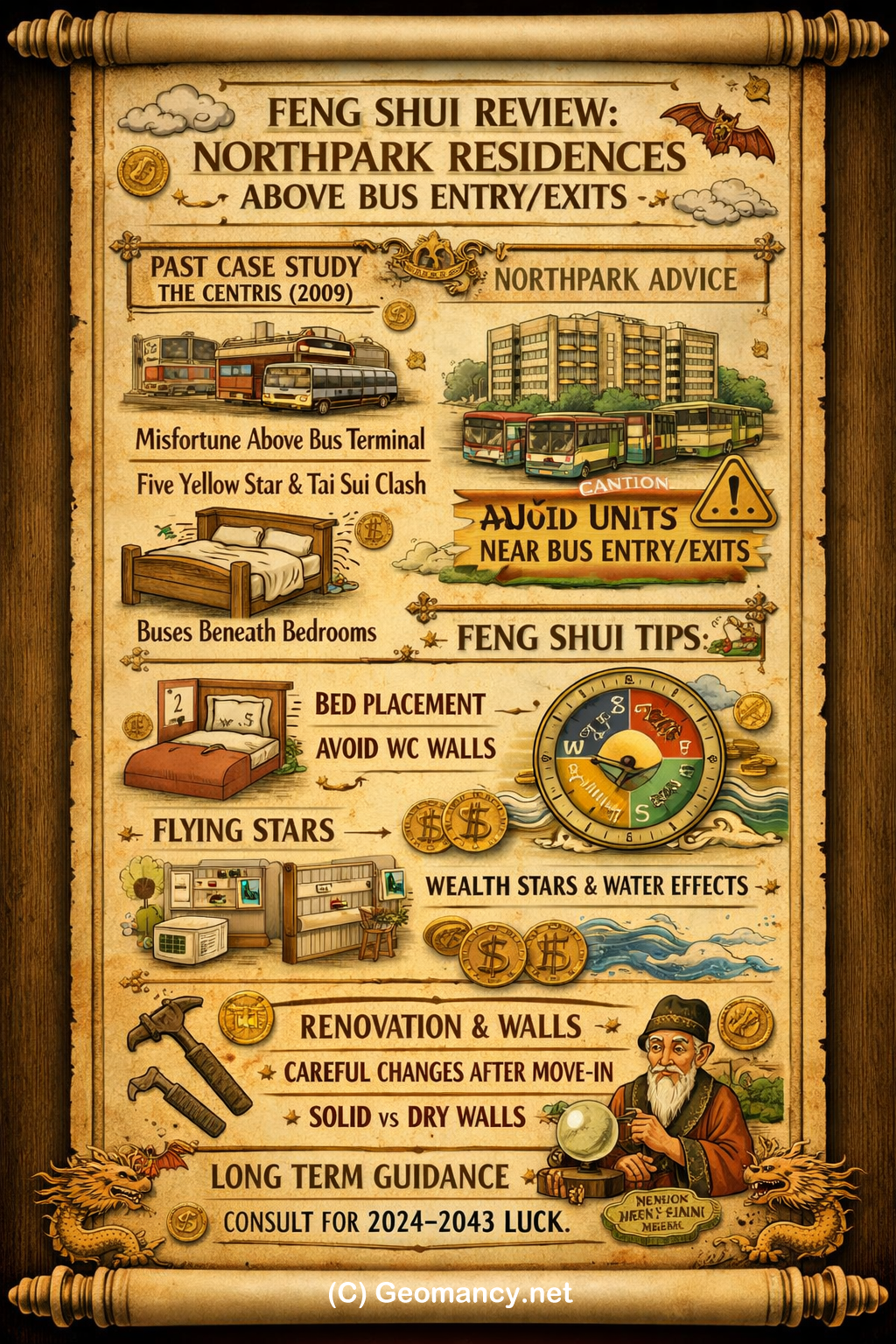
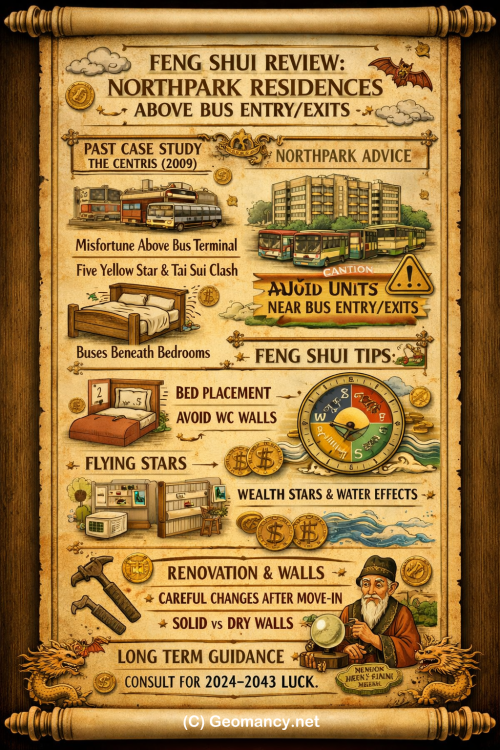
Here are the main points from the Feng Shui review of Northpark Residences units above bus entry/exits: Past case study (The Centris @ Jurong Central, 2009): Units directly above bus terminal entry/exits experienced misfortune. Feng Shui factors included the Five Yellow star (#5, sickness/misfortune) and Grand Duke Tai Sui at North-North-East, creating a “double whammy.” Constant bus movement beneath master bedrooms was considered highly inauspicious. Northpark Residences situation: Unlike The Centris, this development does not have stacks directly above bus terminal entry/exits. Still, buyers are advised to avoid units close to or above these entry/exit points. Additional Feng Shui considerations: Bed placement: Avoid placing bed-heads against WC walls. Flying Star Feng Shui: Most stacks face N2 or S2. N2 orientation places auspicious wealth stars at the rear (kitchen/yard), less favorable. S2 orientation benefits East group residents, with double #8 wealth stars at the frontage and water elements enhancing prosperity. NE1 and SW1 orientations can be favorable if water features are present at the frontage (balcony side), activating health, wealth, and family luck. Negative stars in other sectors must be neutralized. Shapes and Forms Feng Shui: Cautions include air-conditioning ledges, kitchens adjoining balconies, and master toilets at the front of units. Practical advice: Renovations are fine before moving in, but caution is advised once residents occupy the unit. Large projects often progress faster than small ones due to economies of scale, investment recovery needs, and reputation stakes. Wall construction varies (solid vs. dry walls), influencing durability and health considerations. Future outlook: Owners are encouraged to consult Feng Shui masters for long-term luck forecasts (2024–2043). In essence, the review emphasizes avoiding units near bus entry/exits, careful bed and wall placement, and leveraging favorable orientations with water features, while remaining mindful of hidden negative stars and structural details.
-
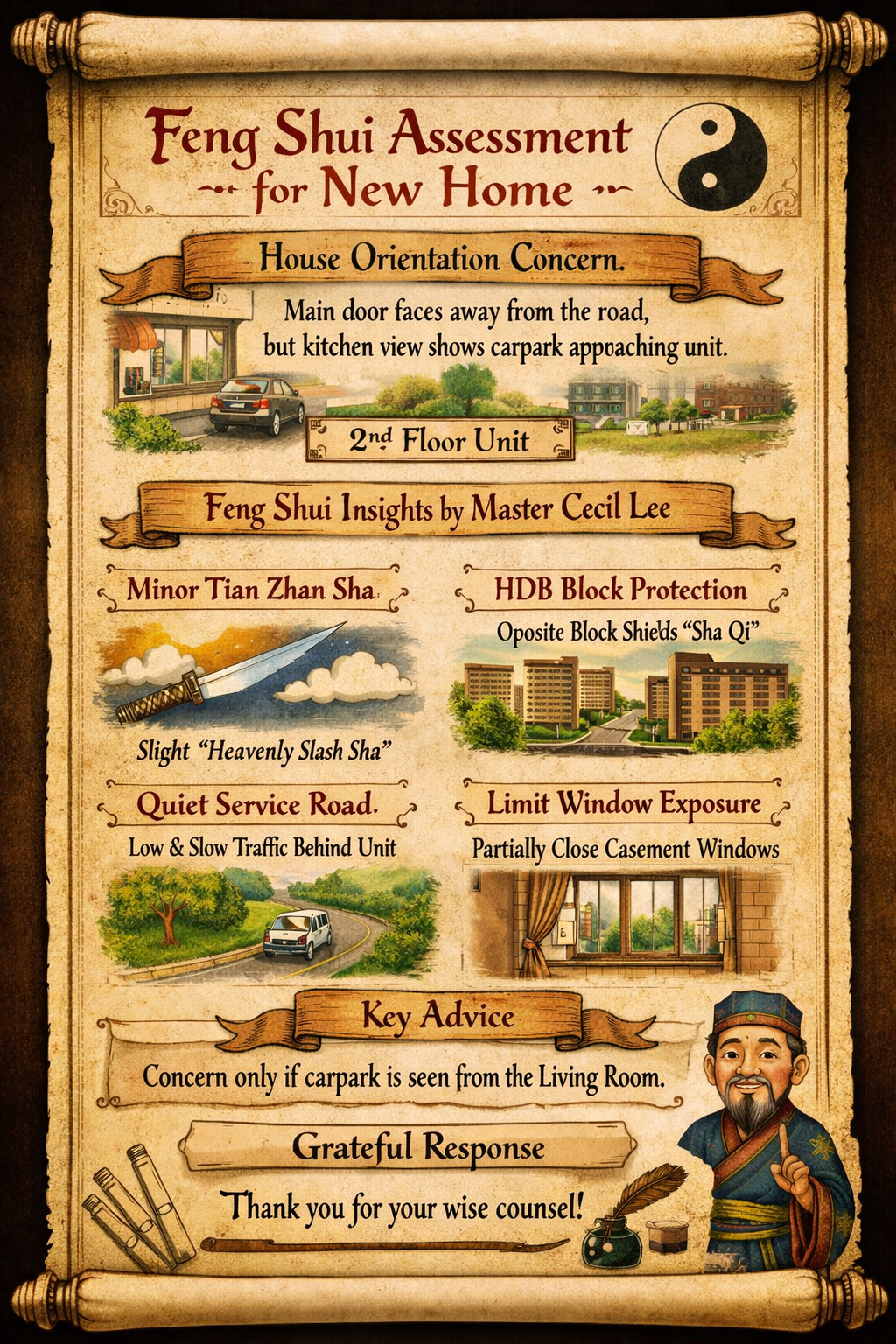
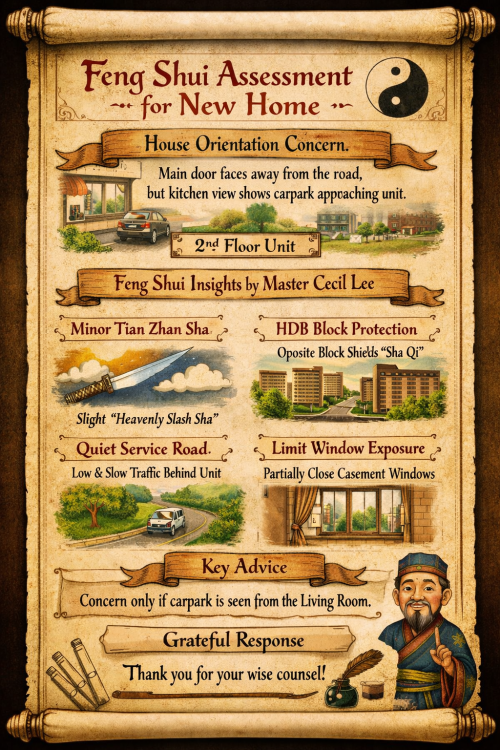
Here are the main points from this page: House orientation concern: The prospective buyer noted that the main door faces away from the road, but from the kitchen, a carpark appears to come directly toward the unit. Unit details: The property is located on the second floor. Feng Shui assessment by Cecil Lee: There is a slight Tian Zhan Sha (Heavenly Slash Sha), but it is not considered a major issue. A nearby HDB block across the street helps obstruct a direct “sha qi” (negative energy) path to the kitchen. The service road behind the unit does not seem to have heavy or fast traffic, reducing potential Feng Shui concerns. If the kitchen has casement windows, limiting the opening of certain panels can help mitigate exposure. The main concern would only arise if the carpark view directly affects the living room, rather than just the kitchen. Outcome: The buyer thanked Cecil Lee for the professional advice, indicating reassurance about the property’s Feng Shui.
-
Congratulations! Key Collection

-
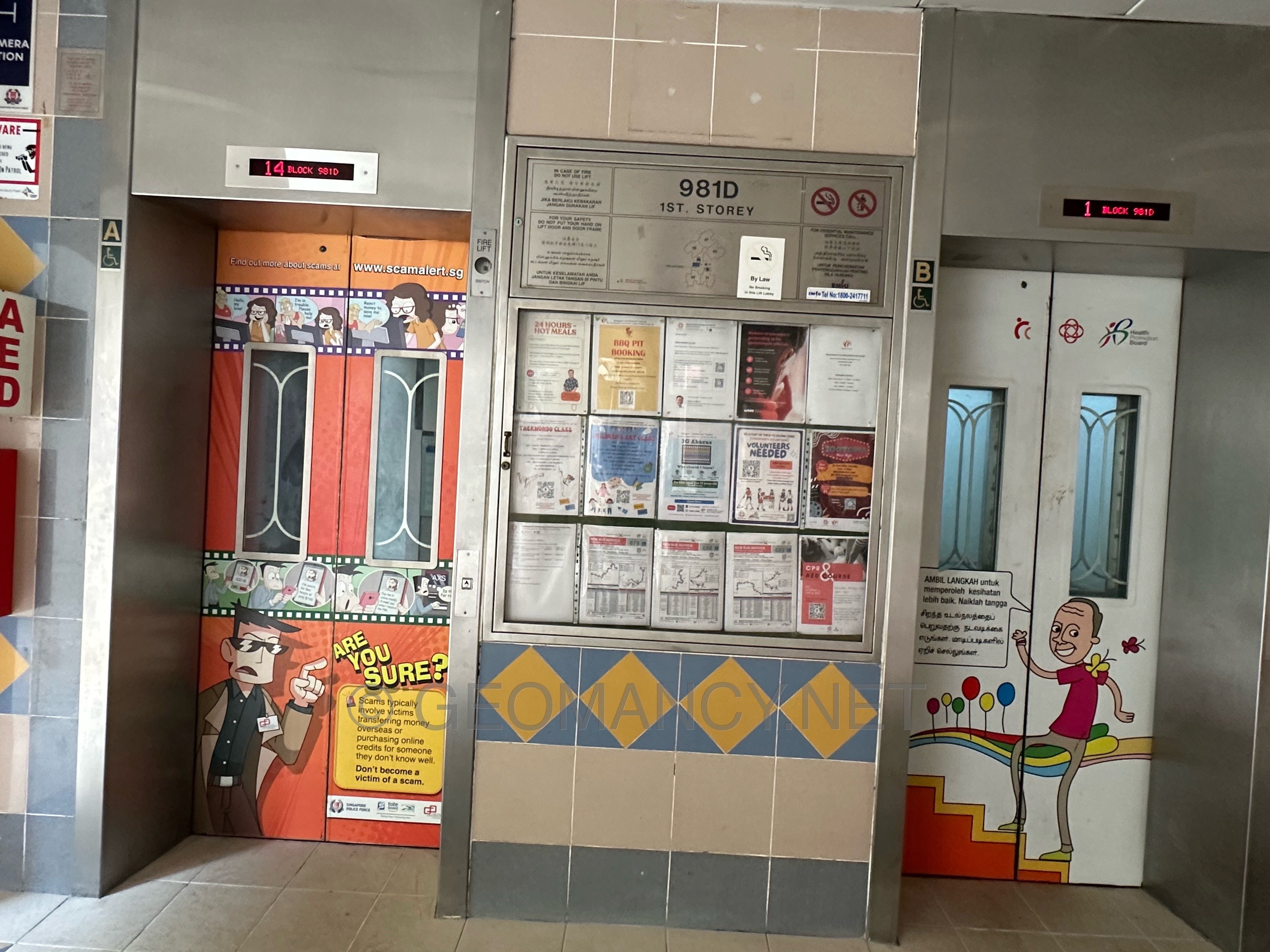
981D Buangkok Crescent
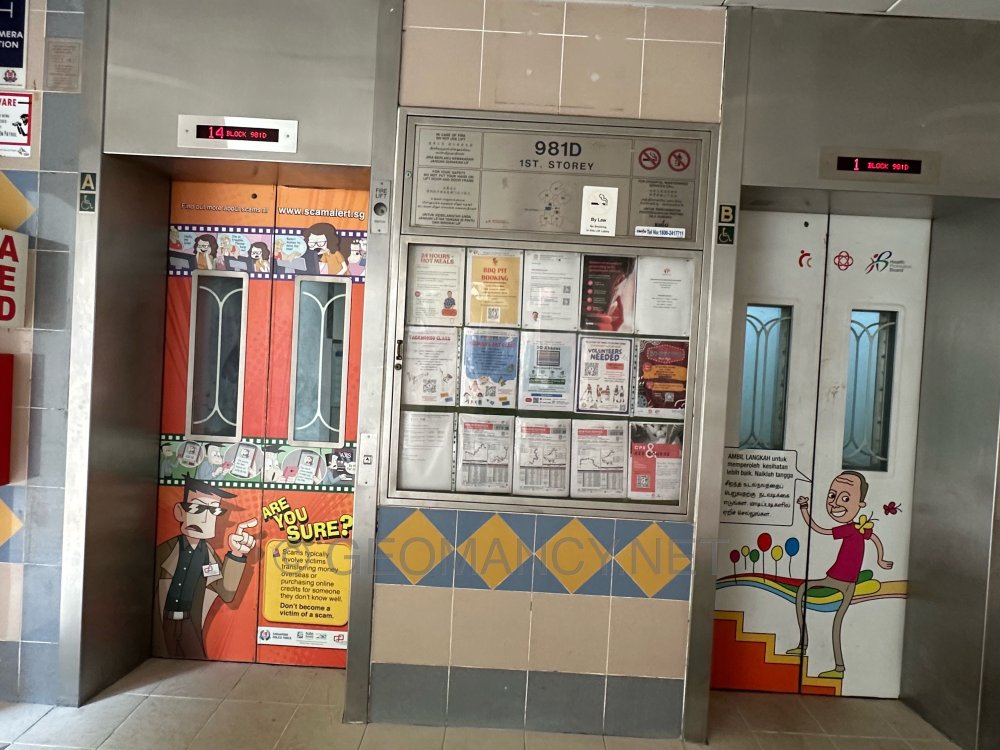
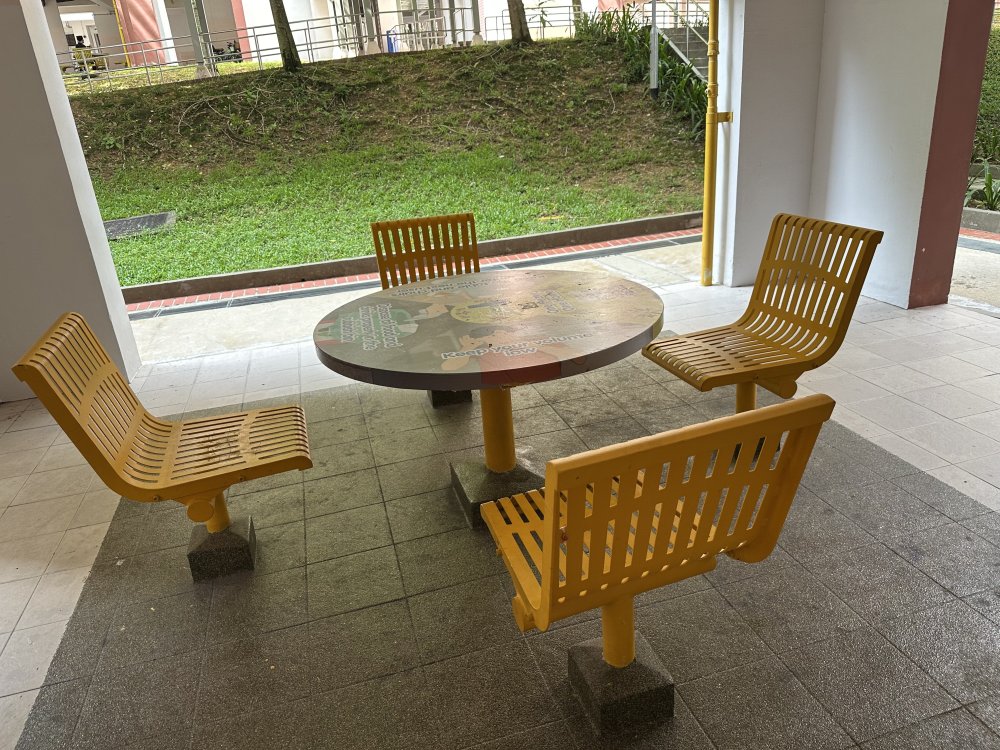
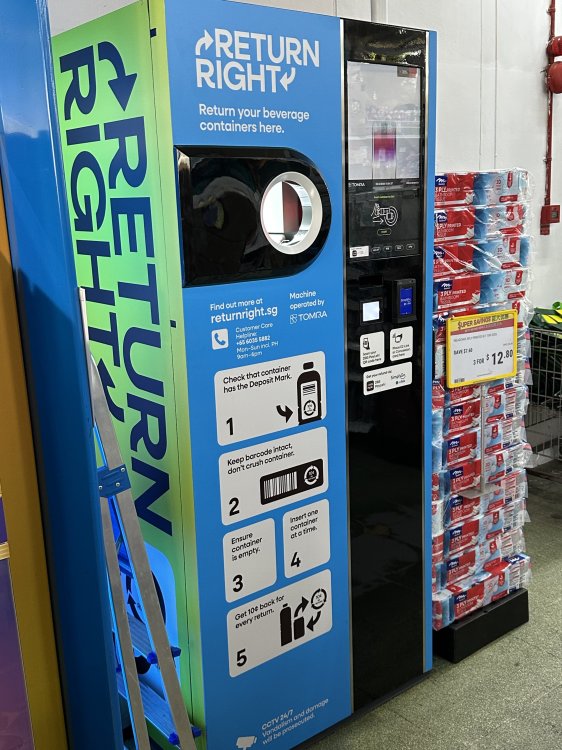
- Last week
-
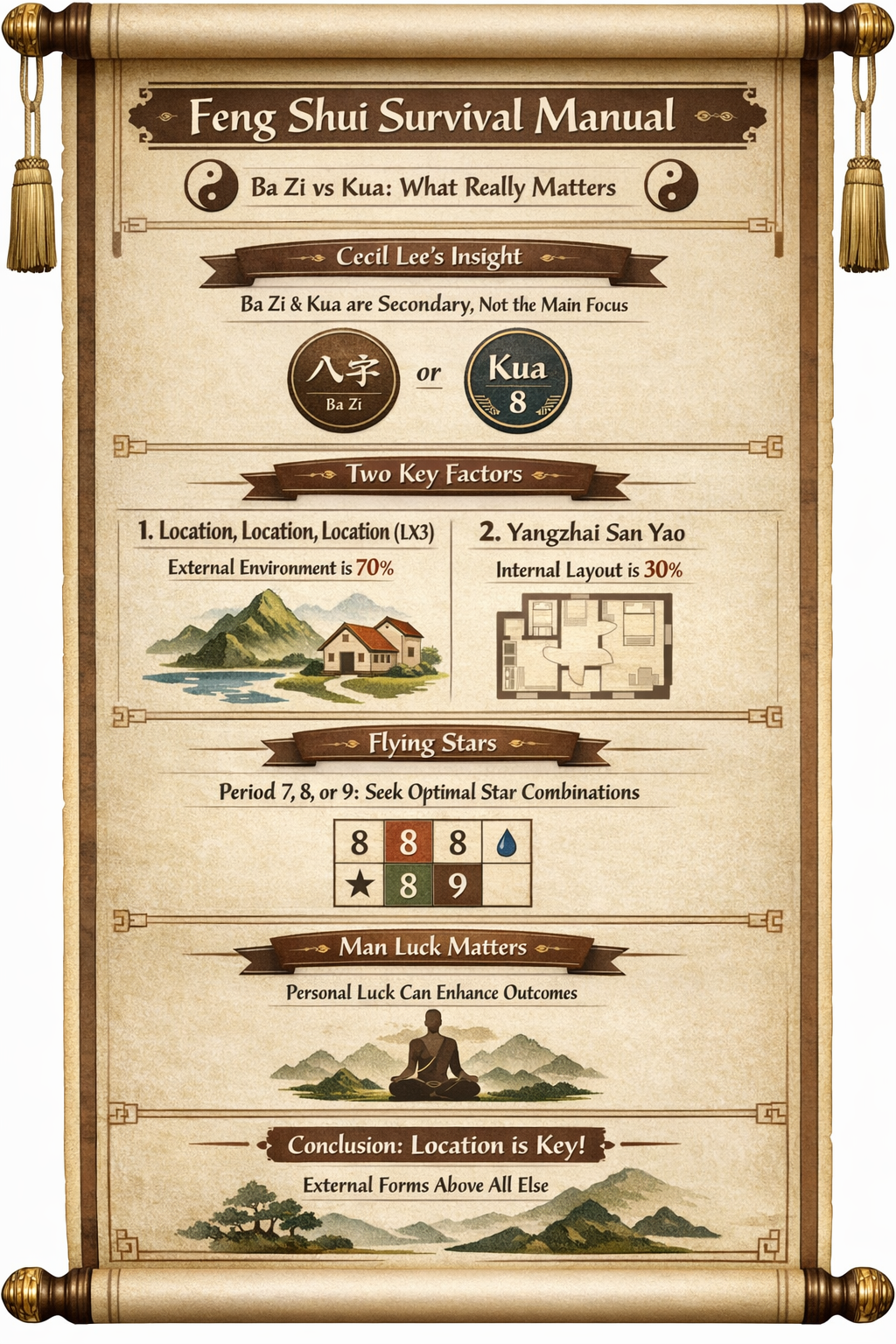
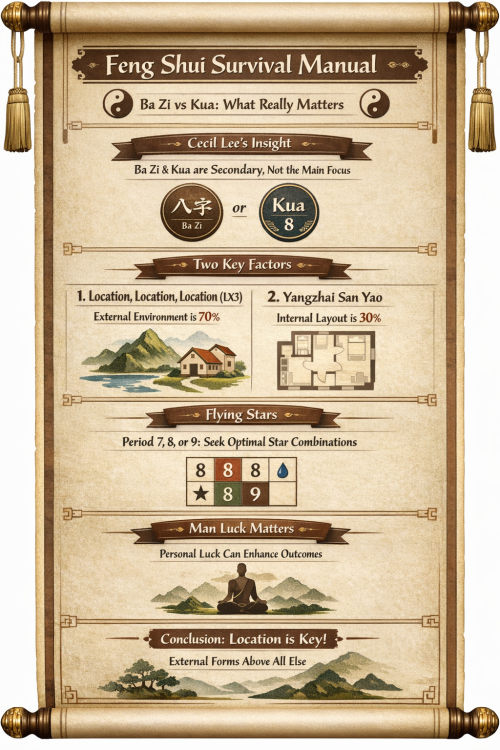
Here are the main points from this page: Key InsightsBa Zi vs. Kua (8 Mansion): The question is whether to prioritize Ba Zi (personal element chart) or Kua directions when choosing house orientation. Cecil Lee’s stance: Overly strict reliance on either system risks missing good opportunities. Ba Zi and Kua can be treated as supplementary, but they are not the central decision factors. Two decisive factors: Location, location, location (LX3): External environment, shapes, and forms carry the greatest weight (70%). Yangzhai San Yao: Internal layout principles account for the remaining 30%. Frontage factor: Plays only a minor role compared to LX3. Flying Stars consideration: Depending on the Feng Shui period (7, 8, or 9), certain star combinations at the frontage are preferred (e.g., double #8’s in Period 8, water star #9 in Period 9). Practical application over theory: Many rely too much on textbook knowledge; true mastery lies in applying Feng Shui practically. Human/Man Luck: Even if a house’s Feng Shui is average, personal luck can enhance outcomes. Conclusion: Prioritize location and external forms above all else. Ba Zi and Kua are useful but secondary.
-
Lodi 646 App joined the community
-
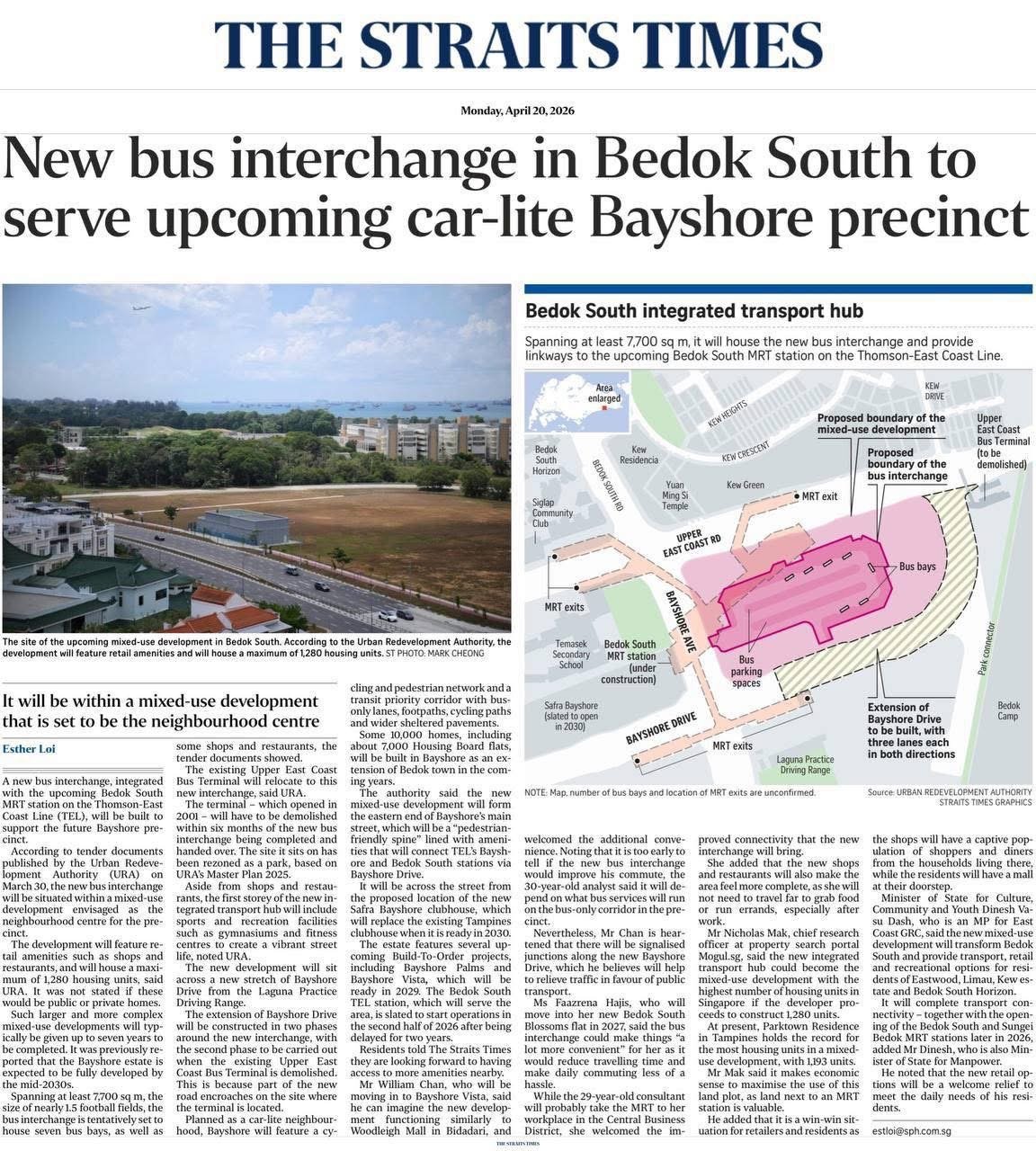
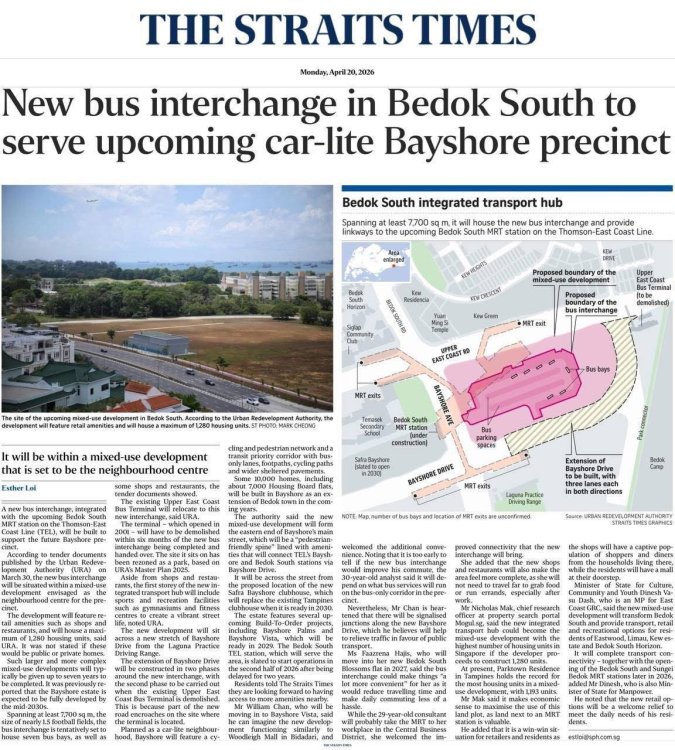
Source & Credit: The Straits Times (Apr 20, 2026) reports that a new bus interchange will be built in Bedok South as part of an integrated transport hub designed to serve the upcoming, car-lite Bayshore precinct and the future Bedok South MRT station on the Thomson–East Coast Line. Key points: - Location & concept: The interchange will sit within a mixed-use “neighbourhood centre” development in Bedok South, alongside commercial/community uses and homes, forming a single transport-and-amenities node. - Integrated connectivity: Plans indicate covered linkways and direct connections between the bus interchange and Bedok South MRT, making transfers easier and improving first/last-mile access. - Serving Bayshore’s car-lite vision: The hub is positioned to support Bayshore’s planned car-lite lifestyle, where public transport, walking and cycling are prioritised as new housing comes on stream. - Scale & planning status: The development is described as a large site (tens of thousands of square metres); some interchange specifics (e.g., final bus-bay configuration) are still subject to confirmation as plans are refined. Overall, the project is framed as a major piece of infrastructure to anchor Bedok South/Bayshore’s growth, improve connectivity for future residents, and advance the area’s car-lite transport goals.
-
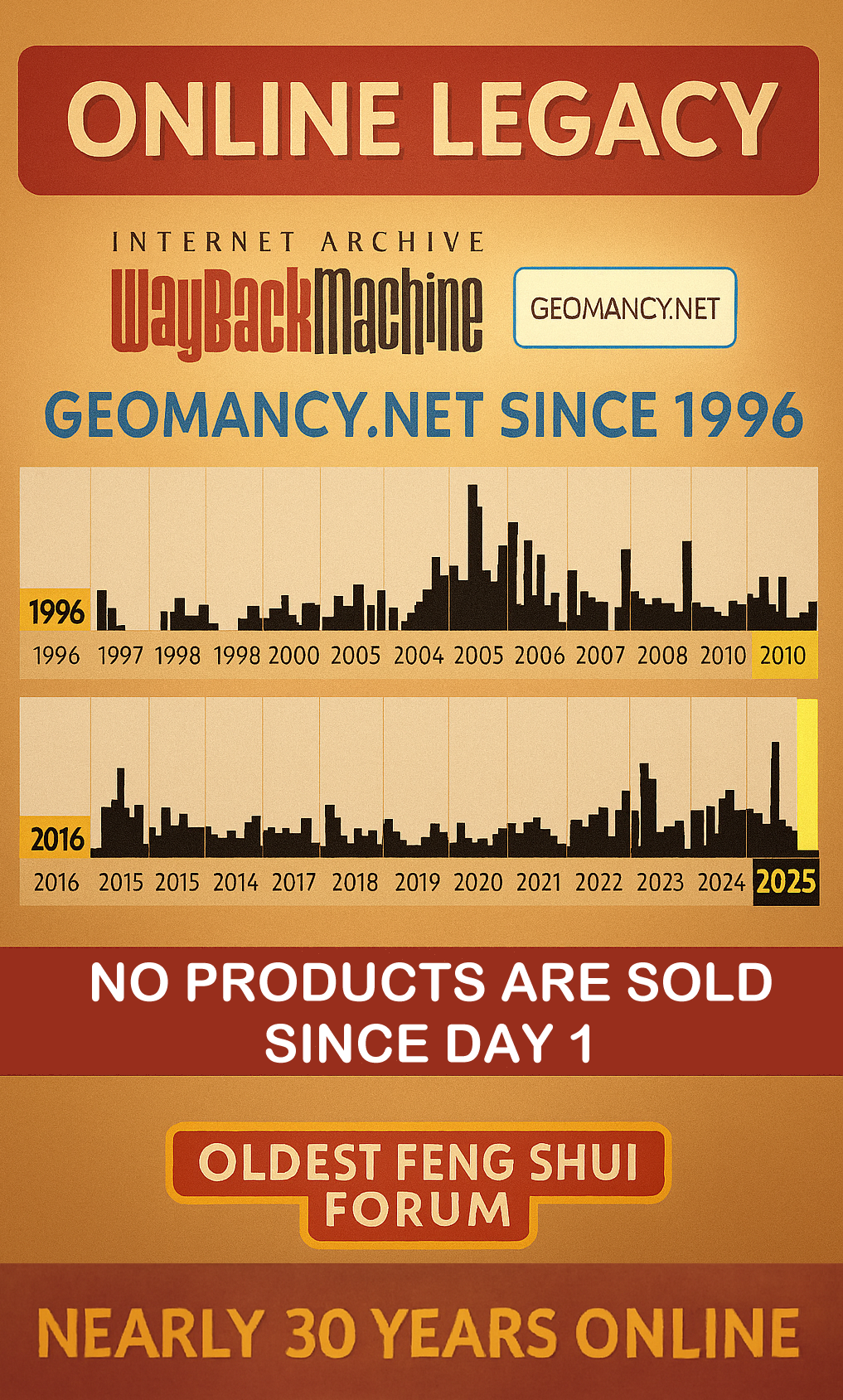
Discover the World’s Oldest Feng Shui Forum (C) Geomancy.net Geomancy.net holds the distinction of being the oldest Feng Shui forum globally, serving as a significant platform for discussions and insights related to this ancient practice. Its longevity underscores its importance as a Leader in the field of Feng Shui. How can we help you today? GET EXPERT HELP: IMPROVE YOUR HEALTH, WEALTH & HAPPINESS TODAY Comprehensive Home Package [A.]: On-site or [B.]: Off-site for HDB / Condo / EC & Landed Properties for New/Re-Sale House or facing financial/ marriage/ relationship/ health issues Do you offer a 1 visit On-site audit? How much? " As much as we see, Geomancy.net has great web presence built up over the years and is seen as one of the SG market leaders in residential house audit. " Transparent Pricing & No Hidden Costs. No Purchase of Products. Cecil Lee, +65 9785-3171 / support@geomancy.net House Hunting? We will help you select the most auspicious unit! Learn More The Experts in House Hunting AUSPICIOUS DATES FOR ONE OR TWO PERSONS Please visit 30 Days Auspicious Date for ONE or TWO Person(s) - FengShui.Geomancy.Net +++ Related: Non-Religious Chinese Customs For New Re-Sale Home +++ Geomancy.net e-books https://www.geomancy.net/forums/store/category/1-geomancynet-e-books/ +++ ALL ELSE FANNING CALM & LET CECIL HANDLE IT






-
Discover the World’s Oldest Feng Shui Forum (C) Geomancy.net Geomancy.net holds the distinction of being the oldest Feng Shui forum globally, serving as a significant platform for discussions and insights related to this ancient practice. Its longevity underscores its importance as a Leader in the field of Feng Shui. How can we help you today? GET EXPERT HELP: IMPROVE YOUR HEALTH, WEALTH & HAPPINESS TODAY Comprehensive Home Package [A.]: On-site or [B.]: Off-site for HDB / Condo / EC & Landed Properties for New/Re-Sale House or facing financial/ marriage/ relationship/ health issues Do you offer a 1 visit On-site audit? How much? " As much as we see, Geomancy.net has great web presence built up over the years and is seen as one of the SG market leaders in residential house audit. " Transparent Pricing & No Hidden Costs. No Purchase of Products. Cecil Lee, +65 9785-3171 / support@geomancy.net House Hunting? We will help you select the most auspicious unit! Learn More The Experts in House Hunting AUSPICIOUS DATES FOR ONE OR TWO PERSONS Please visit 30 Days Auspicious Date for ONE or TWO Person(s) - FengShui.Geomancy.Net +++ Related: Non-Religious Chinese Customs For New Re-Sale Home +++ Geomancy.net e-books https://www.geomancy.net/forums/store/category/1-geomancynet-e-books/ +++ ALL ELSE FANNING CALM & LET CECIL HANDLE IT
-
Squarish layout preferred Is a squarish or narrow layout better for an office unit What key factors should I consider Does this also apply to homes - Feng Shui for Business - FengShui.Geomancy.Net
-
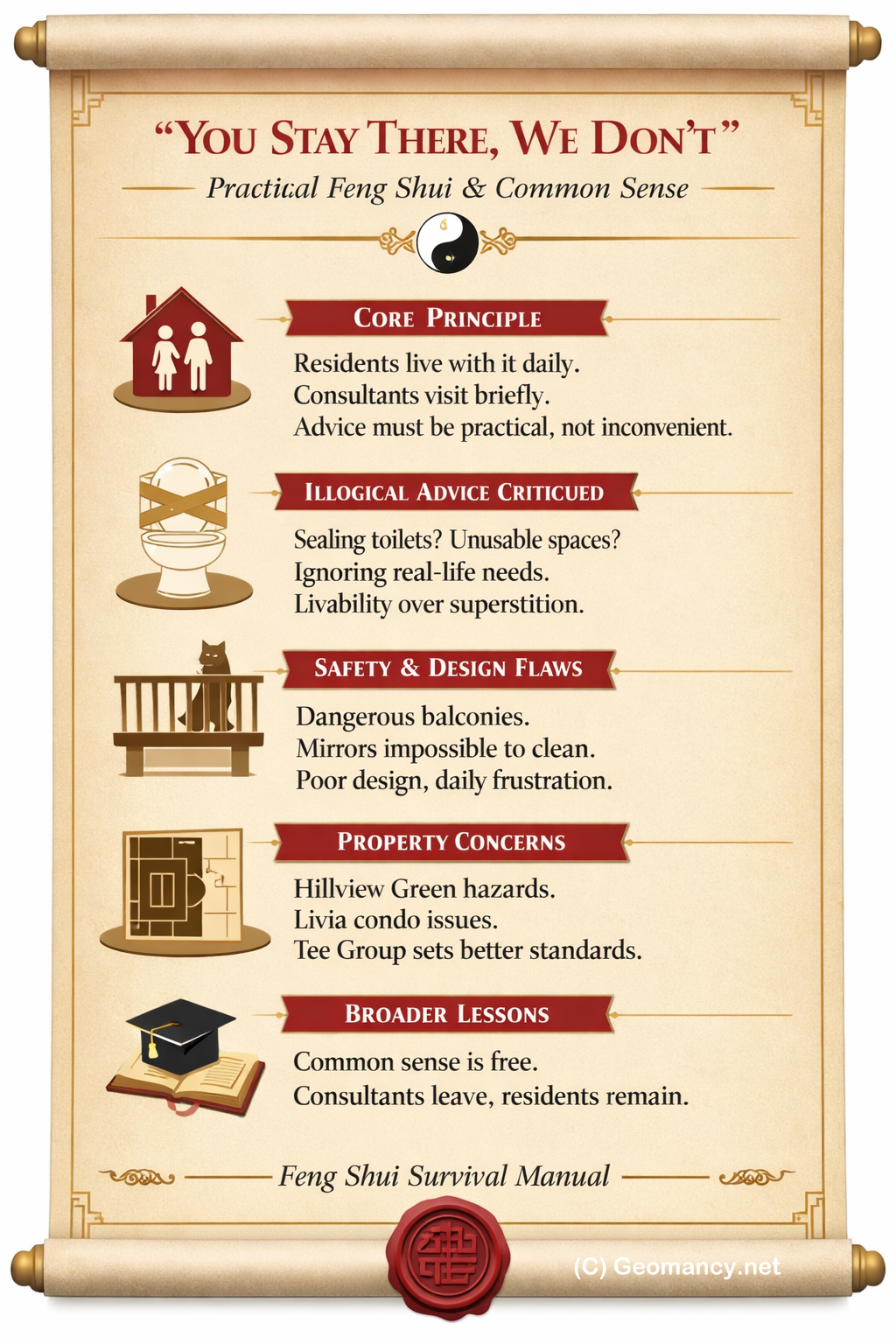
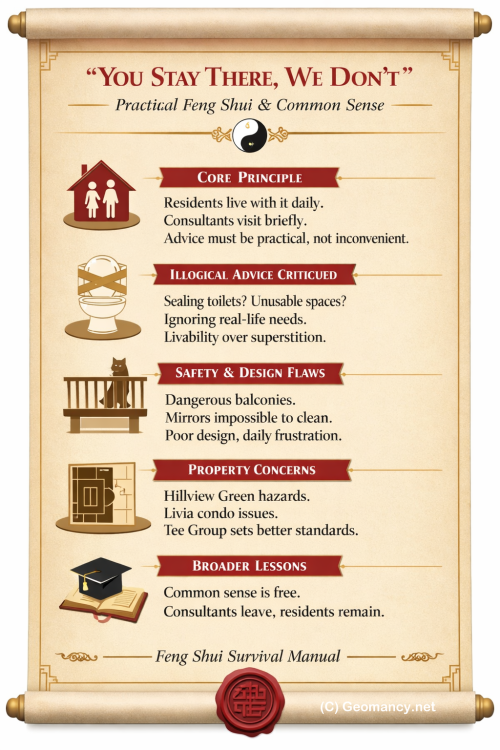
Core GuidelineThe central principle emphasized is: “You stay there, we (outsiders) don’t.” This means Feng Shui advice must be practical and livable for the residents, not just convenient for consultants. Critique of Illogical AdviceSome geomancers give impractical recommendations (e.g., sealing up or avoiding use of the master toilet). Such advice ignores the reality that residents must live with the consequences daily, while consultants only visit briefly. Common Sense in DesignSafety concerns are highlighted, such as dangerous balcony gaps in condominiums that could be fatal for children or pets. The author criticizes architects and developers for poor design choices that lack common sense. Property Development ConcernsSpecific criticism of City Developments Ltd projects: Hillview Green: balcony barriers seen as unsafe. Livia condo: interior walls made of plasterboard instead of solid concrete, raising durability and moisture concerns. Comparison with Tee Group, which provides clearer material specifications in brochures. Case Studies & ExamplesExample of impractical interior design: mirrors installed behind thick motif panels that are impossible to clean. Reinforcement of the principle: service providers must consider long-term consequences for clients. Broader LessonsA “degree in common sense” is free, yet often ignored in professional advice. The author refuses to recommend contractors/IDs due to inconsistency in service quality and accountability. The recurring moral: clients live with the outcomes, so advice must prioritize their daily reality.
-
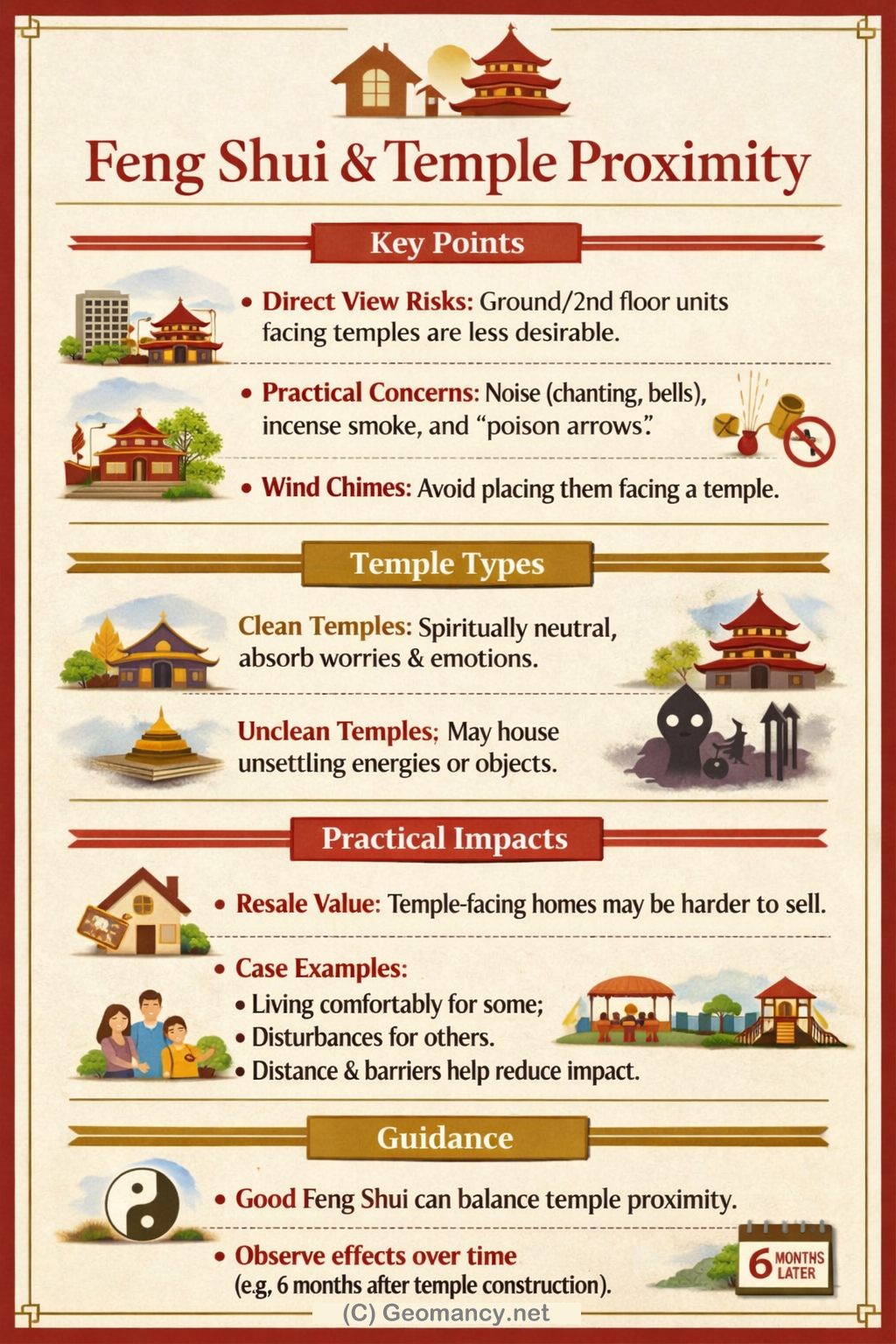
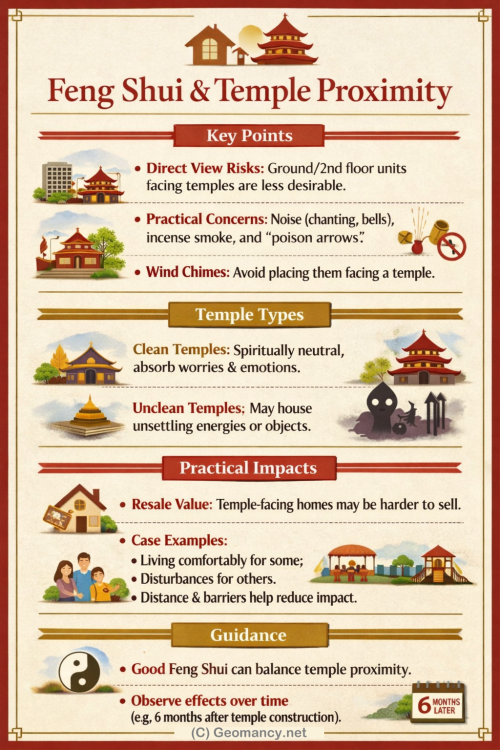
Main Takeaways Common in Singapore: Homes and apartments are often located near temples; it’s not unusual to have a view of one. Direct view cautions: Units that face a temple directly (especially ground or second floor) are generally less desirable in Feng Shui. Practical advice: Avoid hanging wind chimes facing a temple. Noise (chanting, bells) and smoke from incense can be disruptive. Architectural features like sharp corners or roofs may create “poison arrows.” Temple types: “Clean” temples are considered spiritually neutral. “Unclean” temples may house unsettling energies or objects. Absorbing energy: Even clean temples are seen as places that absorb people’s worries and emotions. Resale considerations: Living near a temple may affect future property value or ease of selling, since some buyers are cautious. Case examples: Some residents live comfortably near temples without issues. Others report disturbances (noise, blocked access during events). Distance, orientation, and separation (roads, playgrounds, courts) can reduce impact. Guidance: If your home has good Feng Shui overall, proximity to a temple doesn’t automatically make it inauspicious. Observation over time (e.g., six months after a temple is built) is recommended.
-
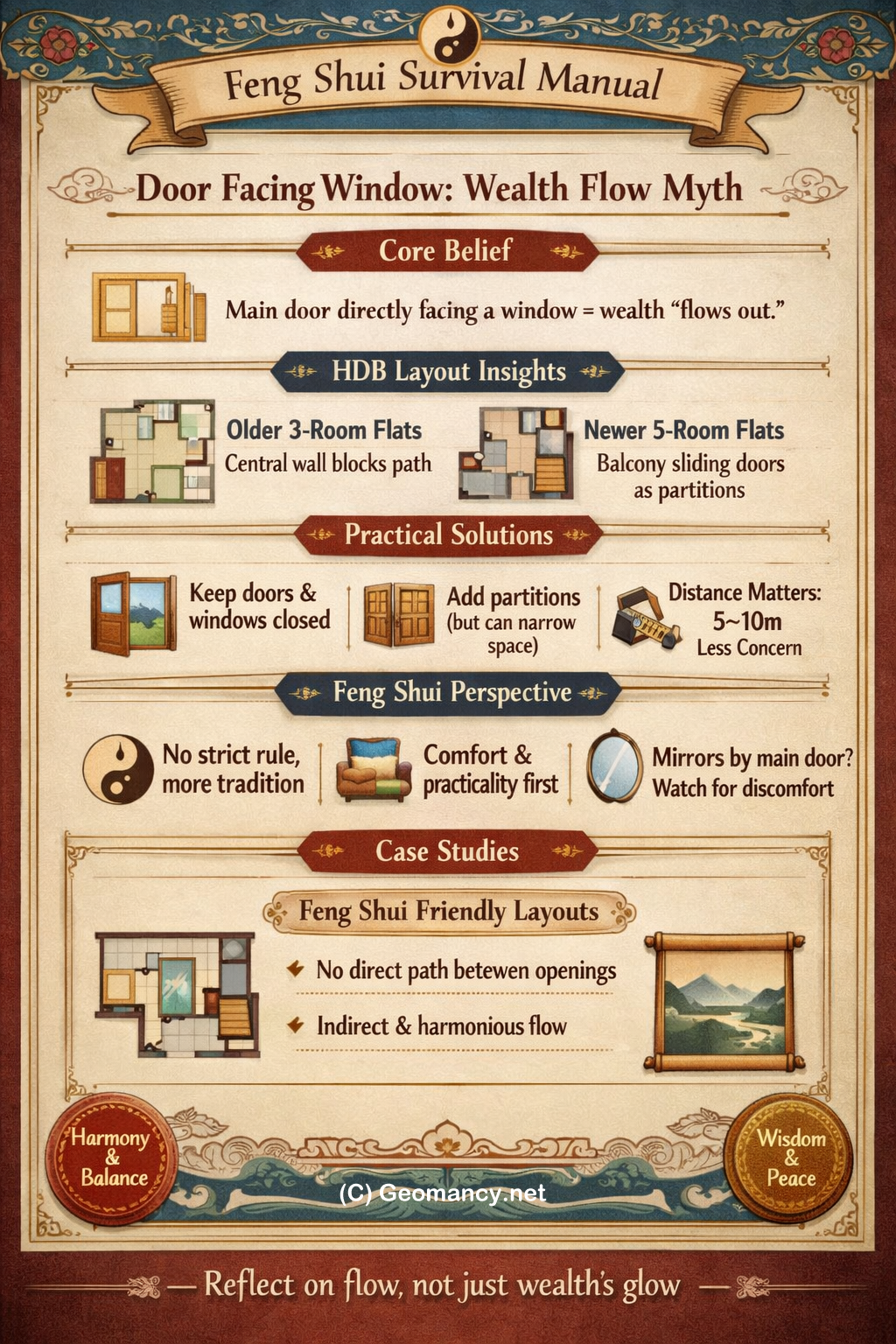
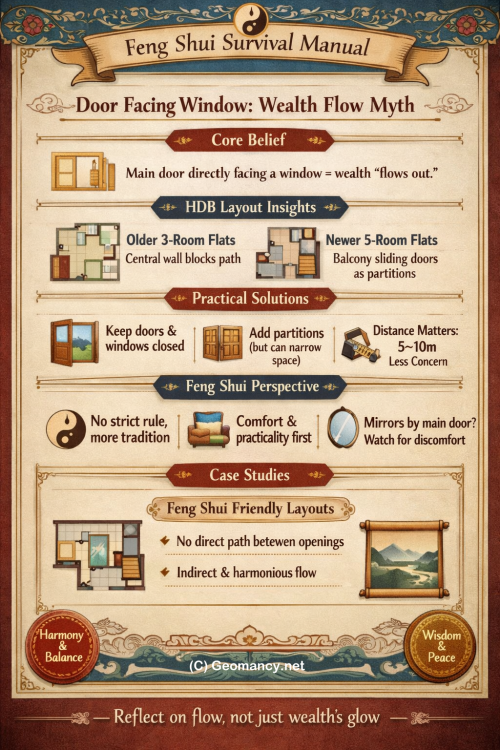
Here are the main points from this page: Common belief: Many people think that if the main door directly faces a window, wealth may “flow out.” This idea is widespread even among those who don’t formally practice Feng Shui. Practical solutions: To avoid a direct path between door and window, people often install partitions, keep balcony sliding doors, or simply close windows. HDB layouts: Older 3-room flats often have a wall in the middle, preventing a straight path from door to back windows. Newer 5-room flats usually retain balcony sliding doors, which act as partitions. Removing them can create a direct line between door and window, so closing casement windows is advised. Distance matters: If the window is far (e.g., 5–10 meters away), it’s generally less of a concern. No strict rules: There isn’t a hard-and-fast Feng Shui law here. Comfort and practicality matter—consult family or friends to see if the layout feels right. Partitions: Adding a partition can help, but it may make passageways narrow. The usefulness depends on the specific layout. Other considerations: Mirrors near the main door can cause discomfort if they reflect someone suddenly upon entry. Case studies: Examples of “Feng Shui friendly” designs show layouts where there’s no direct path between openings, which is considered favorable. In short, the concern about wealth flowing out is more a traditional belief than a rigid Feng Shui rule. The key is avoiding a direct line between the main door and window, often solved with partitions, sliding doors, or simply keeping windows closed.
-
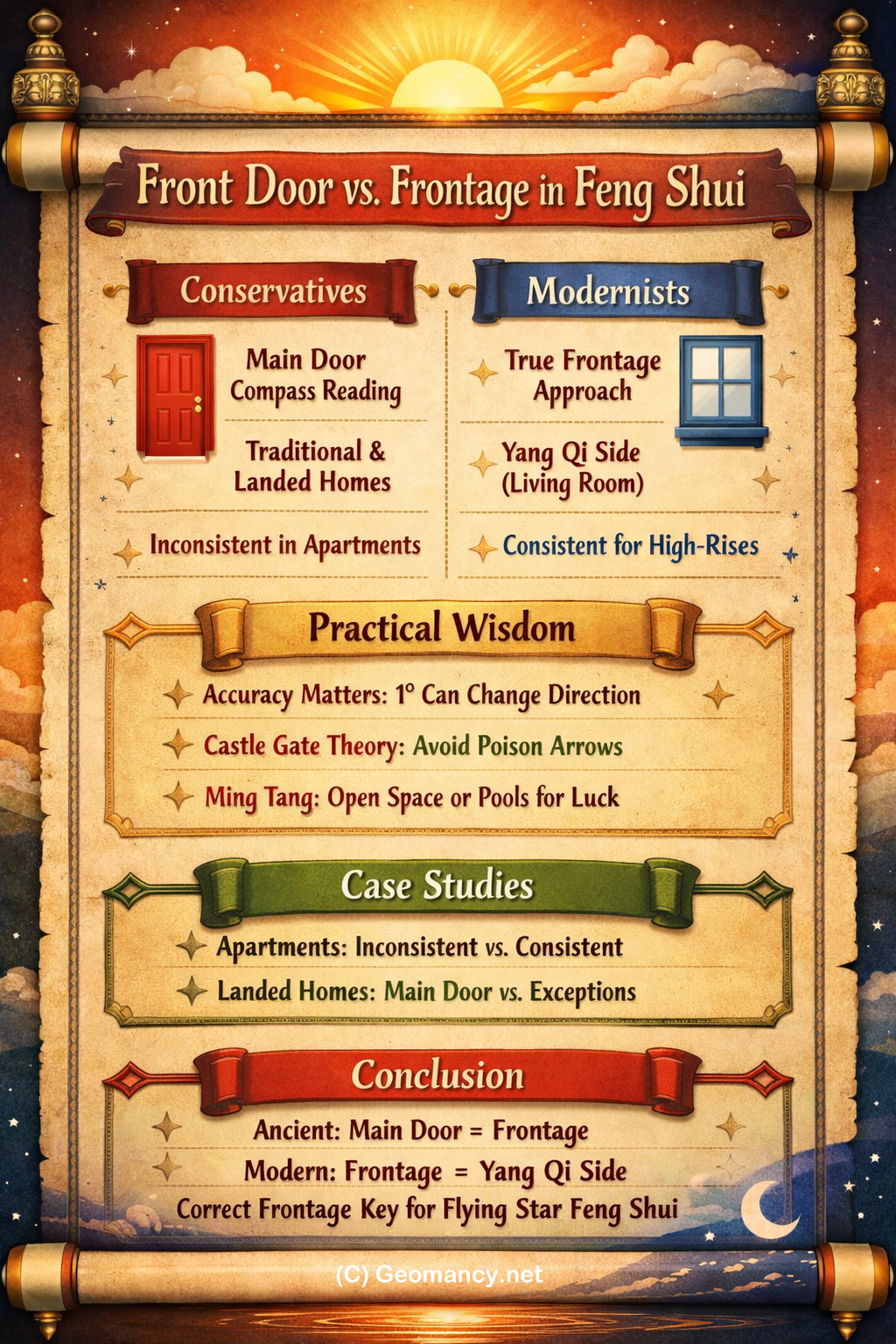
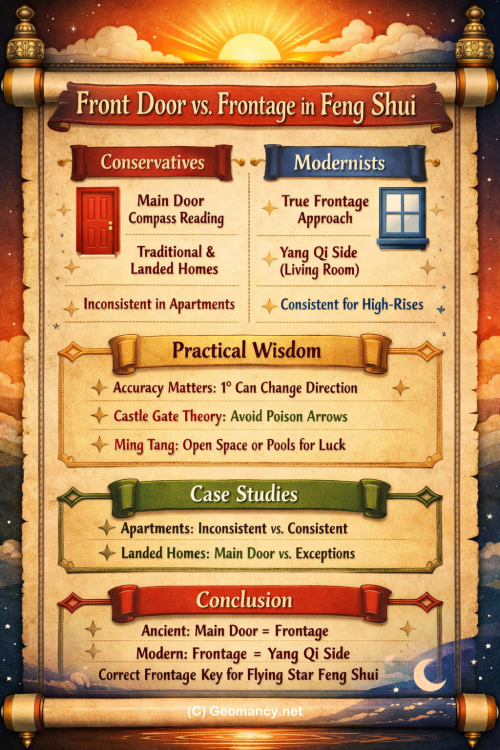
Here’s a clear summary of the main points from this page: Key ThemesTwo Schools of Thought Conservatives: Always take Feng Shui readings from the main door, standing inside and looking out. This method is rooted in tradition and widely used in Taiwan and Malaysia, especially for landed properties. Modernists: Distinguish between the main door and the true frontage. They argue that in high-rise apartments, the frontage is usually the living room side with windows and light, not the main door. Frontage vs. Main Door In ancient times, the main door and frontage were the same. In modern housing, especially high-rise units, the frontage is often the side with the most yang qi (light, airflow, openness). Compass readings should ideally be taken from the living room outward, not just from the main door. Practical Considerations Accuracy of Compass Readings: Small differences (like 1°) can change the classification of a house’s facing direction. Poison Arrows & Castle Gate Theory: Tilting doors may be recommended to avoid obstacles like lamp posts. Ming Tang (Bright Hall): Open space in front of the home is vital for good luck. Pools or clear space act as “virtual water,” enhancing energy flow. Case Studies Conservative methods can lead to inconsistent results in apartments, where identical units may be classified differently depending on door orientation. Modernist methods treat all units with the same living room orientation as having the same frontage. For landed properties, the main door often aligns with frontage, but exceptions exist (e.g., corner terraces, bungalows with multiple open sides). Conclusion The main entrance is not always the frontage in modern times. The true frontage is the side with the most yang qi, usually the living room windows or balcony. Flying Star Feng Shui depends on correctly identifying this frontage for accurate application
-
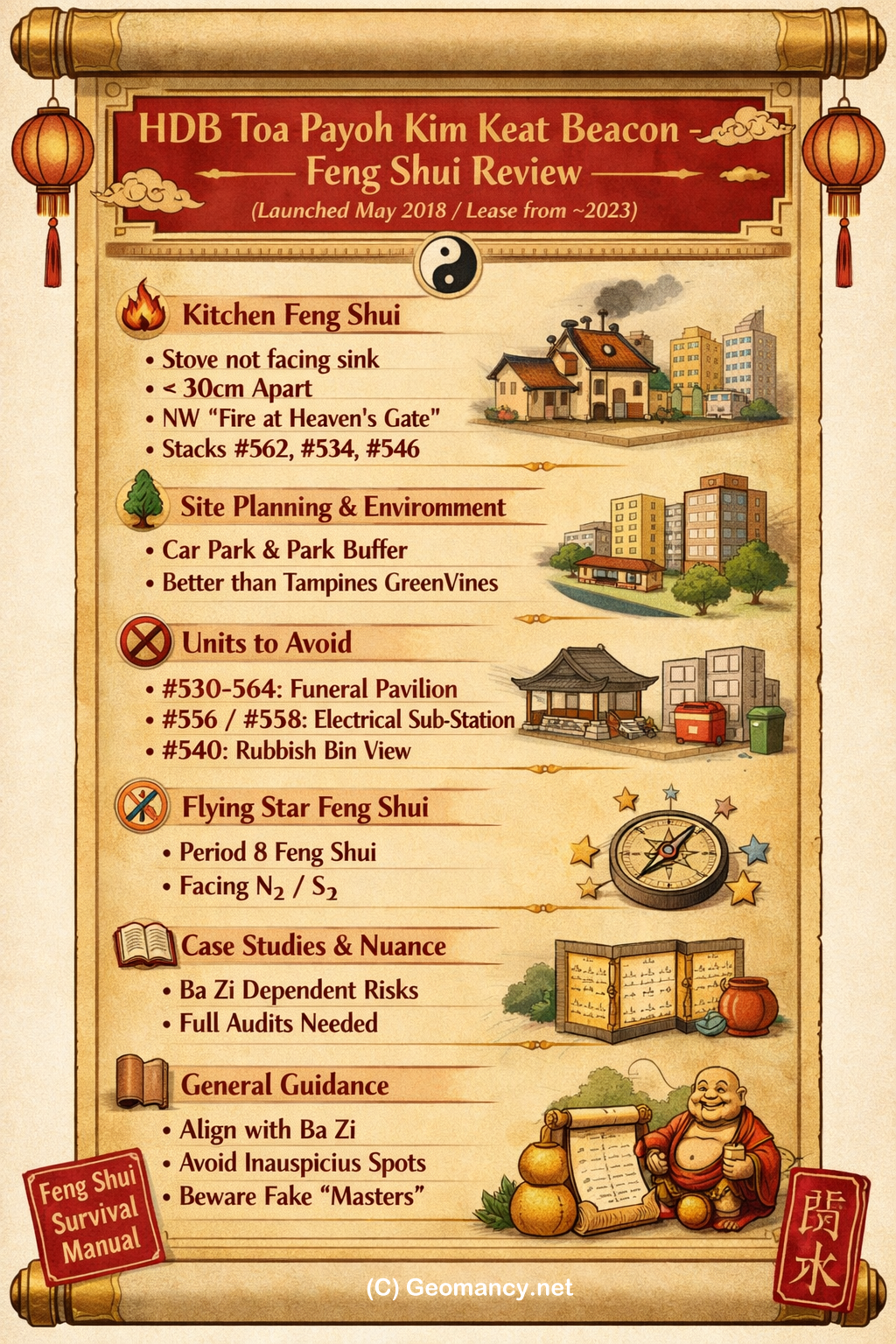
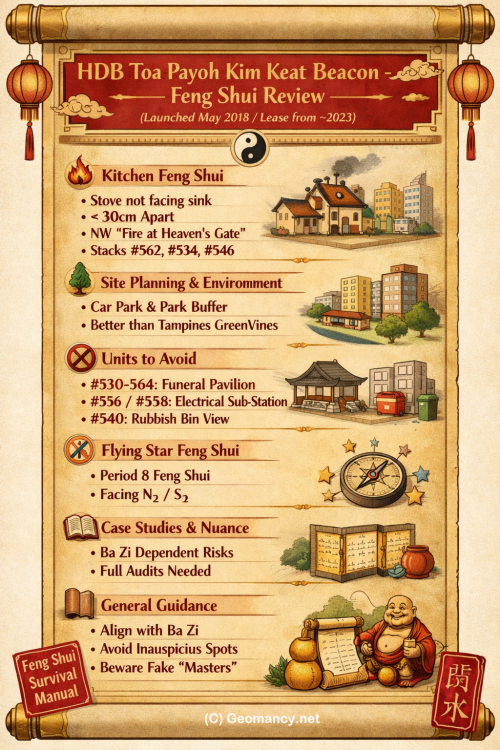
Here’s a concise summary of the main points from this page: 🔑 Key Takeaways – HDB Toa Payoh Kim Keat Beacon BTO (Launched May 2018)Sales & Timeline Brochure and floor plans were released in 2018. Lease commencement expected around 2023. Kitchen Layout & Feng Shui Avoid stove directly facing the sink. Side-by-side stove and sink is acceptable with at least 30cm separation. Kitchens located in the Northwest (NW) sector are considered inauspicious (“Fire at Heaven’s Gate”), potentially affecting the male breadwinner’s luck and career. Specific stacks flagged: #562, #534, #546. External Environment & Site Planning PIE slip road curves inward, but planners buffered with a 4-storey car park and park. Compared favorably to Tampines GreenVines, which had weaker planning. Units to Avoid Low-level stacks facing the Precinct Pavilion (#530, #532, #538, #540, #564) due to wakes/funerals held there. Units near the Electrical Sub-Station (ESS) (#556, #558 low floors) – considered taboo even if not scientifically proven. Stack #540 has direct view of rubbish bins. Flying Star Feng Shui Development falls under Period 8 Feng Shui. Most stacks face N2 or S2 orientations. Case Studies & Nuance Effects of NW kitchens vary depending on breadwinner’s Ba Zi chart and household conditions. Some families may not feel negative impact, while others could face career or financial setbacks. Solutions require full Feng Shui audits; outcomes are not one-size-fits-all. General Advice Evaluate suitability of unit for breadwinner and family. Consider auspicious sectors, Flying Star charts, and practical remedies. Be cautious of over-commercialized Feng Shui “masters” selling products. In essence, the review highlights both planning strengths (buffering against roads, thoughtful site layout) and Feng Shui cautions (NW kitchens, proximity to pavilions or ESS). The “Fire at Heaven’s Gate” issue is emphasized as a major consideration for buyers.
-
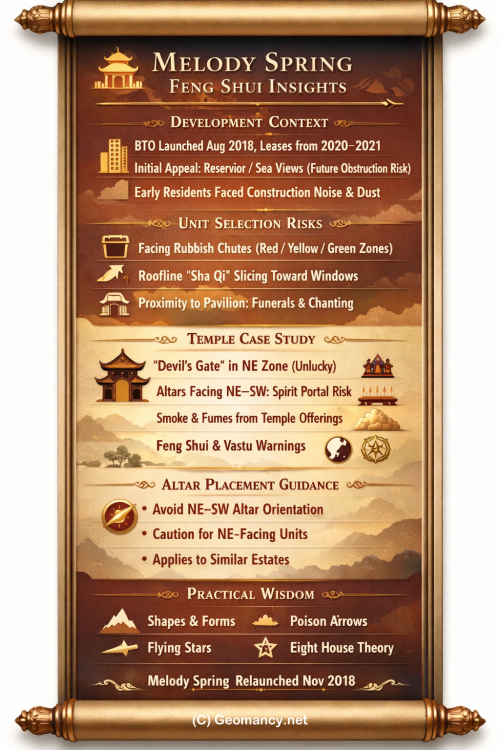
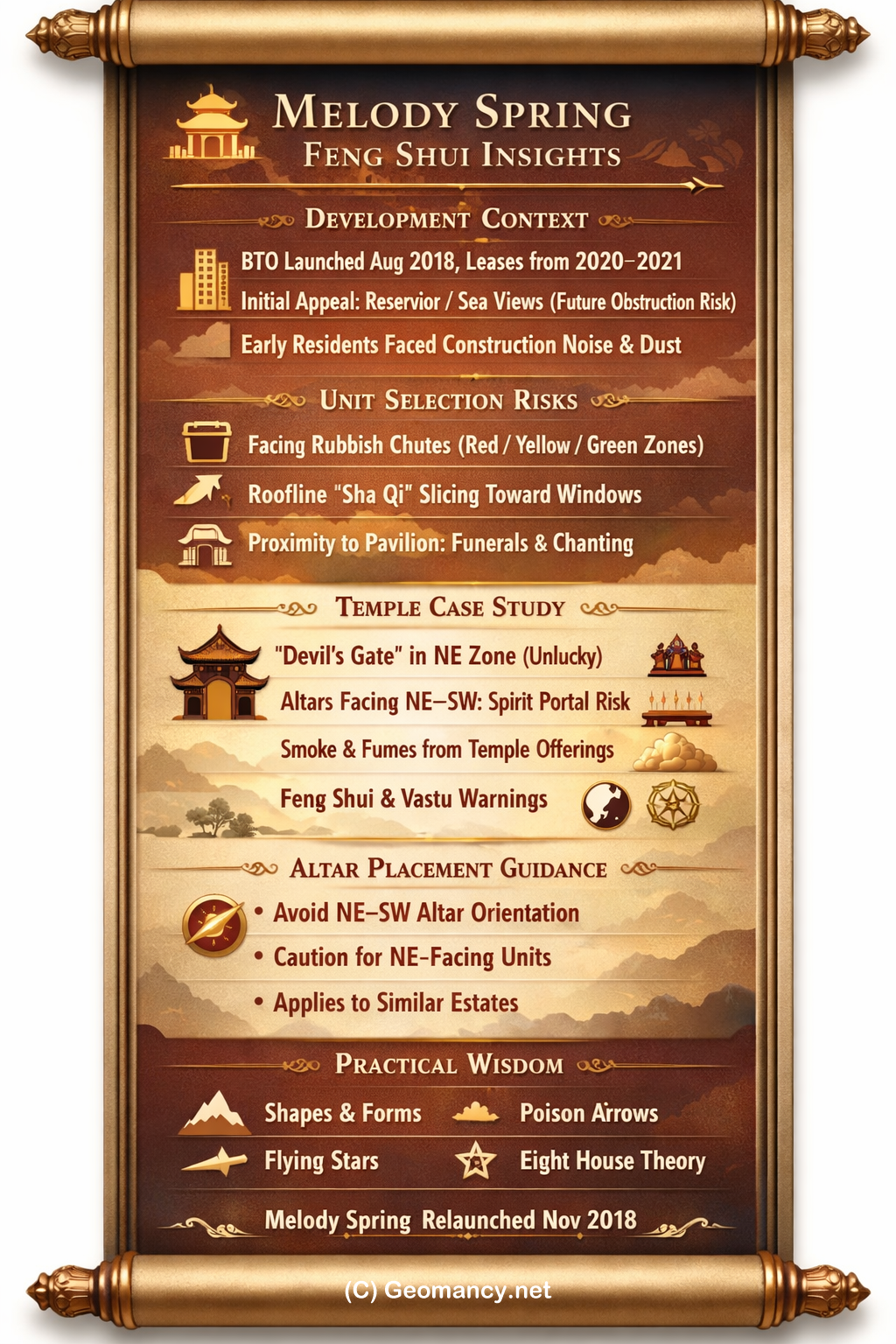
Here are the key points from this page on HDB Melody Spring Yishun BTO and Feng Shui case studies: Development Overview Melody Spring BTO launched in August 2018, with lease commencement dates in 2020–2021. Initial appeal included unblocked sea and reservoir views, but future high-rise projects may obstruct them. Some residents faced construction noise and dust soon after moving in. Unit Selection Concerns Certain units face rubbish bin chutes directly (red zone), or are in close proximity (yellow/green zones). These are considered undesirable. Units near drop-off point rooflines risk “Sha Qi” (poison arrows) if roof edges slice toward windows. Temple Case Study A future Chinese temple beside Melody Spring raises Feng Shui concerns. Units in the NE zone may be affected by the “Devil’s Gate” (considered unlucky). Placement of altars facing NE–SW could act as portals for spirits. Burning offerings at the temple may cause smoke/fume issues depending on wind direction. Both Chinese Feng Shui and Indian Vastu principles highlight risks of NE alignment. Precinct Pavilion (PP) Issues Units near or facing the PP may be exposed to wakes, funerals, or religious chanting, especially during festive periods. Altar Placement Guidance NE-facing units are particularly sensitive. Aligning altars NE–SW is discouraged due to susceptibility to negative influences. These principles apply not only to Melody Spring but also to other developments with similar orientations. General Advice Buying decisions should consider multiple Feng Shui disciplines: shapes and forms, poison arrows, Flying Stars, Eight House theory. Melody Spring was initially under-subscribed, requiring a second launch in November 2018. In short: the page highlights practical Feng Shui risks tied to rubbish chute placement, temple alignment, altar orientation, roofline angles, and proximity to precinct pavilions. It emphasizes careful unit selection to avoid long-term negative effects.