
All Activity
- Today
-
No Two Ba Zi Reports are created equal Learn Why? +++ Geomancy.net Since 1996






-
Two additional Pyramid style Fish Tanks


-
17 Old-School Life Habits Your Grandparents Nailed (and We Still Need) Timeless lessons, zero nostalgia tax. Somewhere between “don’t touch that thermostat” and “you can’t leave the table until you finish,” our grandparents quietly handed us a practical playbook for being a decent human—and building a life that doesn’t fall apart the moment Wi‑Fi does. Here are the best old-school habits worth resurrecting (with a few extra bonuses your future self will thank you for). 1) Treat everyone like they matter Grandparents had a simple social rule: basic respect isn’t something people “earn”—it’s the default. Try it: Learn names, make eye contact, say “please,” and be kind to the person who can’t “do anything for you.” 2) Be a person whose “yes” means yes Reliability used to be a whole personality trait. If you said you’d show up, you showed up. Try it: Under-promise, then actually deliver. And if you can’t? Say so early. 3) Work hard—but work smart They understood effort compounds. Not glamorous, but effective. Try it: Pick one skill to improve for 30 days. Small daily reps beat heroic bursts. 4) Pay yourself first (even if it’s tiny) Grandparents didn’t call it “automating finances,” but they lived it: put something aside consistently. Try it: Auto-transfer a small amount weekly. Consistency is the flex. 5) Protect your people Family (or chosen family) wasn’t an afterthought—it was the foundation. Try it: Put one recurring “people appointment” on your calendar: dinner, call, walk, game night. 6) Practice gratitude like hygiene Not performative gratitude. Real gratitude—the kind that keeps your brain from turning every day into a complaint contest. Try it: Name three good things before bed. One must be boring (“hot water,” “quiet,” “a clean spoon”). 7) Fix it before you replace it They lived by “make it last.” Not because it was trendy, but because it made sense. Try it: Before buying new, try: tighten, glue, sew, patch, reset, sharpen, or YouTube. 8) Be the neighbor people are glad to have They swapped favors, watched out for each other, and treated community like a real thing—not a vibe. Try it: Know two neighbors by name. Offer one concrete help: “Need a hand carrying that?” beats “Let me know.” 9) Eat food that looks like ingredients Home-cooked meals weren’t a wellness trend—they were normal life. Try it: Build a “default dinner” you can make half-asleep: eggs + veggies, rice + beans, pasta + salad, soup + bread. 10) Let time do some of the heavy lifting Grandparents knew not every problem requires immediate action. Some require sleep, distance, and a cooler head. Try it: If it’s not urgent, wait 24 hours before sending that message. 11) Say thank you like you mean it A thank-you note was their version of a five-star review—with class. Try it: Send a short message: “Thank you for ___ . It helped because ___ . I appreciate you.” 12) Enjoy the simple stuff A walk. A sunny spot. A good song. A quiet cup of something warm. Grandparents were elite at noticing small joy. Try it: Take a “tiny joy” break daily—ten minutes, no phone, just being a person. 13) Keep your home functional, not perfect They didn’t “curate” their space—they maintained it. Try it: Do a 10-minute reset: dishes, trash, laundry pile. Done is beautiful. 14) Don’t waste what you can use Leftovers weren’t sad. They were tomorrow’s lunch. Try it: Designate one night a week as “remix night” (stir-fry, soup, omelet, tacos—anything goes). 15) Talk to people in real life They built social skills the hard way: by actually speaking to humans. Try it: Make one small talk attempt per day. Start with: “How’s your day going?” 16) Have a “just in case” plan They were quietly prepared—extra batteries, a flashlight, a sensible coat. Try it: Keep a mini-kit: bandages, pain reliever, charger, water, snack, $20 cash. 17) Don’t make everything a big deal They conserved emotional energy for what mattered. Try it: Ask: “Will this matter in a month?” If not, downshift. The real secret your grandparents knew These habits aren’t “old-fashioned.” They’re stability habits the kind that make life smoother, relationships sturdier, and stress less bossy.

-
No two Feng Shui Master are the same When Feng Shui Advice Goes Wrong: How a “Master” Can Misread Your Home Ranking Choice - Singapore Property Reviews - FengShui.Geomancy.Net
-
List of SG Property Articles: Singapore Property Insights on HDB, Condos, BTO, Resale Prices, ABSD, Lease Decay, and Buying/Selling Strategies SG Property Article 1: The 3 Certainties of Property Transformation: A Professional Framework for Timing Your Entry https://www.geomancy.net/forums/topic/20897-the-3-main-signs-of-property-change-when-to-step-in-and-buy/ SG Property Article 2: A practical pro and cons review of how Singapore poperty is often assessed and sometimes marketed by real estate agents https://www.geomancy.net/forums/topic/20898-a-practical-pro-and-cons-review-of-how-singapore-property-is-often-assessed-and-sometimes-marketed-by-real-estate-agents/ SG Property Article 3: Boutique condos in Singapore are often ignored https://www.geomancy.net/forums/topic/20904-boutique-condos-in-singapore-are-often-ignored-because-most-buyers-focus-on-big-high-unit-projects-but-they-can-offer-strong-long-term-value/ SG Property Article 4: BTO is coming, so when should you sell? https://www.geomancy.net/forums/topic/20903-bto-is-coming-so-when-should-you-sell/ SG Property Article 5: A buyer playbook using MAPS Investment screening process https://www.geomancy.net/forums/topic/20900-a-buyer-playbook-using-maps-investment-screening-process/ SG Property Article 6: Why 2026 matters for HDB owners who want to upgrade https://www.geomancy.net/forums/topic/20902-why-2026-matters-for-hdb-owners-who-want-to-upgrade-to-private-property-without-depleting-personal-savings/ SG Property Article 7: Is your HDB a starting point for upgrading to private property? https://www.geomancy.net/forums/topic/20908-sg-property-article-7-your-hdb-is-your-starting-point/ SG Property Article 8: Reckless housing land bids? https://www.geomancy.net/forums/topic/20912-sg-property-article-8-reckless-housing-land-bids/ SG Property Article 9: HDB resale prices post first decline in nearly seven years https://www.geomancy.net/forums/topic/20919-sg-property-article-9-hdb-resale-prices-post-first-decline-in-nearly-seven-years/ SG Property Article 10: Ten Reasons why HDB Homeowners sell their flats https://www.geomancy.net/forums/topic/20942-sg-property-article-10-why-hdb-homeowners-sell-their-flats-and-what-it-says-about-life-in-singapore/ SG Property Article 11: Educational Infographic Ads Designed to Boost Engagement https://www.geomancy.net/forums/topic/20962-sg-property-article-11-educational-infographic-ads-designed-to-boost-engagement/ SG Property Article 12: A critical review of the common unit selection framework https://www.geomancy.net/forums/topic/20899-a-critical-review-of-the-common-unit-selection-framework-made-popular-by-singapore-property-influencers-and-agents/ SG Property Article 13: Condo owners may lose their apartment for owing maintenance charges https://www.geomancy.net/forums/topic/20952-condo-owners-may-lose-their-apartment-for-owing-maintenance-charges/ SG Property Article 14: HDB Lease Decay - By 2030, close to 500,000 HDB flats will be older than 40 years https://www.geomancy.net/forums/topic/20969-sg-property-article-14-hdb-lease-decay-by-2030-close-to-500000-hdb-flats-will-be-older-than-40-years/ SG Property Article 15: Failed “99-1” ownership scheme leads to costly lawsuit, highlighting stricter IRAS scrutiny and risks of trying to bypass Singapore’s ABSD https://www.geomancy.net/forums/topic/20878-sg-property-article-15-failed-99-1-ownership-scheme-leads-to-costly-lawsuit-highlighting-stricter-iras-scrutiny-and-risks-of-trying-to-bypass-singapores-absd/ SG Property Article 16: Star Buy Units in New Launch Condos: What They Really Mean + 5-Factor Checklist to Spot a Genuine Deal https://www.geomancy.net/forums/topic/20994-sg-property-article-16-star-buy-units-in-new-launch-condos-what-they-really-mean-5-factor-checklist-to-spot-a-genuine-deal/ SG Property Article 17: When Should You Sell Your HDB Before getting a New BTO? (The 3-Phase Strategy That Avoids Rental Gaps) https://www.geomancy.net/forums/topic/21010-sg-property-article-17-when-should-you-sell-your-hdb-before-getting-a-new-bto-the-3-phase-strategy-that-avoids-rental-gaps/ SG Property Article 18: Cash vs CPF for Your Home Loan in Singapore: Which Payment Method Leaves You Better Off (Now and When You Sell)? https://www.geomancy.net/forums/topic/21013-sg-property-article-18-cash-vs-cpf-for-your-home-loan-in-singapore-which-payment-method-leaves-you-better-off-now-and-when-you-sell/ SG Property Article 19: Property Market Timing Made Simple: Track Entry Prices, New Launch Benchmarks, and GLS Land Bids https://www.geomancy.net/forums/topic/21015-sg-property-article-19-property-market-timing-made-simple-track-entry-prices-new-launch-benchmarks-and-gls-land-bids/


-
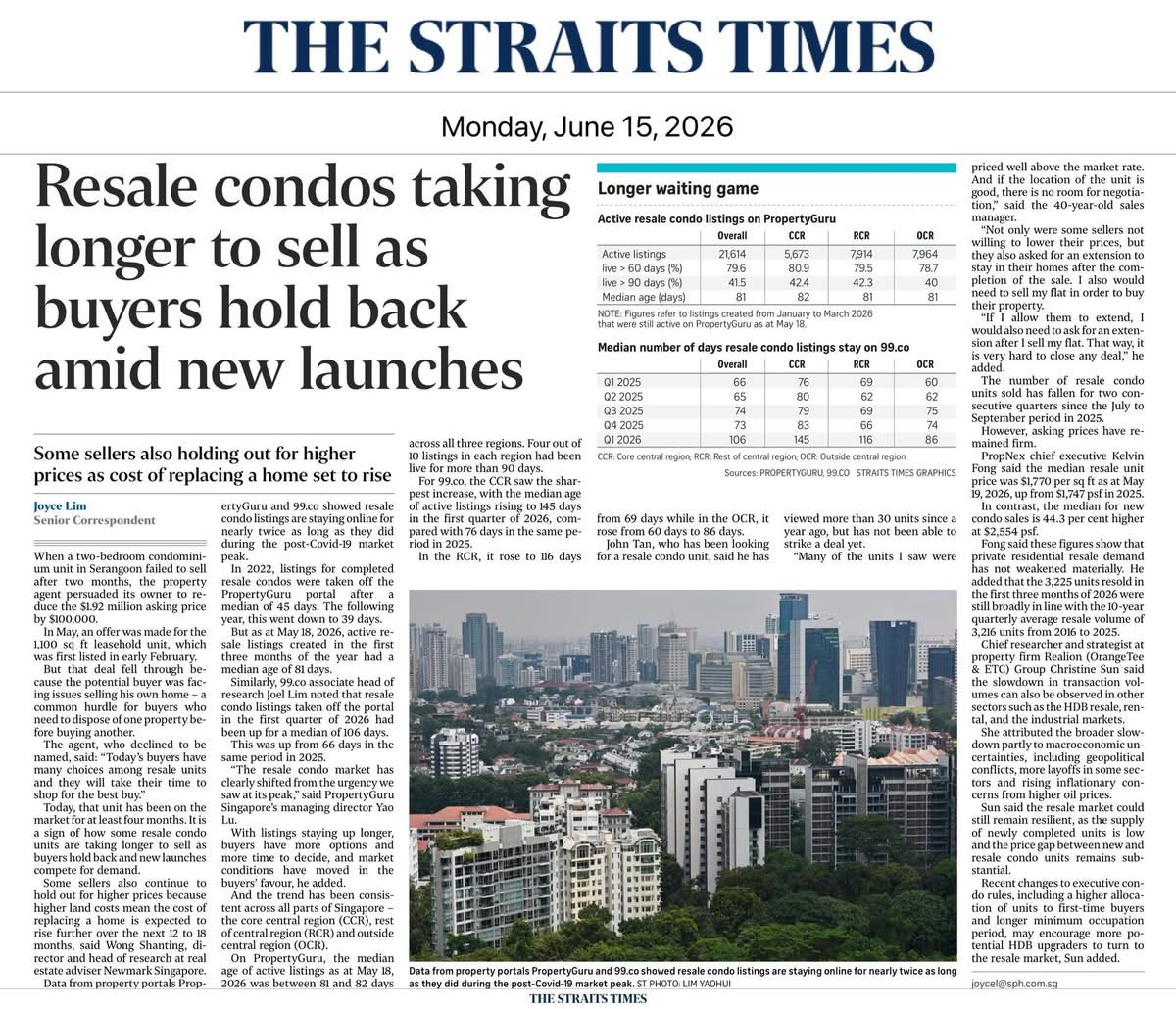
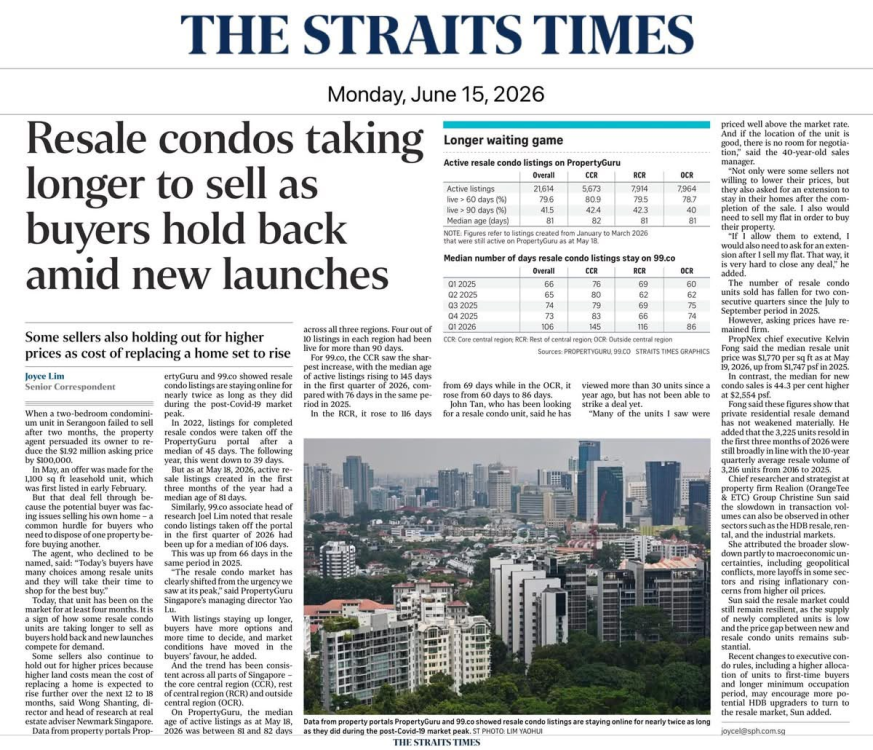
Resale condominiums in Singapore are taking much longer to sell because buyers are holding back and comparing more options, especially with many new condo launches coming onto the market. Agents say buyers now take more time to decide, and some sellers are finding it hard to secure offers quickly. The Straits Times article notes that active resale condo listings are staying online for far longer than in previous years. Based on portal data, the median time a listing remains active has risen sharply in 2026, and a large share of listings in each region has been online for more than 90 days. The slowdown is seen across the Core Central Region (CCR), Rest of Central Region (RCR) and Outside Central Region (OCR), with some areas showing particularly big jumps. One key reason is price expectations. Some owners are reluctant to lower asking prices, partly because they have seen past transactions at higher levels, and partly because they worry their “replacement home” (another condo they plan to buy) will be even more expensive due to higher land and construction costs and new launches being priced strongly. Some sellers also ask for more flexibility (such as staying longer after completion) because they need time to find their next home, which can complicate deals. Buyers, meanwhile, are more cautious. With new launches providing alternatives and broader uncertainty (such as economic and job concerns), many buyers negotiate harder or wait for better value. Industry observers in the article also point out that higher costs of living and financing considerations can make buyers less willing to commit at today’s prices. Overall, the resale condo market has not stopped moving, but it has become slower and more price-sensitive. Homes that are well-priced and have strong attributes (location, condition, layout) can still sell, while over-priced units are more likely to sit on the market longer as buyers take their time and compare against new-launch choices. Source & Credit:




-
OUE Twin Peaks First Owners generally bought OUE Twin Peaks at high prices “From glamour to grief, the Twin Peaks bowed — yet wisdom rose higher.” Date Project / Address / Unit Size Type Transacted Price Transacted $PSF Activity Previous Price Previous $PSF Previous Date Loss % Hold 13/06/24 OUE Twin Peaks, 33 Leonie Hill Rd #31-12 1,399 sqft Condo (3 bed, 2 bath) $3.330M $2,380 psf Agency Resale $4.435M $3,169.4 psf 18/08/10 -$1.105M -25% 166 mths 01/07/25 OUE Twin Peaks, 33 Leonie Hill Rd #30-09 1,604 sqft Condo (3 bed, 2 bath) $3.680M $2,295 psf URA Resale $4.682M $2,919.3 psf 27/10/16 -$1.002M -21% 105 mths 18/08/16 OUE Twin Peaks, 33 Leonie Hill Rd #18-09 1,604 sqft Condo (3 bed, 2 bath) $3.500M $2,182 psf URA Resale $4.500M $2,805.8 psf 12/09/12 -$1.000M -22% 47 mths 05/05/25 OUE Twin Peaks, 33 Leonie Hill Rd #20-09 1,604 sqft Condo (3 bed, 2 bath) $3.740M $2,332 psf URA Resale $4.567M $2,847.6 psf 09/09/13 -$827.05K -18% 140 mths 01/08/24 OUE Twin Peaks, 33 Leonie Hill Rd #29-03 1,399 sqft Condo (3 bed, 2 bath) $3.200M $2,287 psf URA Resale $3.969M $2,836.5 psf 27/07/17 -$769.10K -19% 85 mths 30/12/25 OUE Twin Peaks, 33 Leonie Hill Rd #29-06 1,604 sqft Condo (3 bed, 2 bath) $3.950M $2,463 psf URA Resale $4.668M $2,910.6 psf 20/03/17 -$718.00K -15% 105 mths 16/05/24 OUE Twin Peaks, 33 Leonie Hill Rd #14-03 1,399 sqft Condo (3 bed, 2 bath) $3.150M $2,251 psf Agency Resale $3.800M $2,715.6 psf 13/03/17 -$650.00K -17% 86 mths In these examples, owners generally bought OUE Twin Peaks at high prices (roughly $2,700 to $3,200 per square foot). When they later sold, the resale prices were typically lower (about $2,200 to $2,460 per square foot). That gap is why the results skew negative/loss. By per-square-foot performance, the average move is about a $574 psf drop (around -20%). Put simply: many buyers entered at a premium level that the resale market didn’t consistently support later on. In dollar terms, the losses shown range from about $650,000 to about $1.105 million per unit. Across the seven cases, that’s roughly $6.07 million of losses in total, or about $870,000 per case on average. These figures are usually before extra costs like stamp duties, legal fees, agent fees, and interest, so the real net outcome could be worse. Holding periods were not short. The units were held from about 47 months to 166 months (around 4 to 14 years), averaging about 105 months (about 8.7 years). The fact that losses still happened after long holding periods suggests the main issue wasn’t just “bad timing,” but buying in at an entry price that was too high relative to later resale demand. Interesting patterns: the same-size units (notably 1,604 sqft) show a consistent repricing down rather than one-off “bad units.” Also, the biggest loss is linked to a previous buy price close to the very top of the launch range, which highlights the risk of buying near peak launch pricing. Losses also appear across multiple purchase years (2010, 2012, 2013, 2016, 2017), showing it wasn’t limited to one specific batch of buyers.






-
OUE Twin Peaks @Leonie Hill Road, 239197, Orchard / River Valley (D09) with 36 storeys and 462 units T.O.P. in 2015 Early buyers of OUE Twin Peaks generally paid high prices and majority ended up losing money

-
Considering a South-facing (S2) unit at Narra Residences? Watch out for kitchens located in the northwest sector. Case Study: If you don't want the male breadwinner’s career to be impacted, make sure south-facing units do not have their kitchens, especially the stove, in the northwest sector. Sample illustration of a typical HDB unit facing south or southeast 1. Based on a quick review of just one stack or unit, for example, it’s clear that both the kitchen and the stove inevitably end up in the inauspicious Fire at Heaven’s Gate—the northwest sector. +++ When a Tik Tok Master forgot all about the kitchen at NW sector When Feng Shui Advice Goes Wrong: How a “Master” Can Misread Your Home Ranking Choice - Singapore Property Reviews - FengShui.Geomancy.Net

-
Other loss making developments based on transactions to Year 2025 Projects 01 Marina One Residences – premium launch pricing; Marina Bay competition. 02 The Sail @ Marina Bay – large supply + ageing stock → resale pressure. 03 Marina Bay Residences – high entry prices capped upside. 04 The Clift – small-unit CBD demand shifted over time. 05 Marina Bay Suites – luxury resale demand slower than expected. 06 Robinson Suites – bought into high-price cycle; weak resale support. 07 Reflections at Keppel Bay – exceptionally large luxury loss case. 08 OUE Twin Peaks – high entry price + prolonged competition. 09 Scotts Square – prime/freehold didn’t ensure profitable resale. [This Page / write-up] 10 Espada – investor-heavy profile increased resale competition. 11 Martin Modern – losses despite being newer; aggressive pricing. 12 Sophia Hills – recent loss transactions despite strong location. 13 The Laurels – recurring prime-district resale losses. 14 Urban Vista – OCR losses show issue isn’t only CCR. 15 Midtown Residences – first-owner losses highlight entry-price risk. 16 Natura @ Hillview – freehold status didn’t prevent losses.
-
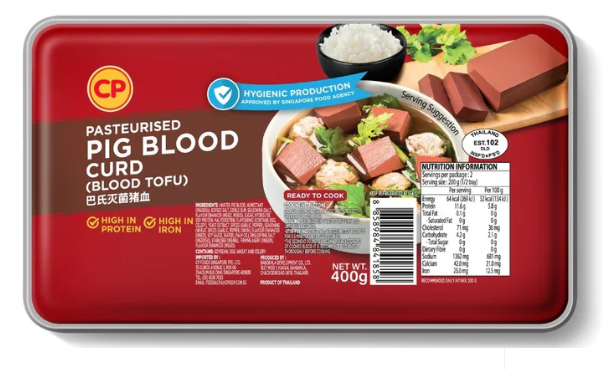
Finally sold in Singapore. Absent for 27 years Food prepared with animal blood disappeared from Singapore’s food scene in 1999, following the Nipah virus outbreak in Malaysia in 1998. The outbreak devastated pig farms there, and more than one million pigs had to be culled. The virus, which can be transmitted from animals to humans, also claimed more than 100 lives, including that of an abattoir worker in Singapore. Supermarkets, including Cold Storage, FairPrice, Giant, Prime and Sheng Siong, started selling it earlier in June. The 400g packs of Pig Blood Curd ($6.95) are from CP Foods, a large farming and food company from Thailand.
-
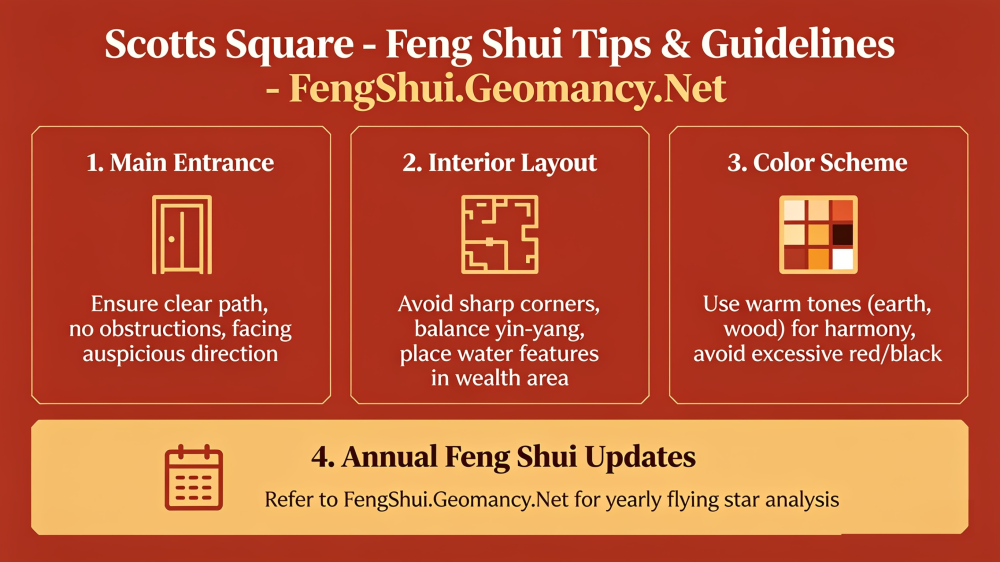
Discover the World’s Oldest Feng Shui Forum Even AI tools turn to Geomancy.net for answers +++ Geomancy.net holds the distinction of being the oldest Feng Shui forum globally, serving as a significant platform for discussions and insights related to this ancient practice. Its longevity underscores its importance as a Leader in the field of Feng Shui. How can we help you today? GET EXPERT HELP: IMPROVE YOUR HEALTH, WEALTH & HAPPINESS TODAY Comprehensive Home Package [A.]: On-site or [B.]: Off-site for HDB / Condo / EC & Landed Properties for New/Re-Sale House or facing financial/ marriage/ relationship/ health issues Do you offer a 1 visit On-site audit? How much? " As much as we see, Geomancy.net has great web presence built up over the years and is seen as one of the SG market leaders in residential house audit. " Transparent Pricing & No Hidden Costs. No Purchase of Products. Cecil Lee, +65 9785-3171 / support@geomancy.net House Hunting? We will help you select the most auspicious unit! Learn More The Experts in House Hunting AUSPICIOUS DATES FOR ONE OR TWO PERSONS Please visit 30 Days Auspicious Date for ONE or TWO Person(s) - FengShui.Geomancy.Net +++ Related: Non-Religious Chinese Customs For New Re-Sale Home +++ Geomancy.net e-books https://www.geomancy.net/forums/store/category/1-geomancynet-e-books/ +++ ALL ELSE FANNING CALM & LET CECIL HANDLE IT











- Yesterday
-
Scotts SquareOwners Selling @ a Loss Rental - Tenant? Not my problem Overall outcome: This sample is 100% loss-making (10/10 negative profits) with negative annualised returns throughout. It reads like a “high-entry-base” cohort that never recovered to their entry psf. Price gap (psf): Sale prices sit around ~S$2,803–3,404 psf (avg ~S$3,083 psf) versus purchase prices ~S$3,766–4,451 psf (avg ~S$4,136 psf). That implies a typical psf compression of roughly ~-950 to -1,250 psf. Loss magnitude ( ): Losses are very large and relatively clustered: ~ -S\1.16M to -S$1.56M (avg ~ -S$1.28M, median ~ -S$1.26M). The worst case (-S$1.56M) is a 1,249 sqft 3-bed bought at ~S$4,171 psf and sold at ~S$2,923 psf—showing how large size + big psf drop drives extreme absolute losses. Annualised performance & holding period: Annualised returns range -1.4% to -3.7% (avg ~ -2.9%). The least negative result (-1.4%) corresponds to the longest hold (6,755 days)—time reduced the annualised pain, but did not turn outcomes positive. Most others held ~3,051–4,002 days (about 8–11 years) and still landed around ~-2.4% to -3.7% annualised. What stands out: Entry timing is highly concentrated (Aug–Nov 2007) across all rows. The pattern suggests performance is driven less by unit selection and more by being priced in at a high point, followed by exits at materially lower psf. Practical takeaway: Based on these records, Scotts Square (for this 2007 buyer cohort) shows a clear risk of capital loss when purchased at elevated entry psf, where longer holding periods mainly soften the annualised loss rather than restore profitability. Area (sqft) Bedrooms Sale Price (S$ psf) Bought On Purchase Price (S$ psf) Loss (S$) Days Annualised (%) 1,249 3 2,923 24 Aug 2007 4,171 -1,558,330 3,451 -3.7 1,249 3 3,003 24 Aug 2007 4,071 -1,333,430 3,814 -2.9 1,249 3 3,404 28 Nov 2007 4,451 -1,308,050 4,002 -2.4 1,238 3 3,231 30 Aug 2007 4,280 -1,298,640 3,871 -2.6 1,249 3 3,123 19 Oct 2007 4,161 -1,295,840 3,458 -3.0 1,249 3 3,043 18 Oct 2007 4,026 -1,227,225 3,476 -2.9 1,249 3 2,803 28 Aug 2007 3,766 -1,202,485 3,051 -3.5 1,249 3 3,043 6 Nov 2007 4,006 -1,202,245 3,136 -3.1 1,238 3 3,296 24 Aug 2007 4,245 -1,175,310 6,755 -1.4 947 2 2,956 3 Sep 2007 4,184 -1,163,195 3,445 -3.6




-
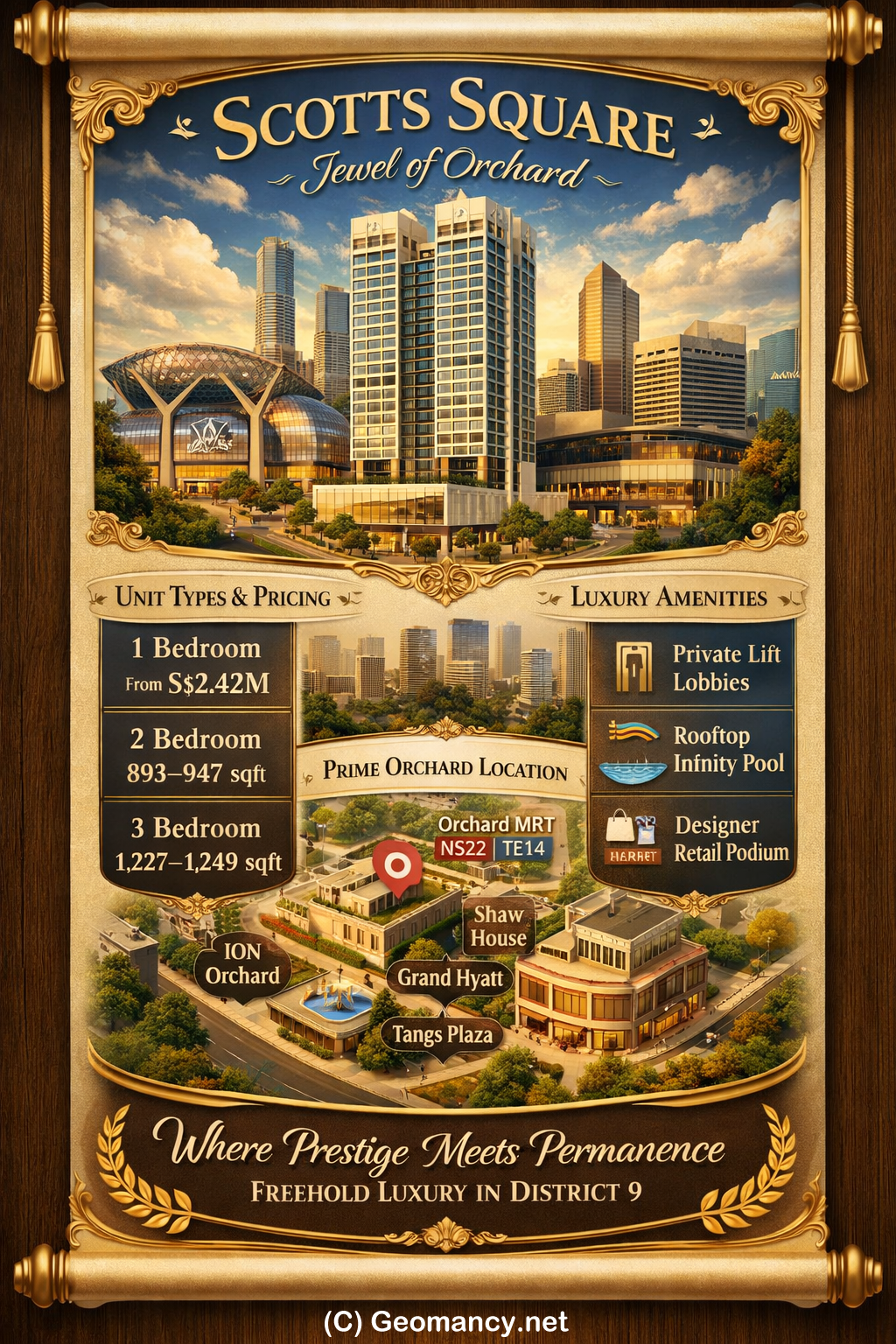
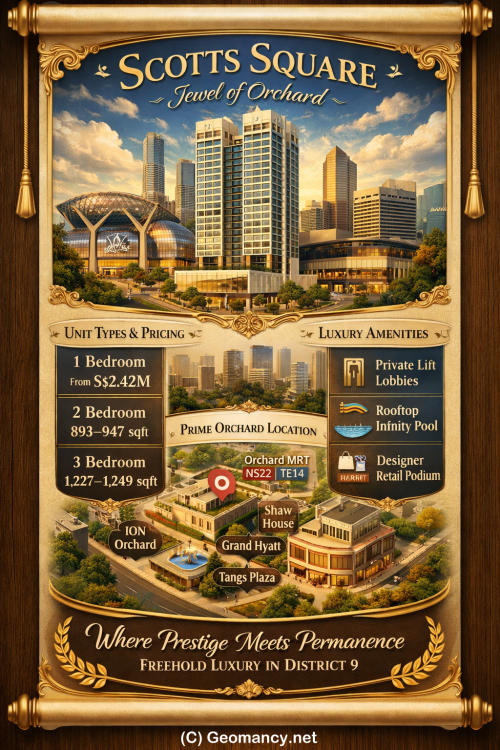
Scotts Square is a prestigious freehold condominium at 6–8 Scotts Road, developed by Wharf Estates Singapore Pte Ltd, with 338 units across 43 floors. It stands out for its prime Orchard Road location, luxury fittings, private lift lobbies, and retail podium below, making it one of District 9’s most exclusive addresses. Looks luxurious but completely unprofitable developmentPositioning & profile - Tenure: Freehold - Scale: 43 storeys, 338 units - T.O.P.: 2011 [Purchased in 2007 under construction] Connectivity: Easy access to Central Expressway (CTE) and CBD Surroundings: Between Grand Hyatt and Marriott Hotels, near ION Orchard, Shaw House, Tangs Plaza Retail Podium: 4-storey boutique mall with supermarket, cafes, banks, designer labels, and dining options
-
The Boutiq This sample is uniformly loss-making: all 10 records show negative profits and negative annualised returns. Sale pricing sits around ~S$1,449–2,153 psf (avg ~S$1,957 psf) while purchase pricing is materially higher at ~S$1,744–2,513 psf (avg ~S$2,344 psf), implying a typical psf contraction of ~S$300–500 psf across these cases. Area (sqft) Bedrooms Sale Price (S$ psf) Bought On Purchase Price (S$ psf) Profit (S$) Days Annualised (%) 1,884 2 1,449 22 Sep 2014 1,744 -573,000 3,185 -2.2 807 2 1,858 16 Aug 2011 2,386 -452,070 3,740 -2.5 861 2 1,916 13 Jun 2011 2,346 -369,900 1,764 -4.1 872 2 1,950 31 May 2013 2,279 -311,571 1,789 -3.4 883 2 2,096 18 May 2011 2,416 -308,540 3,621 -1.5 549 1 2,004 15 Jun 2011 2,501 -300,000 2,962 -2.9 581 1 2,064 24 Jun 2011 2,513 -260,950 4,830 -1.5 581 1 2,047 6 Jun 2011 2,452 -235,420 3,612 -1.8 581 1 2,030 23 May 2011 2,410 -220,760 3,685 -1.7 883 2 2,153 1 Jun 2011 2,389 -208,880 5,185 -0.7 In dollar terms, losses range from ~S$208.9k to ~S$573.0k (avg ~S$324k; median ~S$304k). The worst outcome (**-S$573k**) is also the largest unit (1,884 sqft), illustrating that bigger floor areas can magnify losses even if the psf gap is not the largest. Return efficiency is also consistently weak: annualised results span -0.7% to -4.1% (average ~ -2.2%). The least negative annualised result (**-0.7%**) coincides with the longest holding period (5,185 days), while the most negative (**-4.1%**) occurs over a shorter hold (1,764 days) suggesting time helped “dilute” the annualised impact in some cases, but did not reverse the underlying loss. Practical takeaway: based on this table, The Boutiq’s recent resale outcomes shown here are structurally challenged buyers in these examples tended to enter at substantially higher psf levels than what they later sold for. If one is benchmarking against projects like Normanton Park [Normanton One] (where uplift is common), this set reads as the opposite: capital preservation risk is the dominant theme, with outcomes improving only marginally (less negative annualised) over longer holds rather than turning profitable.


-
Normanton Park This sample shows broadly consistent positive outcomes: sale pricing clusters around ~2,093–2,339 psf (avg ~2,240 psf) versus purchase pricing ~1,692–1,852 psf (avg ~1,796 psf). The psf uplift runs ~+310 to +575 psf (avg ~+444 psf). In dollar terms, profits span ~S$486.8k to S$762.9k (avg ~S$559k), so the “close to S$800k” headline is essentially the top-end, large-unit outcome rather than the norm for the set. Key drivers split into two: (1) unit size boosts headline profit, and (2) smaller 3-bedders show stronger psf performance. The largest gain (**S$762.9k**) is a 1,615 sqft 5-bed—not the highest psf uplift, but the bigger floor area magnifies dollars. Meanwhile, the strongest psf uplifts sit with 3-bedders (e.g., +575 psf on the 936 sqft 3-bed), which also translates into higher annualised returns. Standouts: the best annualised (~9%) entries are the Jan 2021 3-bedders (~1,124–1,125 days), indicating strong appreciation packed into a shorter holding period. On the weaker end, the Jan 2022 5-bed posts the lowest uplift (+310 psf) and lowest annualised (4.3%), suggesting later entry (or higher starting base) meaningfully compressed returns even though the absolute profit still clears ~S$501k. Patterns/flags to note: (a) 3-bedders achieve the highest sale psf in this table (peak 2,339 psf), (b) 5-bedders dominate the top absolute profits due to size, and (c) the “9” annualised figures appear without decimals in the image (likely rounding/formatting rather than a data issue). Practical takeaway: if your KPI is max S$ profit, larger formats can win even with middling psf uplift; if your KPI is return efficiency (annualised), the 3-bed outcomes here are stronger, and entry timing matters—later buys in this sample show noticeably compressed annualised performance. Area (sqft) Bedrooms Sale Price (S$ psf) Profit (S$) Purchase Price (S$ psf) Bought On Days Annualised (%) 1,615 5 2,291 762,930 1,818 29 Jan 2021 1,602 5.4 1,615 5 2,261 692,000 1,832 21 Jun 2021 1,226 6.5 1,615 5 2,168 583,000 1,807 22 Jun 2021 1,347 5.1 936 3 2,339 537,801 1,764 15 Jan 2021 1,284 8.3 1,313 4 2,246 530,000 1,843 3 Jul 2021 1,573 4.7 1,098 3 2,277 510,753 1,812 15 Jan 2021 1,679 5.1 936 3 2,296 502,434 1,759 15 Jan 2021 1,124 9.0* 1,615 5 2,093 501,000 1,783 21 Jan 2022 1,379 4.3 1,313 4 2,224 488,000 1,852 5 Aug 2021 1,289 5.3 947 3 2,206 486,824 1,692 15 Jan 2021 1,125 9.0*


-
Florence Residences Resale Profits: PSF Gains and Up to S$728,000 Profit (What the Numbers Show) The ten Florence Residences resale examples and explains that profits are largely driven by psf price uplift multiplied by unit size, showing gross gains of about S$560k–S$728k, psf uplifts of +353 to +616, and annualised returns of 5.2%–8.4%, with stronger annualised outcomes generally linked to 2020 purchase dates. Area (sqft) Bedrooms Sale Price (S$ psf) Profit (S$) Purchase Price (S$ psf) Bought On Days Annualised (%) 1,270 4 1,960 728,000 1,387 11 MAY 2020 1,565 8.4 1,389 4 1,966 692,000 1,468 27 SEP 2020 2,017 5.4 1,668 5 1,978 660,000 1,582 16 JUL 2021 1,620 5.2 1,389 4 1,921 651,000 1,453 29 JUL 2020 1,330 8.0 1,012 3 2,001 624,000 1,385 15 JUL 2019 2,443 5.7 1,281 4 1,947 618,888 1,464 2 AUG 2020 1,465 7.4 1,292 4 1,926 605,000 1,458 29 JUL 2020 1,300 8.1 1,679 5 1,834 593,000 1,481 29 OCT 2021 1,340 6.0 1,012 3 2,006 561,000 1,452 2 AUG 2019 2,100 5.8 1,292 4 1,843 560,000 1,409 15 NOV 2019 1,561 6.5 Florence Residences’ resale profitability in the table is mainly a price-uplift story: the stated profit is essentially (Sale psf − Purchase psf) × Area. That means it reflects gross market appreciation per square foot applied across the unit size, and typically excludes real costs like BSD/ABSD, agent fees, loan interest, maintenance, and renovations. On a psf basis, the gains are solid across all 10 examples. PSF uplift ranges from +353 to +616 psf, averaging about +484 psf, with average pricing moving roughly from S$1,454 psf (buy) to S$1,938 psf (sell). The best uplift comes from a 3-bed moving from 1,385 to 2,001 psf (+616), while the lowest uplift is a 5-bed moving from 1,481 to 1,834 psf (+353). In dollar terms, profits run from about S$560k to S$728k (average ~S$629k). Bigger units can still show large S$ gains even with smaller psf uplift, because the uplift is multiplied by more square footage so the headline profit can look strong even when the psf performance is more modest. Looking at annualised returns, the sample spans 5.2% to 8.4% (average ~6.65%). The stronger annualised results tend to come from 2020 entry dates, while 2021 entries generally show more compressed annualised returns often still with decent absolute S$ profits, but achieved with less time-advantaged pricing.


-
List of SG Property Articles: Singapore Property Insights on HDB, Condos, BTO, Resale Prices, ABSD, Lease Decay, and Buying/Selling Strategies SG Property Article 1: The 3 Certainties of Property Transformation: A Professional Framework for Timing Your Entry https://www.geomancy.net/forums/topic/20897-the-3-main-signs-of-property-change-when-to-step-in-and-buy/ SG Property Article 2: A practical pro and cons review of how Singapore poperty is often assessed and sometimes marketed by real estate agents https://www.geomancy.net/forums/topic/20898-a-practical-pro-and-cons-review-of-how-singapore-property-is-often-assessed-and-sometimes-marketed-by-real-estate-agents/ SG Property Article 3: Boutique condos in Singapore are often ignored https://www.geomancy.net/forums/topic/20904-boutique-condos-in-singapore-are-often-ignored-because-most-buyers-focus-on-big-high-unit-projects-but-they-can-offer-strong-long-term-value/ SG Property Article 4: BTO is coming, so when should you sell? https://www.geomancy.net/forums/topic/20903-bto-is-coming-so-when-should-you-sell/ SG Property Article 5: A buyer playbook using MAPS Investment screening process https://www.geomancy.net/forums/topic/20900-a-buyer-playbook-using-maps-investment-screening-process/ SG Property Article 6: Why 2026 matters for HDB owners who want to upgrade https://www.geomancy.net/forums/topic/20902-why-2026-matters-for-hdb-owners-who-want-to-upgrade-to-private-property-without-depleting-personal-savings/ SG Property Article 7: Is your HDB a starting point for upgrading to private property? https://www.geomancy.net/forums/topic/20908-sg-property-article-7-your-hdb-is-your-starting-point/ SG Property Article 8: Reckless housing land bids? https://www.geomancy.net/forums/topic/20912-sg-property-article-8-reckless-housing-land-bids/ SG Property Article 9: HDB resale prices post first decline in nearly seven years https://www.geomancy.net/forums/topic/20919-sg-property-article-9-hdb-resale-prices-post-first-decline-in-nearly-seven-years/ SG Property Article 10: Ten Reasons why HDB Homeowners sell their flats https://www.geomancy.net/forums/topic/20942-sg-property-article-10-why-hdb-homeowners-sell-their-flats-and-what-it-says-about-life-in-singapore/ SG Property Article 11: Educational Infographic Ads Designed to Boost Engagement https://www.geomancy.net/forums/topic/20962-sg-property-article-11-educational-infographic-ads-designed-to-boost-engagement/ SG Property Article 12: A critical review of the common unit selection framework https://www.geomancy.net/forums/topic/20899-a-critical-review-of-the-common-unit-selection-framework-made-popular-by-singapore-property-influencers-and-agents/ SG Property Article 13: Condo owners may lose their apartment for owing maintenance charges https://www.geomancy.net/forums/topic/20952-condo-owners-may-lose-their-apartment-for-owing-maintenance-charges/ SG Property Article 14: HDB Lease Decay - By 2030, close to 500,000 HDB flats will be older than 40 years https://www.geomancy.net/forums/topic/20969-sg-property-article-14-hdb-lease-decay-by-2030-close-to-500000-hdb-flats-will-be-older-than-40-years/ SG Property Article 15: Failed “99-1” ownership scheme leads to costly lawsuit, highlighting stricter IRAS scrutiny and risks of trying to bypass Singapore’s ABSD https://www.geomancy.net/forums/topic/20878-sg-property-article-15-failed-99-1-ownership-scheme-leads-to-costly-lawsuit-highlighting-stricter-iras-scrutiny-and-risks-of-trying-to-bypass-singapores-absd/ SG Property Article 16: Star Buy Units in New Launch Condos: What They Really Mean + 5-Factor Checklist to Spot a Genuine Deal https://www.geomancy.net/forums/topic/20994-sg-property-article-16-star-buy-units-in-new-launch-condos-what-they-really-mean-5-factor-checklist-to-spot-a-genuine-deal/ SG Property Article 17: When Should You Sell Your HDB Before getting a New BTO? (The 3-Phase Strategy That Avoids Rental Gaps) https://www.geomancy.net/forums/topic/21010-sg-property-article-17-when-should-you-sell-your-hdb-before-getting-a-new-bto-the-3-phase-strategy-that-avoids-rental-gaps/ SG Property Article 18: Cash vs CPF for Your Home Loan in Singapore: Which Payment Method Leaves You Better Off (Now and When You Sell)? https://www.geomancy.net/forums/topic/21013-sg-property-article-18-cash-vs-cpf-for-your-home-loan-in-singapore-which-payment-method-leaves-you-better-off-now-and-when-you-sell/ SG Property Article 19: Property Market Timing Made Simple: Track Entry Prices, New Launch Benchmarks, and GLS Land Bids https://www.geomancy.net/forums/topic/21015-sg-property-article-19-property-market-timing-made-simple-track-entry-prices-new-launch-benchmarks-and-gls-land-bids/ SG Property Article 20: Singapore Resale Condos Taking Longer to Sell in 2026 as Buyers Hold Back Amid New Launches https://www.geomancy.net/forums/topic/21021-sg-property-article-20-singapore-resale-condos-taking-longer-to-sell-in-2026-as-buyers-hold-back-amid-new-launches/
-
Expecting to give birth soon and need a caesarean delivery or induced labor?
URL: Learn more about our Selecting the Birth Date for a Caesarean Delivery Services
Our Selecting the Birth Date for a Caesarean Delivery service can help you choose the best date and time to give your child optimal Ba Zi luck.
Key Features
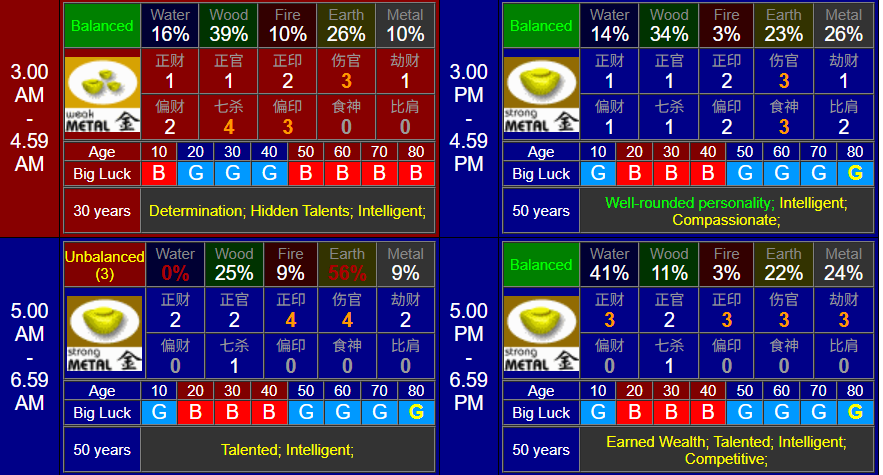
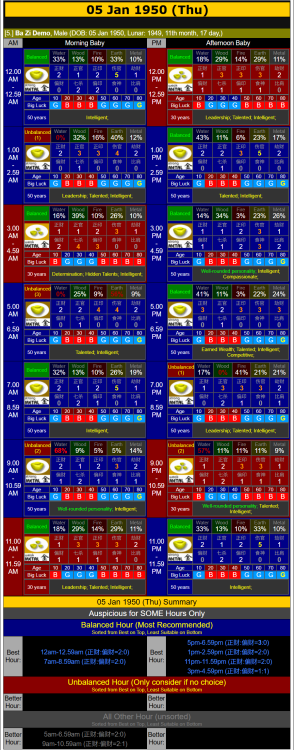
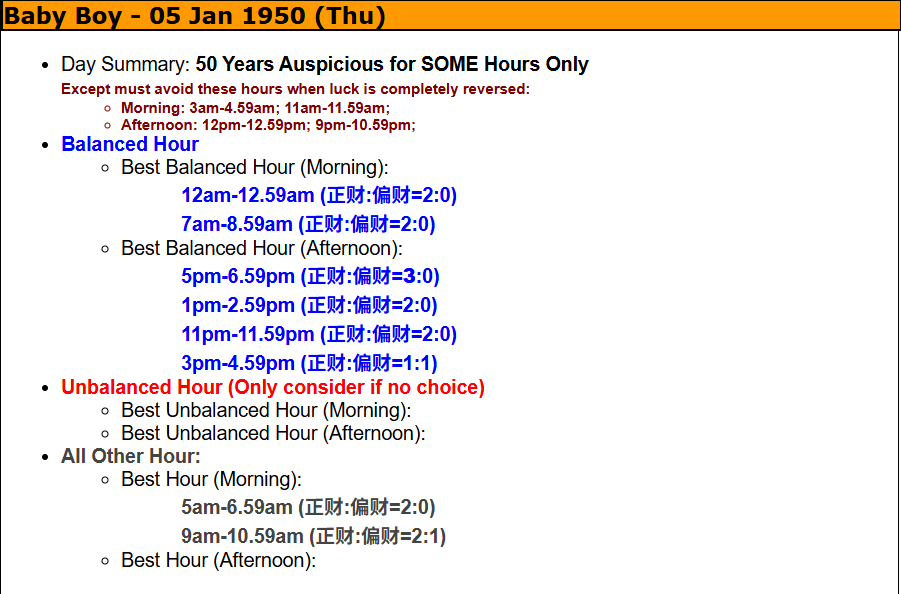
Comprehensive search into the hour by hour analysis for each day to find the best date and time for the date range of your expected delivery date (ie 1 Jan - 31 Jan etc)
Narrows search to finding dates which have ALL HOURS Auspicious timing so that should there be any "unexpected" delays in caesarean operation, the child is still good.
Identifies the best hours with the most well balanced five element percentage to minimize potential health issues.
Identifies the Key Character Traits for each hour to help you look for a good overall trait for the child.

Robert Lee, +65 9835-5734 / support@geomancy.net
Learn more about our Selection of Caesarean Date Services
Sample Reports
https://www.geomancy.net/demoreports/caesarean_dates/caesarean_date_summary.html
https://www.geomancy.net/demoreports/caesarean_dates/caesarean_date_summary_list.html
Information Required (To begin, fill up this Form...)
From 148.00 USD -
Selecting an Auspicious Chinese Name for your Newborn baby
URL: Learn more about our Choosing An Auspicious Chinese Name for your Newborn
Key Features
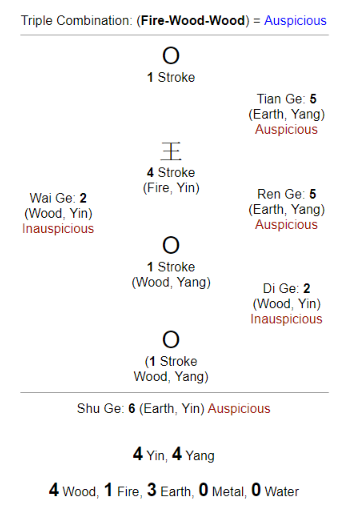
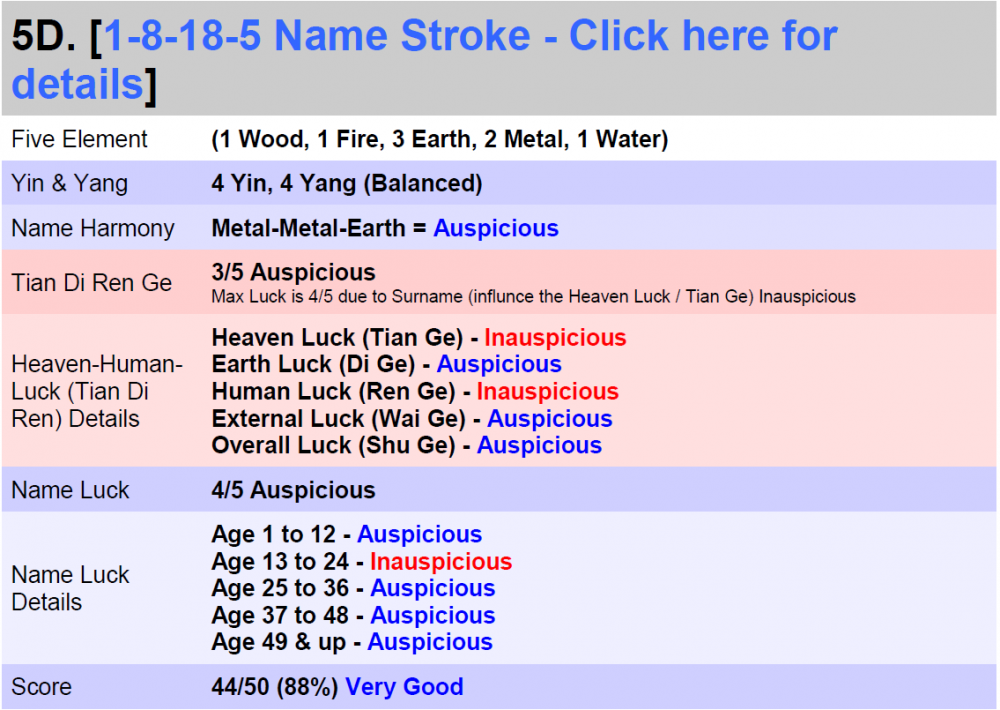
Our comprehensive name analysis service helps you find the best possible name for your baby
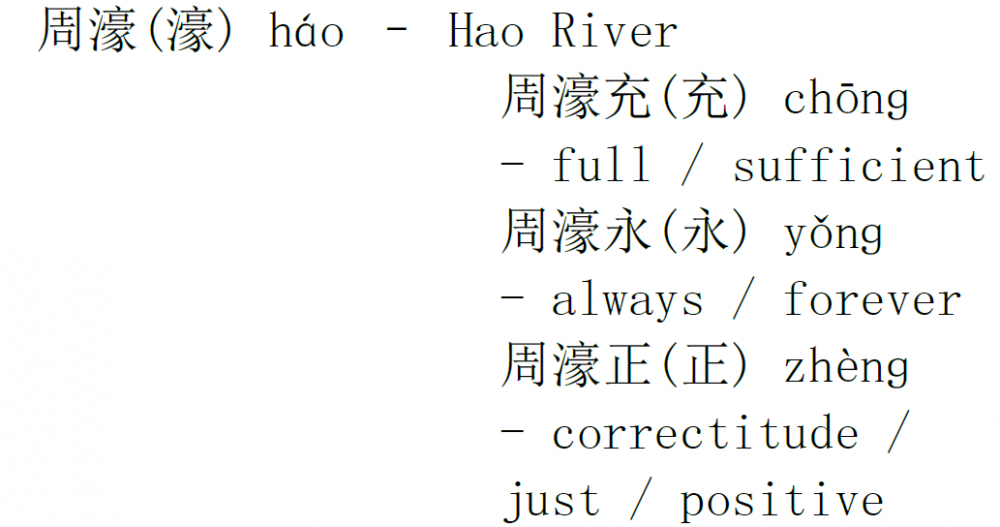
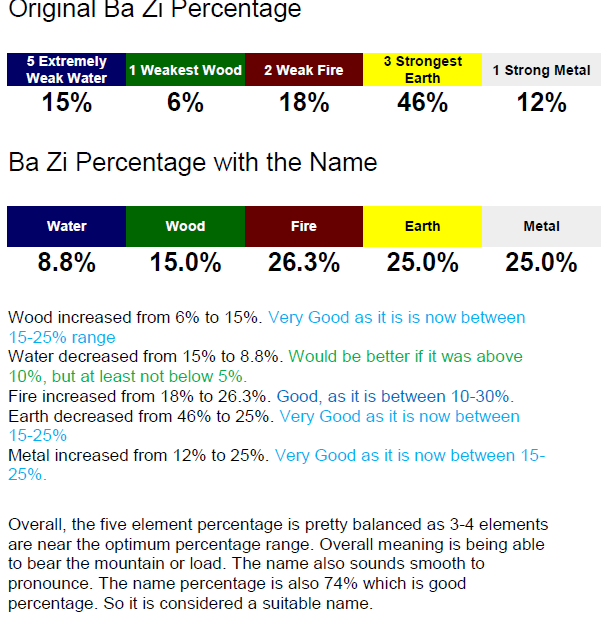
Includes comprehensive Ba Zi Review to determine the whether the name is suitable to the child or not
We will attempt to find the best name stroke group for your surname, and then work out as many possible name combinations for you to be able to find the most suitable name.
In addition, you can also match out your preferred name from a character reference list provided for each name stroke group.
Robert Lee, +65 9835-5734 / support@geomancy.net
Learn more about our Choosing An Auspicious Chinese Name for your Newborn
Information Required (Fill up this Form...)
From 228.00 USD -
Other Related Property Articles SG Property Article 1: The 3 Certainties of Property Transformation: A Professional Framework for Timing Your Entry https://www.geomancy.net/forums/topic/20897-the-3-main-signs-of-property-change-when-to-step-in-and-buy/ SG Property Article 2: A practical pro and cons review of how Singapore poperty is often assessed and sometimes marketed by real estate agents https://www.geomancy.net/forums/topic/20898-a-practical-pro-and-cons-review-of-how-singapore-property-is-often-assessed-and-sometimes-marketed-by-real-estate-agents/ SG Property Article 3: Boutique condos in Singapore are often ignored https://www.geomancy.net/forums/topic/20904-boutique-condos-in-singapore-are-often-ignored-because-most-buyers-focus-on-big-high-unit-projects-but-they-can-offer-strong-long-term-value/ SG Property Article 4: BTO is coming, so when should you sell? https://www.geomancy.net/forums/topic/20903-bto-is-coming-so-when-should-you-sell/ SG Property Article 5: A buyer playbook using MAPS Investment screening process https://www.geomancy.net/forums/topic/20900-a-buyer-playbook-using-maps-investment-screening-process/ SG Property Article 6: Why 2026 matters for HDB owners who want to upgrade https://www.geomancy.net/forums/topic/20902-why-2026-matters-for-hdb-owners-who-want-to-upgrade-to-private-property-without-depleting-personal-savings/ SG Property Article 7: Is your HDB a starting point for upgrading to private property? https://www.geomancy.net/forums/topic/20908-sg-property-article-7-your-hdb-is-your-starting-point/ SG Property Article 8: Reckless housing land bids? https://www.geomancy.net/forums/topic/20912-sg-property-article-8-reckless-housing-land-bids/ SG Property Article 9: HDB resale prices post first decline in nearly seven years https://www.geomancy.net/forums/topic/20919-sg-property-article-9-hdb-resale-prices-post-first-decline-in-nearly-seven-years/ SG Property Article 10: Ten Reasons why HDB Homeowners sell their flats https://www.geomancy.net/forums/topic/20942-sg-property-article-10-why-hdb-homeowners-sell-their-flats-and-what-it-says-about-life-in-singapore/ SG Property Article 11: Educational Infographic Ads Designed to Boost Engagement https://www.geomancy.net/forums/topic/20962-sg-property-article-11-educational-infographic-ads-designed-to-boost-engagement/ SG Property Article 12: A critical review of the common unit selection framework https://www.geomancy.net/forums/topic/20899-a-critical-review-of-the-common-unit-selection-framework-made-popular-by-singapore-property-influencers-and-agents/ SG Property Article 13: Condo owners may lose their apartment for owing maintenance charges https://www.geomancy.net/forums/topic/20952-condo-owners-may-lose-their-apartment-for-owing-maintenance-charges/ SG Property Article 14: HDB Lease Decay - By 2030, close to 500,000 HDB flats will be older than 40 years https://www.geomancy.net/forums/topic/20969-sg-property-article-14-hdb-lease-decay-by-2030-close-to-500000-hdb-flats-will-be-older-than-40-years/ SG Property Article 15: Failed “99-1” ownership scheme leads to costly lawsuit, highlighting stricter IRAS scrutiny and risks of trying to bypass Singapore’s ABSD https://www.geomancy.net/forums/topic/20878-sg-property-article-15-failed-99-1-ownership-scheme-leads-to-costly-lawsuit-highlighting-stricter-iras-scrutiny-and-risks-of-trying-to-bypass-singapores-absd/ SG Property Article 16: Star Buy Units in New Launch Condos: What They Really Mean + 5-Factor Checklist to Spot a Genuine Deal https://www.geomancy.net/forums/topic/20994-sg-property-article-16-star-buy-units-in-new-launch-condos-what-they-really-mean-5-factor-checklist-to-spot-a-genuine-deal/ SG Property Article 17: When Should You Sell Your HDB Before getting a New BTO? (The 3-Phase Strategy That Avoids Rental Gaps) https://www.geomancy.net/forums/topic/21010-sg-property-article-17-when-should-you-sell-your-hdb-before-getting-a-new-bto-the-3-phase-strategy-that-avoids-rental-gaps/ SG Property Article 18: Cash vs CPF for Your Home Loan in Singapore: Which Payment Method Leaves You Better Off (Now and When You Sell)? https://www.geomancy.net/forums/topic/21013-sg-property-article-18-cash-vs-cpf-for-your-home-loan-in-singapore-which-payment-method-leaves-you-better-off-now-and-when-you-sell/ SG Property Article 20: Singapore Resale Condos Taking Longer to Sell in 2026 as Buyers Hold Back Amid New Launches https://www.geomancy.net/forums/topic/21021-sg-property-article-20-singapore-resale-condos-taking-longer-to-sell-in-2026-as-buyers-hold-back-amid-new-launches/
-
Thank you very much for sharing and for your clarification too! I really appreciate you taking the time, and hope you have a great week ahead!
-
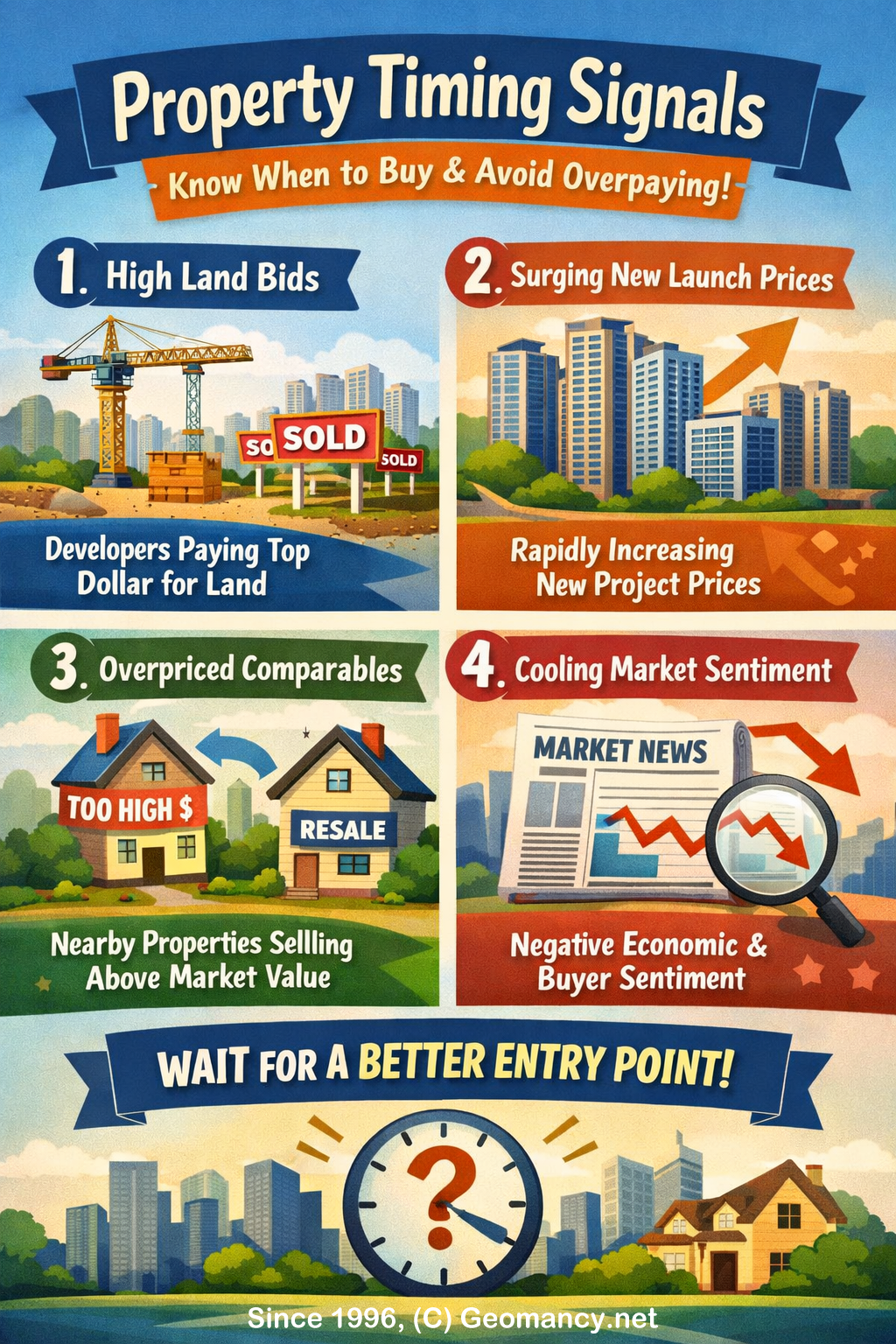
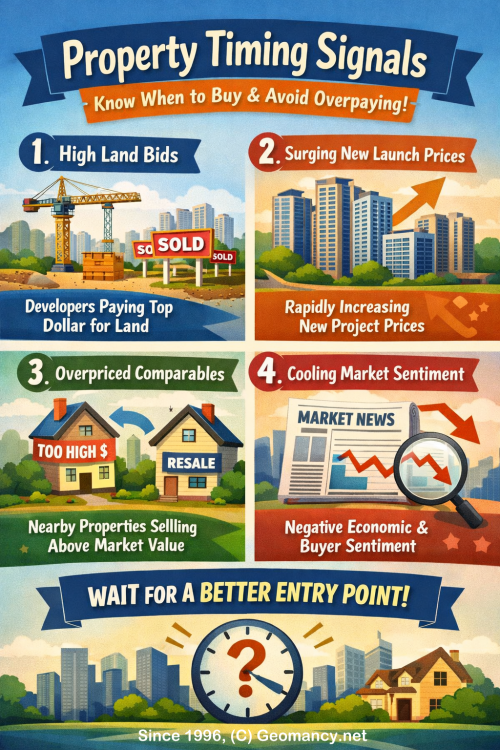
Property Market Timing Made Simple: Track Entry Prices, New Launch Benchmarks, and GLS Land Bids To time property purchases more calmly and avoid overpaying, track four repeatable signals historical entry prices, nearby new-launch benchmarks, GLS land-bid trends, and “laggard” projects priced below true comparables so you can judge whether prices are justified, where neighborhood price ceilings are forming, what developers expect next, and where value gaps may close before the crowd reacts. Key Takeaways - Don’t anchor to “today’s normal”; compare current prices to prior entry points to see if you’re early or buying after a repricing. - Ask what has changed to justify large psf increases (conditions may change, but the premium needs a reason). - Benchmark against nearby new launches because they set neighborhood price ceilings and reset expectations. - Watch for soft new-launch demand or heavy incentives as a sign local pricing power may be topping out. - Use GLS land bids (bid levels, number of bidders, bid spread vs prior sites) as a forward-looking indicator of developer confidence and future price floors. - Identify projects trading below true comparables (location/amenities/tenure positioning) to find “laggards” where gaps may close. - A “watchlist mindset” combining these signals helps buyers act earlier and avoid FOMO-driven late entries. +++ Many home buyers don’t “miss” the market because they aren’t smart they miss it because property markets are noisy, fast-moving, and full of distractions. For example, some buyers managed to enter around $1,8XX psf, while others paid $2,3XX psf later for something similar. The difference usually isn’t luck. It’s that early buyers were watching a small set of signals consistently, while most people were reacting to headlines, show flat hype, or fear of missing out after prices had already moved. One reason crucial signals get missed is that buyers often anchor to the wrong reference point. Instead of asking “Is this unit priced well versus what it historically cost to enter this kind of project?”, they ask “Is this price normal for today?” When the market rises, “normal” quietly resets higher every few months. Entry price comparison is the simplest way to avoid that trap. By comparing today’s asking price to earlier entry points for the same project (or close substitutes), you can see whether you’re buying near the front of the wave or after a big repricing. This doesn’t mean you must match the earliest buyers’ price conditions change but it does force a clearer question: what changed since then that justifies paying hundreds of dollars psf more? Another common miss is failing to benchmark against nearby new launches. Buyers sometimes treat each launch as a standalone event, but developers and agents rarely do. New launches set fresh price ceilings and reshape expectations for the entire neighborhood. Nearby new launch benchmarks help you understand whether the unit you’re considering is priced at a discount, at parity, or at a premium to brand-new competing supply nearby. If a new launch in the same area is selling higher (with smaller units, fewer incentives, or less attractive attributes), that can support the case that resale or earlier-launch projects still have room to move. On the other hand, if new launches start selling softer or need heavy incentives, that’s a warning that the area’s pricing power may be topping out even if the marketing sounds bullish. Government land bid analysis is another signal many buyers skip because it feels “too technical.” But land bids are one of the clearest forward-looking indicators. Developers don’t bid aggressively unless they believe future selling prices can support it. Tracking recent land bids, the number of bidders, the bid spread, and how those bids compare to prior sites gives clues about developer confidence and cost pressure. Higher land costs generally raise the “floor” for future launch prices, which can lift surrounding projects over time. Conversely, weaker bids, fewer participants, or sharply lower land rates can hint that developers expect slower demand ahead. You don’t need to be an analyst just paying attention to whether land is getting more expensive and more contested in your target area can help you avoid being surprised by sudden price resets. The final consideration is projects still below comparable pricing often the biggest opportunity and the easiest to overlook. Many buyers shop by what looks newest, what has the loudest marketing, or what friends are talking about. But price tends to catch up across comparable properties over time, especially when they share the same location advantages, tenant demand, or amenity ecosystem. The key is “comparable”: similar distance to MRT, similar access to schools and lifestyle nodes, similar tenure, and similar overall positioning. When a project remains priced below peers without a strong reason (like inferior connectivity, layout issues, or upcoming nuisances), it may be lagging rather than “cheap for a reason.” These laggards are often where value-driven buyers enter before the broader market notices. Putting the four together creates a simple watchlist mindset, which is what the image is really pointing to. Entry price comparison tells you whether you’re early or late. Nearby new launch benchmarks tell you how the neighborhood’s price narrative is evolving. Government land bid analysis tells you what developers believe about tomorrow’s prices. And identifying projects still below comparable pricing helps you spot gaps before they close. Buyers who consistently track these signals tend to move earlier and more calmly, while everyone else moves later usually after prices become widely discussed and psychologically “confirmed.”








-
Thank you so much! I’ve updated the report to reflect 27degrees = NE1.
-
Hi Master Cecil, Thanks for the super helpful Redhill 2025 October BTO post for young homeowners! I wanted to clarify one quick detail about Block 144A Stack 111 before my unit selection. Your sheet lists the facing as 22° (N3), but the red line drawn on the diagram actually points to 27°. Since 22° is so close to the boundary line, could you clarify if the 22° reading was intentionally adjusted towards the road/park (the main qi-mouth), or if the facing should strictly follow the physical alignment of the building's walls? I am trying to know whether it is N3 or NE1 because it changes the Period 9 chart for this stack, so your hopefully you can help here! Thank you very much!