

Everything posted by Cecil Lee
-
Dear Trini, Do try to check the influences especially at the bedroom. Where possible this is an auspicious location. There is not much that can be analysed using the Eight House Theory other than if the death or disaster line falls at the main entrance, keep the location `bright' and avoid leaving the door open unless you are using it. Warmest Regards, Cecil
-
Dear Anon, From my personal experience, this would depend also depend on the qualities of the advise given. If one uses a combination of the best `tools' of analysis such as knowing a person's true element and strength, Flying Star and Eight house and for the home a high level of Shapes and Form School, the results are nearly `immediate'. For example, there are many cases where at one glance of the Flying Star Chart of the house, one can tell whether the house is auspicious or not. Sometimes we do compare the house under e.g. Period 6 and Period 7. I know of a few cases where the owners did a major renovation in Period 7. The original birth chart e.g. in Period 6 was excellent but due to the reno, it pushes to Period 7. Here proper cures relating to the `five elements' when used properly can help in such a situation. Unfortunately, there are a few instances where, although the birth chart of the house is `acceptable', but under the Shapes and Form School e.g. the toilet is located at the centre, at the front of the house. As most readers are aware, it is very difficult or nearly impossible to `neutralise' these... I have to be frank with you. Alternatively, at the particular period, one's Luck Pillar is in an inauspcious period. So one can understand that no two situations are alike. A good FS practioner is one who is able to digest as much `relevant' information on the person, his home and use the information to provide a `solution'. There is a growing trend of `Fast Food' Feng Shui, where I know of quite alot of cases where either the FS practioner "over do" such as asking the poor person to purchase wind chimes, fountains etc... Some I believe only want to push such products without care or concern. This will usually do more harm than good (not adding to the fact that one has spent so much money...) In these cases, one not only has to try to reverse the situation but try to neutralise these added `problems'. These are the more difficult cases. Usually if done properly, `recovery' can be from 3 months to 6 months. There are cases where one offends the Grand Duke, and `he' is very unforgiving even after a few years. So, how to improve in such situations. We have to be realistic not to over do Feng Shui. If one is not sure, ask a FS professional. Many Feng Shui Masters or Grand Masters will provide this advice: Go to someone who geniunely wants to do a good job and honest about trying to help. Rather than approach one where his/her sole interests is making money. This makes all the difference in the world. I believe the above is the best advice I can give. Warmest Regards, Cecil
-
Dear Anon, I do understand your problem. Are there any clues from visual appearance. For example, especially the type of flooring laid. Alternatively, is there a fresh coat of paint on the ceiling. One is able to change the `birth chart' of the house .. for example .. by painting the ceiling. If you had obtain a paid report, please email : robert-lee@3dmail.com privately to provide you with the credit to generate another paid credit. Here, you can find out or compare whether it is more auspicious for the house to be in period 7 or previous period. If you can find out that there was some renovation especially in period 6, we can provide u the report also for Period 6. The objective is to see whether it is `worth' changing the `birth chart' of the house under the various periods. Warmest Regards, Cecil
-
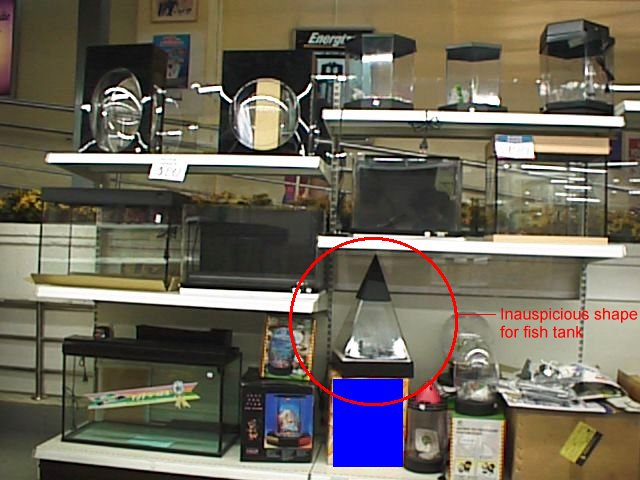
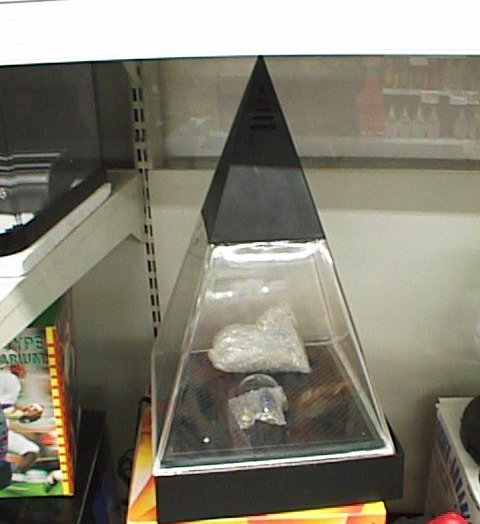
1. Where possible, please avoid purchasing a triangle fish tank. It is considered an inauspicious shape for a fish tank. As water is confined in a `fire' environment. 2. If you are a person who is a weak Fire or strong Water, where possible avoid having a fish tank in the home. Particularly for a weak Fire person.
-
Dear Anon, In a general sense, one can say that fudogs are considered `puppies' while lions are `heavy weight'. Both are considered `guardians'. It is very common for large Chinese buildings to have lion statutes rather than fudogs. Fudogs are usually used in a house and serves as a `milder' form of `guardian'. You will never find a pair of fudogs guarding a large building. Warmest Regards, Cecil
-
Dear Anon, There is quite a diverse group of users in this forum and not all are of Chinese `origin'. It is quite common for Westerners especially those celebrating Christmas to hang a " bouquet " or a round Christmas decoration on their door. In my opinion, it is very difficult to say whether this practise is `good' `bad' or neutral. What is more important is trying to understand what each Feng Shui / Divinity (Pillars of Destiny) can help us and apply them. We should then classify such objects as of `secondary' importance. The only thing I personally feel is that where possible try not to hang `dried' plants or flowers on the door. This is because it usally turns brown/black? and thus is not as auspicious as `live' or fresh plants/flowers/decoration. Warmest Regards, Cecil
-
Dear Anon, Based on just the Shapes and Form School, there should not be a problem with the kitchen above the toilet. It would be inauspicious if it is the other way around i.e. the toilet (especially the toilet bowl) above i.e. the stove or cooking area. Warmest Regards, Cecil
-
Dear Anon, It is common to associate `white' with purity particularly with the west. Chinese in some ways do associate white or `straw' clothing where it is worn during funerals. So far, under Chinese customs or practises, fences are never painted white. Personally, I have yet to see a white fencing both locally or on my trips abroad. I believe this is certainly a `taboo' colour even for FS practioners. The most common colour as you have mentioned for a picket fence is green. Most fences I come across can also be in black. Hmm.. as far I can remember, I seldom see a blue fence. In my opinion, green or black is a "better" choice. Warmest Regards, Cecil
-
Dear Tegs, If I read your message correctly, I believe you will be placing the headrest of your bed against a wall. This is a good choice. If you have a low linen cupboard, you can actually place it at the foot of the bed. Alternatively, whether it is possible to use a privacy screen or any other cabinet e.g. a low book shelf (with the shelf) facing outwards towards the door. Taking into consideration "priorities", the legs facing the door is not as bad as the bed against a window etc... Warmest Regards, Cecil
-
Dear Dave, Thanks for sharing with us your information. In your situation, you can consider NE as the frontage of the house although there is no `front' door. You are not alone in this situation. In my country, many Housing Development Flats (developed by the government) for more than 90 percent of the population has this `bright hall' effect (although they have a front door.) Many a times I find the front door to be `darker' similiar to the `back' door of yours. I have given quite alot of examples on why this `fixed' template format is not a reliable FS method. Overall, if Feng Shui is so easy, and if everyone do the same, imagine an entire population following this fixed principle, we ask ourselve this question: will it work? Only if other FS principles have been explored and if one have the time or the luxury, can go for this fixed template format. Even the Eight House Theory is personalised to an individual. My advise is not to take the Eight Associations/Life Associations Concept too seriously. It would be best that do not apply the cures you mentioned unless it is truly necessary such as to deflect a poision arrow or after investigations e.g. using the Flying Star to check the auspiciou/inauspciousness of a particular location. Warmest Regards, Cecil
-
Dear Jojo, Under the Shapes and Form School, this is inherent with the unit i.e. you cannot do much here other than to balance the `yin' aspect to make the location more bright `yang' due to the lower level housing. Other than the above, more investigations can be done using the Flying Star to analyse the birth chart of the house. This is not compulsory. Warmest Regards, Cecil
-
Dear Sudha, Please see below:- 1. The intangible force (auspicious or inauspicious) influencing i.e. the bedroom is more important than sleeping with the head facing a good direction. Hope that you would take the above into consideration. Where possible sleep closer/nearer to a good auspicious intangible force location. 2. Pay attention to the Four Symbolic Animals Concept (Ref: http://www.geomancy.net/fs/four.htm ) where the bed headrest should be firmly against a wall. Note other important considerations like the bed not directly in full view of the bedroom door. Try not to place the bed on the opposite wall as the toilet bowl... Only after taking into consideration the above, then, you have the `luxury' of getting your head facing a good direction. Warmest Regards, Cecil
-
Dear Jacqueline, Please accept my sincere apologies as I have no speciality over this subject. This is because it does not come under Feng Shui, Chinese astrology or Divinity methods. In my personal opinion, I feel that I do not have the expertise to comment on this subject. However, I will look out for any tradtional methods that hopefully does work. This is also because there are some Chinese superstitions I come across such as the bridegroom and bride get a handsome child to roll over the bed etc... I am too "embarrased" to share Chinese superstitions. Therefore, I prefer to stick to `more scientific' aspects of Chinese culture such as sharing information on traditional Feng Shui and Divinity methods. Warmest Regards, Cecil
-
Dear Anon, The Chinese Animal Signs is based on Chinese Astrology. In a broad sense, it is the equivalent of say the `English' Astrology signs such as Gemini, Cancer etc... One should take note that Chinese Astrology is also called "Zi Wei Dou Shou". For those who are new and like to find out the 12 different Chinese animal signs can visit one of my earlier sites: http://www.lovesigns.net This site compares the compatibility based on a person's year of birth. One has to be cautious to use different animal signs to improve Feng Shui especially if one purchases `objects'. For example, it is in auspicious to place a picture of a hungry tiger who is on the `prowl' in the home. At www.lovesigns.net, you will find that three sets of animals are considered auspicious and based on the graphic diagram you will find that the animal facing one another is considered it's `worst enemy'. The site will also show that at a famous convent in Singapore, `Tiger' girl babies were left at the doorstep of the convent in the past. In Singapore, the birth rate per year is usally around 60,000 to 50,000 babies but during `bad' years such as the `Tiger' year, the birth rate can drop to around 48,000 or less. One good thing about this is that during such years, there is less competition for such parents to find `better' schools for their child. Warmest Regards, Cecil
-
Dear Anon, There are two types of `gourd':- 1. The first is called simply as "Gourd". The equivalent here is called the water-melon in the west. In the Chinese province of Canton or in Hong Kong, with predominantly Cantonese speaking dialect group. Never give the water-melon as a present as the word "Xi Gua" is = water melon. The word "Xi" signifies death. 2. In this message, you are most likely to refer to the bottle-gourd or in Mandarin called "hu-lu". The bottle-gourd is linked to a Toaist's object. In Chinese symbolism, it is a replica of heaven and earth joining (due to the two spherical shape.) On the Chinese Lunar calendar: 5th day of the 5th month; which is the feast of the summer solstice, a bottle-gourd made of paper is hung at the gate leading into the house. The bottle-gourd is also the `weapon' used by Tie Guai Li, one fo the eight immortals. In my opinion, a bottle-gourd is considered an auspicious item. It is acceptable to keep such an object in the home as a decorative piece only. It is not used in any particular way as an object to neutralise etc... Warmest Regards, Cecil
-
Dear Anon, In my personal opinion, tie a "red thread" has more to do with Chinese customs than the pakua mirror has to be activated with a red thread. As red symbolisies an auspicious colour. 1. When one moves into a house, some Chinese follow the tradition of wraping charcoal with a red paper to represent black gold. Red is considered auspicious. Same goes for bringing into the house a red charcoal stove to symbolise an auspicious occassion when moving into the house. 2. Chinese wedding invitation cards are always in Red especially with the Phoenix (representing Female) and Dragon (representing Male) emblem in gold. Even the double happiness sign is usually in red. 3. I mentioned in a few recent messages that during Chinese Lunar New Year, in the past, red fire crackers were lighted and the result is a red `carpet' effect. We can then understand why red is always used such as red string even to tie the ancient coins to form the 6 coins symbolising `Big metal'. Where `big metal' is used to destroy the Wood element e.g. a wooden ceiling beam. 4. It is also recommended when one is disposing a used Ba Gua mirror, one should wrap the Ba Gua mirror in a used newspaper and tie it with a red string before disposing of it. This is more a tradition than a `MUST' to activate the Ba Gua Mirror. Hope the above helps. Cecil
-
Dear Anon, 1. Firstly, house numbers are considered secondary to Feng Shui. There are two "camps" with regards to this thinking. Like you mentioned some FS practioners would encourage the numbering to be rising at 45 degrees to denote or symbollically represent `progress' or as you mentioned: vertical such as 8 8 8 Others, would consider numbers secondary and not as important ie. the numbers can be at the same level. 2. In my opinion, I do believe that numbers are of secondary importance but it is really no harm raising the numbers 45 degrees or at a vertical position. (Unless this is specifically not permitted in a specific country). Again, symbolism plays an important role in Feng Shui. As we can see that it is best to have even a design of a lamp that looks like:- /\ / \ || The above profile is generally considered more auspicious than other profiles such as a roof of the house slanting to one side only. 3. One other important point to note is that some highly experience Feng Shui Masters also mentioned that the main entrance door is one where you have the number of the house on it. This is a serious consideration especially for those who use another door as their main entrance. (For now, I will not discuss on this further as there are lots of mails to be answered). Warmest Regards, Cecil
-
Dear Anon, Ideally, as you have correctly mentioned, the dead tree should be removed. However, I can certainly sympathise with your plight. The dead tree creates quite a yin imbalance. As I do not know more of your personal information, you can try to use metal above the window to neutralise the `dead tree'. Here what you can do is:- 1. Get hold of a red packet or ang pow packet. If you do not have one, a red rectangular paper (approximately around 130mm by 65 to 70 mm) and place six coins (you can use scotch tape to tape the coins 3 coins each side (flat) on the paper. Hang it at the mid-point above the window. 2. The Big metal of 6 coins is used to destroy the wood element. (Note: This remedy is currently not referenced to the room's Flying Star numbers). It would be better to analyse with the Flying Star numbers. I would not recommend a milder 7 coins that represent `Small metal' as 6 coins represent Big Metal and should be able to neutralise it more effectively. Warmest Regards, Cecil
-
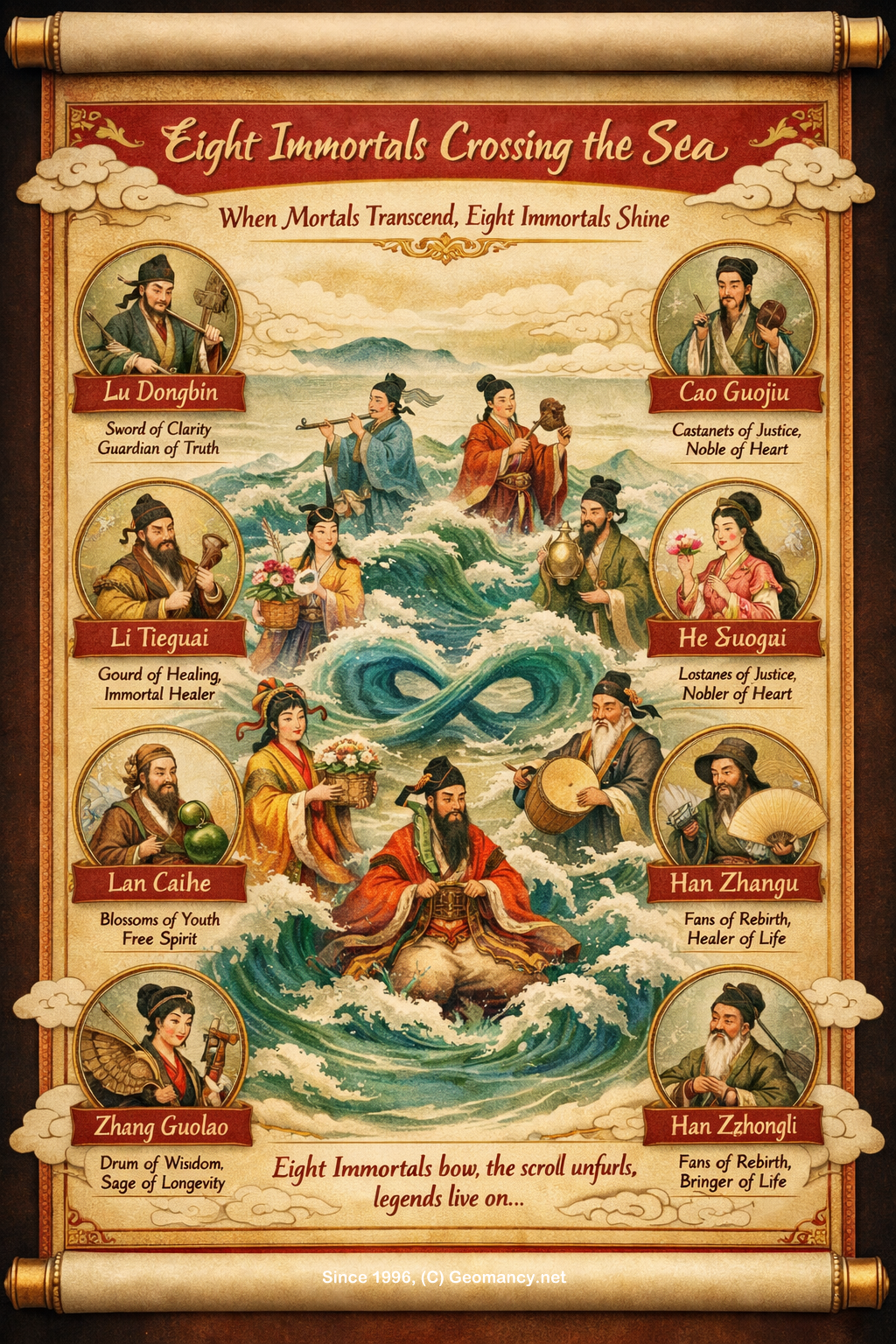
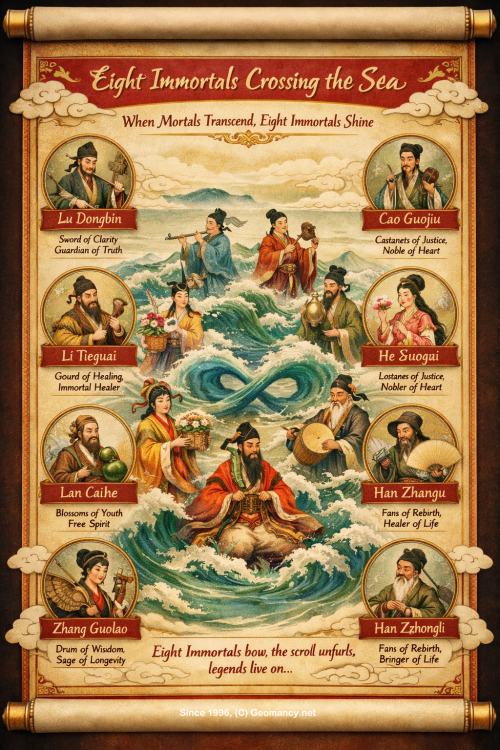
The Eight Immortals of China: Legends Who Walk Between Heaven and Earth If you were to gather a poet, a prince, a beggar, a scholar, a young woman, a loudmouthed reveler, a mystic healer, and a musician who could charm the sea and then tell them they all achieved immortality—you’d have something close to China’s beloved Eight Immortals (*Bāxiān*, 八仙). They’re not a neat pantheon of flawless gods. They’re wonderfully human: eccentric, contradictory, mischievous, compassionate, and occasionally chaotic. And that’s exactly why they’ve endured for centuries as folk heroes of Daoist-inspired imagination. In temples, operas, New Year prints, novels, and street sayings, the Eight Immortals appear as a traveling company of miraculous outsiders—each with a signature tool, each with their own way of bending reality, and together representing a promise: the Dao is open to everyone, not just emperors or saints. Who are the Eight Immortals? The “Eight Immortals” are a group of legendary figures most commonly associated with Daoist mythology and popular religion. Their stories grew over many centuries, especially flourishing in the Song and Yuan periods and later becoming staples of drama and folk art. They’re not always presented with one single “official” biography—variants abound across regions and texts—but the most familiar lineup is: 1. Lǚ Dòngbīn (吕洞宾) – the scholar-swordsman 2. Zhōnglí Quán (钟离权) – the general-turned-alchemist 3. Lǐ Tiěguǎi (李铁拐) – the iron-crutch beggar-healer 4. Hán Xiāngzǐ (韩湘子) – the flute-playing young immortal 5. Cáo Guójiù (曹国舅) – the nobleman redeemed 6. Lán Cǎihé (蓝采和) – the gender-ambiguous wanderer with flowers 7. Zhāng Guǒlǎo (张果老) – the old trickster who rides a donkey backward 8. Hé Xiāngū (何仙姑) – the lotus-bearing immortal woman Immortal Symbol Role / Attribute Lu Dongbin Sword Scholar, protector against evil Han Xiangzi Flute Harmony, music, joy Cao Guojiu Castanets Nobility, justice Li Tieguai Iron crutch & gourd Healing, medicine Lan Caihe Flower basket Youth, spontaneity Zhang Guolao Bamboo drum Longevity, wisdom He Xiangu Lotus flower Purity, health Han Zhongli Fan Revival, life force Each one is distinctive enough to be recognized instantly in art—thanks to an iconic object (often called a “treasure”) and a set of personality traits that make them feel like characters you might meet, rather than distant abstractions. Why “Eight”? In Chinese culture, eight often suggests completeness, auspiciousness, and a balanced set. But the Eight Immortals aren’t a tidy “system” so much as a vivid ensemble: old and young, rich and poor, refined and rough, male and female, respectable and rebellious. Together, they’re a kind of mythic argument that spiritual achievement isn’t limited by class, status, age, or temperament. The group includes: - Aristocrats and paupers - Officials and eccentrics - Healers, artists, wanderers, and warriors - At least one figure portrayed as gender-nonconforming (Lán Cǎihé) in many traditions It’s a spiritual found-family, stitched together by stories rather than bureaucracy. Meet the Immortals: Eight Lives, Eight Ways to Transcend 1) Lǚ Dòngbīn — the blade that cuts illusion Often depicted with a sword and a fly-whisk, Lǚ Dòngbīn is the most famous of the Eight. He’s a cultured figure—part scholar, part wandering exorcist—who helps humans by defeating demons, breaking curses, and pushing people toward awakening. One of his most beloved tales is the “Yellow Millet Dream,” where he experiences an entire lifetime of ambition and success in the time it takes millet to cook—only to wake and realize how quickly worldly glory dissolves. Symbolically: the sharp clarity that sees through desire. 2) Zhōnglí Quán — the alchemist of resurrection A broad, powerful figure often shown with a fan (sometimes said to revive the dead or transform things), Zhōnglí Quán carries the aura of ancient authority. Many stories frame him as a mentor to Lǚ Dòngbīn, teaching inner cultivation and the arts of immortality. Symbolically: transformation—turning failure, ruin, and decay into new life. 3) Lǐ Tiěguǎi — the saint in rags Lǐ Tiěguǎi is immediately recognizable: a limping immortal with an iron crutch and a gourd of medicine (or spirit elixir). His legend often explains his disheveled appearance as the result of a spiritual mishap—his spirit leaves his body, and upon returning, he must inhabit a beggar’s corpse. He becomes a paradox: ugly to the eye, luminous in compassion—an immortal who chooses the streets and the sickbed over palaces. Symbolically: mercy without vanity; healing beyond appearances. 4) Hán Xiāngzǐ — the music that opens heaven A youthful immortal commonly depicted with a flute, Hán Xiāngzǐ embodies artistic spontaneity and the strange power of beauty. In some traditions he’s linked to a historical family and portrayed as a prodigy whose path diverges from conventional scholarship into Daoist wonder. Symbolically: inspiration—what can’t be argued into existence, only breathed into being. 5) Cáo Guójiù — the courtier who chose the Way Cáo Guójiù is often shown with court tablets or ceremonial objects marking his rank. His stories frequently feature moral rehabilitation: proximity to power becomes a test, and he must cleanse himself of corruption or family disgrace before joining the immortals. Symbolically: integrity—spiritual dignity that outlasts political status. 6) Lán Cǎihé — the laughing wanderer with flowers Lán Cǎihé is one of the most intriguing figures: sometimes portrayed as male, sometimes female, sometimes neither, often dressed in tattered clothes and singing strange songs. Their emblem is typically a basket of flowers or castanets. Lán’s presence stretches the imagination of what an “immortal” can look like: not solemn, not consistent, not easy to label. Symbolically: freedom—unfixed identity, unowned life. 7) Zhāng Guǒlǎo — the backward rider An elderly immortal known for riding a white donkey backward, Zhāng Guǒlǎo is the patron saint of doing things the wrong way on purpose. His magic leans toward prankish wisdom: collapsing logic to reveal truth. Riding backward isn’t just a joke—it’s a statement: the world runs on habits, and enlightenment may require reversing them. Symbolically: holy eccentricity; insight via contradiction. 8) Hé Xiāngū — the lotus-bearer Often the only woman in the standard group, Hé Xiāngū is usually shown with a lotus, a flower associated with purity and transcendence. In many stories she’s compassionate and luminous, connected to healing, nourishment, and spiritual refinement. Symbolically: grace—inner purity that moves gently through the world. “The Eight Immortals Cross the Sea”: A Story of Many Powers Among the most famous episodes is “The Eight Immortals Cross the Sea” (*Bāxiān guò hǎi*, 八仙过海). The premise is simple: they must cross the ocean, and each uses their own unique abilities—no one relying on a boat or a single savior. The tale often ends in a clash with the Dragon King’s realm, because miracles tend to disrupt authority, and playful immortals don’t always ask permission. This story gave rise to the idiom: > “The Eight Immortals cross the sea—each shows their divine power.” > (*Bāxiān guò hǎi, gèxiǎn shéntōng* 八仙过海,各显神通) In everyday speech, it means: everyone contributes their strengths; everyone has their own method. What the Eight Immortals Really Represent It’s tempting to read them as simply “magic characters,” but their popularity comes from something deeper: they function as a mythic mirror for society. - They celebrate the outsider. A crippled beggar can be holy. A fool can be wise. A wanderer can outrank a minister. - They honor many paths. Discipline and spontaneity, austerity and laughter, scholarship and street life—no single personality has a monopoly on spiritual truth. - They bring the sacred into the everyday. The Eight Immortals don’t just rule cosmic domains; they drink wine, argue, play music, heal the sick, and get into trouble. In short, they make transcendence feel possible—messy, humorous, and human. The Eight Immortals in Art, Festivals, and Everyday Life For centuries, the Eight Immortals have appeared on: - New Year prints (symbols of blessing and protection) - Opera and folk drama (their adventures are perfect for stage spectacle) - Ceramics, embroidery, and carvings - Birthday celebrations, especially for elders (since immortals symbolize longevity) - Temples and shrines, sometimes individually, sometimes as a set Their attributes—sword, fan, gourd, flute, lotus, flowers, tablets, and donkey—became a visual language. Even when the characters aren’t named, those objects whisper: you are in the presence of the immortals. Why they still enchant us The Eight Immortals endure because they refuse to be reduced to a single message. They’re not a sermon; they’re a traveling carnival of spiritual possibility. In their stories, holiness doesn’t always look holy. Wisdom may arrive disguised as a joke. Power might limp on a crutch. Purity might carry a lotus, while freedom sings in rags. And perhaps that’s their most lasting gift: they suggest that the boundary between the ordinary and the miraculous is thinner than we think—and that each person, in their own strange way, might cross that sea.
-
Dear Mette, Thanks for your detailed description of your home. I can certainly understand the problem faced by you in determing which is your front door. Worse still when it is determine, it really sounds and feel not right. In your case, we should try to apply another concept based on the facing direction of the front house. Let not determing the `front' or main entrance deter you. In your case, lets `forget' the actual main door or back door for the moment. Where is the frontage of your house? Here, you should consider the location where light goes into the house. It can be a window. For your special case, is there a window as I mentioned above where light flows thru or looks like the frontage of the house? If there is a door at this location, then it should be your main entrance door. If not, you can take the subsitute window as the main entrance door. Perhaps, you can feedback on the above and whether it can apply to your situation before, we go further to determine the `frontage' of the house rather than the main entrance door. Under this concept, the `frontage' " replaces " the main entrance door. One method of using this concept is to place the house number above the window. For those who have changed or use alternative doors, it would be best to place the house number on this door or above this door. To symbollically make this the `front door'. (You can still leave the house number on the other door). Warmest Regards, Cecil
-
Dear Sabina, What I understand is that you have measured your main entrance and it is in the mid-point or compass direction 337.5 degrees i.e. between 0 degrees and 315 degrees If you are using the eight house theory, you need not be too concern with the "type" of house ie. North or NW but rather find out what is the intangible force at the main entrance by checking what intangible force is affecting the North and NW. Best that it is not the death or disaster intangible force at either North or NW. If so, this means that the house is considered the least suitable to the breadwinner. Next, check the intangible force affecting the bedrooms. These are the two key considerations if you are using the Eight House Theory. As for the Flying Star theory, you should not have a problem locating the type of house as the compass directions is every 15 degree difference i.e. there are a total of 24 house directions under this theory. Warmest Regards, Cecil (Reference: http://www.geomancy.net/fs/house1.htm for instructions on the use of the Eight House) or goto www.geomancy-online.com to generate a free eight house report.
-
Dear Glyn, I am delighted to hear your success story:) You have really put Feng Shui especially the use of the Five Elements concept. It is cleary a shiny example of how proper use of Feng Shui can yield excellent results. Keep up the good work! Warmest Regards Cecil
-
Dear Anon, Currently, there is no `evidence' to say that opening or closing a door which happens to be at the east direction will distrub the grand duke. It is in my personal opinion that, the Grand Duke does not `stay' or `sit' at a door only be be `banged' upon. Collectively one must understand that (most importantly) the Grand Duke refers to Chinese Astrology where the Grand Duke is based on the planet `Jupiter'. As Jupiter is the largest planet in our solar system, it is suppose to extert a substantial influence on our planet. Overall, it is perfectly ok to have the door at the location. Only remember to try not to do any renovations at the location e.g. the wall surrounding the door. If we want to take taboo abit further, try not to paint the door for this year. If one can wait, no harm be abit more cautious. For those who are new in this forum, the Grand Duke Theory is based on Chinese Astrology. But many Feng Shui practioners incorporate it in Feng Shui as Chinese Astrology and Feng Shui is commonly integrated (subject fields). Similarly, you will notice that Geomancy.net or Geomany-online etc... is not called Feng Shui because fields such as Destiny (Pillars of Destiny), Chinese Animal signs (Astrology) are related fields of study and especially in the Far East, things like face reading, finding a suitable name for a child, changing of a person's name, face and hand reading are other fields of Chinese Geomancy. This should be covered so that we are able to use the best of each of the tools for our benefit. Warmest Regards, Cecil
-
Dear Anon, One of the `principles' in relation to neutralising `objects' is to remember that it has to be `activated'. For example, even a simple table fork has been effectively used by some FS Masters to counteract / neutralise a sha qi. Here, one should remember to point it to the `sha location'. It is usually not advisable to use a sword as one has a problem deciding how to place it. Furthermore, it should not be hang within a home. Under `Symbolism', a knife or pointed object creates sha qi and this would inadvertenly affect the household, a bedroom a living room etc... Instead, one should use other non offensive methods. For example, I have mentioned that one principle is that if one do not see a threat, it no longer becomes a threat. In such a situation, one should instead use a partition behind the main entrance door (for example) to neutralise a threat. Rather than say place a sword facing the main door. Warmest Regards, Cecil
-
Dear Jenney, 1. You mentioned that you stopped using the toilet in the bedroom. Perhaps u can elaborate further the rationale for doing so. This is because it is quite common for the toilet to be in the masterbedroom. It is good that u do not use the toilet but I like to find out more how are u applying the principles. It is because the toilet bowl is directly along the auspicious line/location. 2. For the fire place in the centre of the house. Can u elaborate if it is being used. From what I can understand from your message, looks like your family is not using it. It is best not to use it unless you have a real need for it. If it is not used, leave it as it is and do not need to add anything to it. 3. Currently, overall, what I understand is that the house is not suitable for the breadwinner and as you have mentioned the U shape is not auspicious shape. 4. For the garage `poision' arrow, it is best to close the kitchen door when not in use. As mentioned in the first message, do let us know your login account for us to credit u with the credit for the Period 7 Flying Star. You can then look thru it and use it. We will always help on this matter. Warmest Regards, Cecil