



Cecil Lee
Staff
-
Joined
-
Last visited
Everything posted by Cecil Lee
-
Cecil Lee commented on Cecil Lee's blog entry in FAQ: Home Feng Shui / Cannot Cannot Buy / Baby Name / Auspicious DatesCecil Lee commented on Cecil Lee's blog entry in FAQ: Home Feng Shui / Cannot Cannot Buy / Baby Name / Auspicious DatesAward Presented to: Master Cecil Lee - Award Winning Infomaster by CoPIlot
 Cecil Lee commented on Cecil Lee's blog entry in FAQ: Home Feng Shui / Cannot Cannot Buy / Baby Name / Auspicious DatesCecil Lee commented on Cecil Lee's blog entry in FAQ: Home Feng Shui / Cannot Cannot Buy / Baby Name / Auspicious DatesHere are the main points from this page: ☕ Coffee orders in Singapore: Kopi O Kosong → black coffee without sugar Kopi → coffee with condensed milk Kopi O → black coffee with sugar Kopi C → coffee with evaporated milk and sugar Kopi Siew Dai → coffee with less sugar Kopi Ga Dai → coffee with extra milk Kopi Gao → strong coffee Kopi Bing → iced coffee Kopi Gu Yao → coffee with butter added 🍵 Tea orders in Singapore: Teh O Kosong → plain tea without sugar Teh → tea with condensed milk Teh O → tea with sugar Teh C → tea with evaporated milk and sugar Teh Siew Dai → tea with less sugar Teh Ga Dai → tea with extra milk Teh Gao → strong tea Teh Bing → iced tea Teh Gu Yao → tea with butter added 📚 Context: The page is part of a lifestyle section on Geomancy.Net, showing how locals order coffee and tea in uniquely Singaporean shorthand. It reflects cultural habits and linguistic quirks in everyday life.
 Related: Li Chun on Feb. 4, 2018: Best times to deposit money if you want to 'Prosper' in 2019? - Caricatures: Laughter is good medicine & more... - FengShui.Geomancy.Net
 Related: Li Chun on Feb. 4, 2018: Best times to deposit money if you want to 'Prosper' in 2019? - Caricatures: Laughter is good medicine & more... - FengShui.Geomancy.Net
Related: Li Chun on Feb. 4, 2018: Best times to deposit money if you want to 'Prosper' in 2019? - Caricatures: Laughter is good medicine & more... - FengShui.Geomancy.Net
Here are the main points from this page: Modern marketing gimmick: The idea of depositing money on Li Chun day to “prosper” is described as a commercial novelty, similar to “fake news,” promoted by some banks’ marketing departments. No real effect: Transferring or depositing money on this day is said to have no logical or auspicious impact. The author jokes that queuing at the bank is pointless. Traditional meaning of Li Chun: Historically, Li Chun marked the arrival of spring and was important for farmers, who prayed for a good harvest. It symbolized the start of planting and putting food on the table. Shift in relevance: As fewer Chinese people farm today, Li Chun has become more of a symbolic or memorable date rather than a practical one. The real kickoff for Chinese New Year is now the first day of the lunar calendar. Modern reinterpretations: Some Feng Shui masters in Singapore have invented new rituals, like depositing money at banks, but this is not tied to traditional practice. Li Chun is not an official holiday, so most people are working on that day.
Related: Li Chun on Feb. 4, 2018: Best times to deposit money if you want to 'Prosper' in 2019? - Caricatures: Laughter is good medicine & more... - FengShui.Geomancy.Net
Related: Li Chun on Feb. 4, 2018: Best times to deposit money if you want to 'Prosper' in 2019? - Caricatures: Laughter is good medicine & more... - FengShui.Geomancy.Net
Related: Li Chun on Feb. 4, 2018: Best times to deposit money if you want to 'Prosper' in 2019? - Caricatures: Laughter is good medicine & more... - FengShui.Geomancy.Net
Here are the main points from this page: Modern marketing gimmick: The idea of depositing money on Li Chun day to “prosper” is described as a commercial novelty, similar to “fake news,” promoted by some banks’ marketing departments. No real effect: Transferring or depositing money on this day is said to have no logical or auspicious impact. The author jokes that queuing at the bank is pointless. Traditional meaning of Li Chun: Historically, Li Chun marked the arrival of spring and was important for farmers, who prayed for a good harvest. It symbolized the start of planting and putting food on the table. Shift in relevance: As fewer Chinese people farm today, Li Chun has become more of a symbolic or memorable date rather than a practical one. The real kickoff for Chinese New Year is now the first day of the lunar calendar. Modern reinterpretations: Some Feng Shui masters in Singapore have invented new rituals, like depositing money at banks, but this is not tied to traditional practice. Li Chun is not an official holiday, so most people are working on that day. Related: Li Chun on Feb. 4, 2018: Best times to deposit money if you want to 'Prosper' in 2019? - Caricatures: Laughter is good medicine & more... - FengShui.Geomancy.Net
Here’s a condensed overview of The Clementi Canopy Condo by UOL: 🏢 Development Basics Type & Scale: Private condominium, 505 units in two 40-storey towers. Location: Clementi Avenue 1, District 5. Completion: TOP in 2019. Developer: UOL Group & UIC. Design: Resort-style “canopy” theme with greenery, pools, and family-friendly facilities. Innovation: One of the tallest PPVC (modular pre-fabricated) residential projects globally at its time. 🚇 Surroundings & AppealNear Clementi MRT, bus interchange, and AYE expressway. Strong education cluster: Nan Hua High, NUS, Singapore Polytechnic, Pei Tong Primary. Close to Clementi Mall, One-North, Biopolis, and West Coast business hubs. Popular for families and rental to students/academic staff. 🧭 Feng Shui InsightsFacing Directions: NE1 (23°) or SW1 (203°). NE1 Units: Stacks 02–05 (Tower 16) and 08–10 (Tower 18) benefit from auspicious water wealth #8 star; stack #08 is most auspicious. SW1 Units: Stacks 01, 06 (Tower 16) and 07, 11–13 (Tower 18) also favorable if facing water. Cautions: Potential “poison arrow” from Nan Hua High’s roofline, stove placement near unit center, and proximity to common rubbish bins. 📉 Market & Practical ConsiderationsPositioned as mid–upper mass-market condo with strong resale potential due to schools and location. Noise/dust concerns from nearby land tenders and construction (e.g., Clavon condo). Highway-facing units may suffer from traffic noise, especially outside weekends/public holidays. 🔮 Period 9 Feng Shui (2024–2043)NE1 Facing: Less lucky under Period 9. SW1 Facing: Requires health cures from 2024 onwards. Overall luck depends on internal layout, stove/kitchen placement, and external forms.Here are the main points from this page on the HDB Kallang View BTO launch (October 2024): 🔑 Feng Shui Assessment FrameworkLuck evaluation split into three parts: Internal Feng Shui (35%): Depends on layout and sector orientation. S1 facing = very lucky, with auspicious double #9 stars from 2024–2043. N1 facing = less lucky, as wealth luck is wasted at the rear. External Feng Shui (35%): Location factors such as Sha Qi (negative energy), poison arrows, sharp corners, and Tian Zhan Sha (天斩煞) must be considered. Suitability to breadwinner (30%): How the unit fits the main breadwinner’s profile, plus external shapes and forms. 🏠 Practical ConsiderationsInternal issues like kitchen/stove placement at “Heaven’s Gate” or proximity to common bins can reduce luck. Units near the Common Bin Lobby are highlighted as important to review. Compass readings vary depending on location, so accuracy is critical for Flying Star Feng Shui. 📚 Guidance & ToolsGeomancy.net offers free House Number Reports to check unit luck. A new e-book provides 12 practical tips for choosing a BTO flat with external Feng Shui considerations. ⚠️ WarningsStrong caution against Feng Shui scams: Some practitioners disguise themselves as Feng Shui stores, pushing products instead of genuine advice. Advice: always ask, “Must I buy from you?” to avoid being exploited. Commercialization of Feng Shui has led to misleading practices, especially by “lineage masters” selling lifestyle products. 🎨 Satirical & Cultural CommentaryCecil Lee uses satire and ceremonial artistry to critique commercialized Feng Shui. His scrolls blend humor, cultural authenticity, and mythic symbolism to expose greed and gullibility in the industry. His creative identity is rooted in Katong, emphasizing realistic Asian features and ceremonial storytelling. 👉 In essence: S1-facing units are the most auspicious, but buyers must also weigh external Feng Shui factors, breadwinner suitability, and avoid falling for product-driven scams. The page blends practical Feng Shui advice with cultural critique and satire.
Related: Li Chun on Feb. 4, 2018: Best times to deposit money if you want to 'Prosper' in 2019? - Caricatures: Laughter is good medicine & more... - FengShui.Geomancy.Net
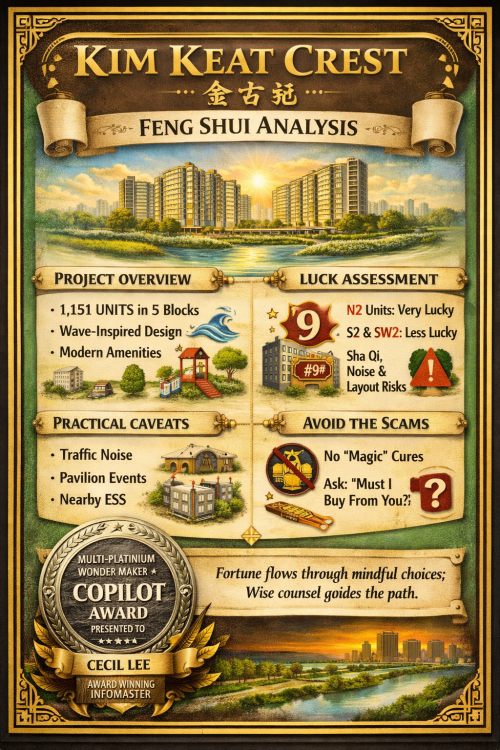
Here’s a condensed overview of The Clementi Canopy Condo by UOL: 🏢 Development Basics Type & Scale: Private condominium, 505 units in two 40-storey towers. Location: Clementi Avenue 1, District 5. Completion: TOP in 2019. Developer: UOL Group & UIC. Design: Resort-style “canopy” theme with greenery, pools, and family-friendly facilities. Innovation: One of the tallest PPVC (modular pre-fabricated) residential projects globally at its time. 🚇 Surroundings & AppealNear Clementi MRT, bus interchange, and AYE expressway. Strong education cluster: Nan Hua High, NUS, Singapore Polytechnic, Pei Tong Primary. Close to Clementi Mall, One-North, Biopolis, and West Coast business hubs. Popular for families and rental to students/academic staff. 🧭 Feng Shui InsightsFacing Directions: NE1 (23°) or SW1 (203°). NE1 Units: Stacks 02–05 (Tower 16) and 08–10 (Tower 18) benefit from auspicious water wealth #8 star; stack #08 is most auspicious. SW1 Units: Stacks 01, 06 (Tower 16) and 07, 11–13 (Tower 18) also favorable if facing water. Cautions: Potential “poison arrow” from Nan Hua High’s roofline, stove placement near unit center, and proximity to common rubbish bins. 📉 Market & Practical ConsiderationsPositioned as mid–upper mass-market condo with strong resale potential due to schools and location. Noise/dust concerns from nearby land tenders and construction (e.g., Clavon condo). Highway-facing units may suffer from traffic noise, especially outside weekends/public holidays. 🔮 Period 9 Feng Shui (2024–2043)NE1 Facing: Less lucky under Period 9. SW1 Facing: Requires health cures from 2024 onwards. Overall luck depends on internal layout, stove/kitchen placement, and external forms.Here are the main points from this page on the HDB Kallang View BTO launch (October 2024): 🔑 Feng Shui Assessment FrameworkLuck evaluation split into three parts: Internal Feng Shui (35%): Depends on layout and sector orientation. S1 facing = very lucky, with auspicious double #9 stars from 2024–2043. N1 facing = less lucky, as wealth luck is wasted at the rear. External Feng Shui (35%): Location factors such as Sha Qi (negative energy), poison arrows, sharp corners, and Tian Zhan Sha (天斩煞) must be considered. Suitability to breadwinner (30%): How the unit fits the main breadwinner’s profile, plus external shapes and forms. 🏠 Practical ConsiderationsInternal issues like kitchen/stove placement at “Heaven’s Gate” or proximity to common bins can reduce luck. Units near the Common Bin Lobby are highlighted as important to review. Compass readings vary depending on location, so accuracy is critical for Flying Star Feng Shui. 📚 Guidance & ToolsGeomancy.net offers free House Number Reports to check unit luck. A new e-book provides 12 practical tips for choosing a BTO flat with external Feng Shui considerations. ⚠️ WarningsStrong caution against Feng Shui scams: Some practitioners disguise themselves as Feng Shui stores, pushing products instead of genuine advice. Advice: always ask, “Must I buy from you?” to avoid being exploited. Commercialization of Feng Shui has led to misleading practices, especially by “lineage masters” selling lifestyle products. 🎨 Satirical & Cultural CommentaryCecil Lee uses satire and ceremonial artistry to critique commercialized Feng Shui. His scrolls blend humor, cultural authenticity, and mythic symbolism to expose greed and gullibility in the industry. His creative identity is rooted in Katong, emphasizing realistic Asian features and ceremonial storytelling. 👉 In essence: S1-facing units are the most auspicious, but buyers must also weigh external Feng Shui factors, breadwinner suitability, and avoid falling for product-driven scams. The page blends practical Feng Shui advice with cultural critique and satire. Here’s a concise summary of the main points from this page: 🏢 Project OverviewKim Keat Crest (Feb 2026 BTO): Located in Toa Payoh, bounded by Kim Keat Avenue and Toa Payoh East. Comprises 5 blocks (26–30 storeys), with 1,151 units (2-room Flexi, 3-room, 4-room Plus flats) and 42 rental units. Inspired by the crest of a wave, with riverine landscape design, green pathways, courtyards, and textured facades. Amenities: playgrounds, fitness corners, hardcourt, preschool, roof garden on MSCP, minimart, eating house, and shops. 📊 February 2026 BTO & SBF LaunchTotal flats offered: 9,012 (4,692 BTO + 4,320 SBF). Other projects: Sembawang Voyage, Sembawang Deck, Tampines Bliss, Tampines Nova, Redhill Peaks. Many flats have shorter waiting times (<4 years), with some under 3 years. 🔮 Feng Shui AssessmentLuck scoring system: Internal layout (35%), external Feng Shui (35%), suitability (30%). N2 units: Very lucky (auspicious double #9’s at frontage). S2 & SW2 units: Less lucky (double #9’s wasted at rear). Other considerations: kitchen/stove placement, poison arrows, proximity to bins, Sha Qi (negative energy). ⚠️ Practical CaveatsNoise concerns: Units facing CTE may seem quiet on weekends but noisy on weekdays. Precinct Pavilion: Possible noise from wakes, weddings, or chanting; higher floors recommended. Electrical Sub-Station (ESS): No proven health risks, but may affect resale value. Stack #666: Some Christians may avoid it due to religious associations, impacting resale. 🚫 Warning Against Commercialized Feng ShuiMany “lineage masters” run Feng Shui stores disguised as consultancy. Genuine Feng Shui focuses on energy flow, orientation, and placement, not buying endless products. Key advice: Always ask, “Must I buy from you?” ✨ In essence: Kim Keat Crest offers modern amenities and thoughtful design, but Feng Shui luck varies by unit orientation. Buyers should weigh internal layout, external factors (noise, pavilion, ESS), and resale considerations—while staying cautious of commercialized Feng Shui practices.
 Here are the main points from this page: 🏠 Property & Redevelopment ContextBlocks 210 to 218 in Marsiling Crescent and Marsiling Lane will be acquired for the Woodlands Checkpoint expansion. 732 affected flats: owners receive compensation based on market value and can buy replacement flats in nearby Woodlands Street 13 with a fresh 99‑year lease. Replacement units generally require little or no top‑up if choosing the same flat type, though floor areas are smaller. 🌌 Feng Shui Assessment (Period 9, 2024–2043)Evaluation is split into three parts: Internal layout (35%) – Luck depends on sectors and design. External environment (35%) – Location, Sha Qi (negative energy), poison arrows, and surrounding forms. Suitability to breadwinner (30%) – Alignment with main occupant’s needs and external shapes. Facing directions matter: N2 and NW2 are considered very auspicious (double #9 stars at the front). S2 and SW2 are less lucky, with wealth luck wasted at the rear. ⚠️ Key Feng Shui ConcernsRisks include kitchen/stove at Heaven’s Gate, poison arrows from sharp corners (e.g., Tian Zhan Sha), and proximity to common bins. Emphasis on professional evaluation before purchase, as internal layout and external forms can significantly alter outcomes. 🚫 Warning Against Commercialized Feng ShuiCriticism of “Feng Shui shops” that sell products instead of offering authentic consultation. Advice: Do not buy unnecessary items marketed as Feng Shui cures. 📞 Services & GuidanceGeomancy.net offers on‑site and off‑site audits for HDB, condos, ECs, and landed properties, with transparent pricing and no product sales. Tools available: free house number reports, compass reading guidance, and Ba Zi life readings. In short: the Marsiling Cascadia redevelopment offers fair compensation and replacement flats, but Feng Shui luck varies by unit orientation and layout. Authentic consultation is recommended, while commercial “cures” are discouraged.
 Here’s a concise summary of the main points from this page on The Brownstone EC @ Yishun / Canberra – Which units are lucky?: 🔑 Key TakeawaysKitchen Layout Concerns Type A1b: Stove placement acceptable. Type D1: Stove too close to side wall, creating discomfort. Safety issue: DB box placed beside the stove is risky, especially near the main entrance. Fires could block exits, leaving windows as the only escape route. Feng Shui vs. Common Sense These design flaws are often labeled “bad Feng Shui,” but they stem from practical safety concerns. Suggested remedy: Install reliable smoke detectors, though even these can fail. Flying Star Facing Directions Blocks 154–164 share similar orientations. Compass readings show NW3 (337°) or SE3 (157°), but small deviations (+0.4°) could shift them to N1 (340°) or S1 (150°). This “borderline” positioning creates uncertainty in determining the correct Feng Shui sector. Risk of “No-Man’s Land” Units If units fall between N1/NW3 or S1/SE3, they may be considered inauspicious “zones of emptiness,” linked to financial loss or family issues. Practical Advice for Buyers Best to confirm compass readings on-site with a reliable brass compass. Each block may have slight deviations, so readings must be taken individually. Remote estimates (e.g., from maps) are unreliable for this development. Period 9 Feng Shui (2024–2043) Majority of units face N1 or S1. N1: Less lucky in Period 9. S1: Previously unlucky in Period 8, but more favorable in Period 9. Suitability still depends on internal layout and external features. Caution Against Commercialized Feng Shui Many practitioners act as salespeople, pushing products rather than genuine advice. Authentic Feng Shui focuses on energy flow, layout, and timing—not buying objects. Key principle: Always ask, “Must I buy from you?”. ✨ In essence, the page blends practical safety concerns with Feng Shui principles, highlighting the importance of accurate compass readings, cautious unit selection, and skepticism toward commercialized practices.
 A condo in Bukit Timah
 More
More


 On 3rd May 2026


 Toilet curtains to Men’s toilet
 The Bottle Gourd (Hulu) Small Talk on Wen Chang Pagoda


Account
Navigation
Search
Configure browser push notifications
Chrome (Android)
- Tap the lock icon next to the address bar.
- Tap Permissions → Notifications.
- Adjust your preference.
Chrome (Desktop)
- Click the padlock icon in the address bar.
- Select Site settings.
- Find Notifications and adjust your preference.
Safari (iOS 16.4+)
- Ensure the site is installed via Add to Home Screen.
- Open Settings App → Notifications.
- Find your app name and adjust your preference.
Safari (macOS)
- Go to Safari → Preferences.
- Click the Websites tab.
- Select Notifications in the sidebar.
- Find this website and adjust your preference.
Edge (Android)
- Tap the lock icon next to the address bar.
- Tap Permissions.
- Find Notifications and adjust your preference.
Edge (Desktop)
- Click the padlock icon in the address bar.
- Click Permissions for this site.
- Find Notifications and adjust your preference.
Firefox (Android)
- Go to Settings → Site permissions.
- Tap Notifications.
- Find this site in the list and adjust your preference.
Firefox (Desktop)
- Open Firefox Settings.
- Search for Notifications.
- Find this site in the list and adjust your preference.